
Census CRM
Census CRM is a web-based CRM for addiction treatment and behavioral health admissions teams.
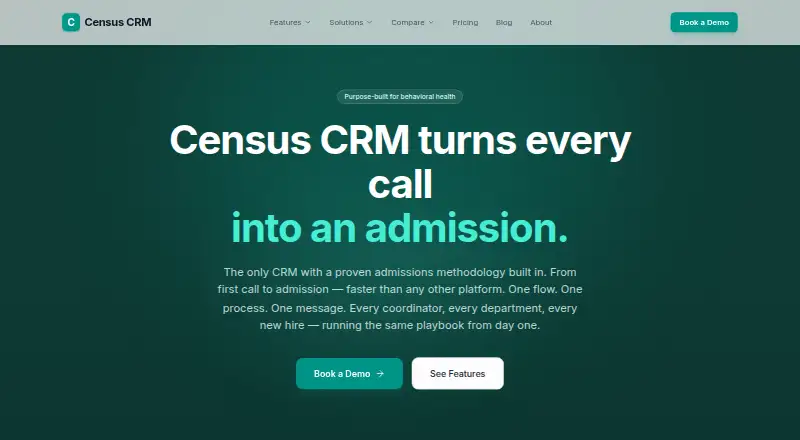
What Census CRM is
Census CRM is a web-based CRM for addiction treatment and behavioral health admissions teams. Its workflow moves prospects through Qualification, Approval, and Commitment stages. A 14-step guided qualification flow uses dynamic branching and includes substance, mental-health, and safety screening. The platform verifies insurance benefits in real time and assigns HIGH, MEDIUM, or LOW risk classifications. Facility matching considers level of care, bed availability, insurance acceptance, exclusions, and specialty programs.
Listed integrations include CallRail, CTM, Twilio, Google Ads, Meta Ads, website platforms, Kipu, and Sunwave. Census CRM hands admission records to EMR systems such as Kipu and Sunwave; it does not perform clinical charting. Security measures include encryption at rest and in transit, audit logging, session timeout, reauthentication, and five role-based access levels. The company states that the service is HIPAA compliant and meets 42 CFR Part 2 requirements, and makes a Business Associate Agreement available. Its SOC 2 Type II audit is in progress, and the report is not complete. Pricing is scoped per seat on request; onboarding fees cover implementation, data migration, and team training.
Good
- Guided 14-step qualification flow includes safety screening
- Real-time benefits checks include risk classification
- Facility matching considers care level and bed availability
- Onboarding includes training and ongoing support
Watch out
- Does not perform clinical charting
- SOC 2 Type II report is not yet complete
- Pricing and onboarding fee are scoped to the operation
Who it suits
Census CRM is designed for behavioral-health admissions, marketing, business-development, owner-operator, and alumni teams. It may suit organizations that need admissions workflows and facility placement support.
Verdict
Census CRM focuses on admissions coordination, insurance verification, and facility placement rather than clinical charting. Teams should account for quote-based pricing and the unfinished SOC 2 Type II audit.
Plans and prices
From Census CRM's own pricing page, checked 30 Sep 2001.
| Plan | Price | What it gives you |
|---|---|---|
| Business Development License | Priced on request | referral partner accounts · 90-day attribution window · channel ROI · HLOC relationships · per-seat quote scoped on demo |
| Coordinator License | Priced on request | 3-stage pipeline · guided talk track · HIPAA-protected texts and emails · insurance verification · scheduling · per-seat quote scoped on demo |
| Alumni License | Priced on request | email and SMS campaigns · Google reviews and surveys · alumni events · sobriety milestones · quarterly reports · per-seat quote scoped on demo |
The facts
Each one read from Census CRM's own pages, with the date it was checked.
What it does
- Audience
- The product is designed for behavioral-health admissions teams, marketing and business-development staff, owners and operators, and alumni teams.checked 30 Sep 2001
- Compliance
- Census CRM states that it is HIPAA compliant, meets 42 CFR Part 2 requirements, and makes a Business Associate Agreement available.checked 30 Sep 2001
- EMR handoff
- Census CRM hands admission records to EMR systems such as Kipu and Sunwave and does not perform clinical charting itself.checked 30 Sep 2001
- Facility placement
- Facility matching considers level of care, bed availability, insurance acceptance, exclusions, and specialty programs.checked 30 Sep 2001
- Insurance verification
- The platform provides real-time verification of benefits with automatic HIGH, MEDIUM, and LOW risk classification.checked 30 Sep 2001
- Integrations
- Officially listed integrations include CallRail, CTM, Twilio, Google Ads, Meta Ads, WordPress, Wix, Squarespace, Webflow, Kipu, and Sunwave.checked 30 Sep 2001
- Onboarding fee
- A one-time onboarding fee covers implementation, data migration, and team training, with the amount scoped to the operation.checked 30 Sep 2001
- Pipeline
- The admissions workflow uses three stages: Qualification, Approval, and Commitment.checked 30 Sep 2001
- Purpose
- Census CRM is a CRM built for addiction treatment and behavioral health admissions teams.checked 30 Sep 2001
- Security
- Data is encrypted at rest and in transit, with audit logging, session timeout, reauthentication, and five role-based access levels.checked 30 Sep 2001
- SOC 2
- The SOC 2 Type II audit is in progress and the report is not yet complete.checked 30 Sep 2001
- Support
- Onboarding includes team training, documentation, video walkthroughs, and ongoing support.checked 30 Sep 2001
- Talk track
- The guided qualification flow has 14 steps with dynamic branching and substance, mental-health, and safety screening.checked 30 Sep 2001
The company
- Headquarters
- East Hampton, New York, United Stateschecked 23 Sep 2001
The full review of Census CRM
Census CRM is an admissions-focused CRM for addiction treatment and behavioral health organizations, built to coordinate leads, verification, and placement. It is best suited to teams whose work spans referral development and admissions, with clinical records managed in a separate EMR. Its specialized workflows are a clear advantage, but per-seat custom pricing and an unfinished SOC 2 Type II audit merit attention.
Overview
The product organizes admissions around Qualification, Approval, and Commitment. That structure gives teams a shared path from initial inquiry to commitment rather than a general-purpose sales pipeline. Census CRM also connects business-development activity, insurance checks, and facility matching, making it relevant to organizations managing relationships with both prospective patients and providers.
It is not a clinical record system. Census CRM passes admission records to EMRs such as Kipu and Sunwave, while clinical charting remains in those systems. That division can suit organizations already using an EMR, but teams seeking one application for admissions and clinical documentation should look elsewhere.
Key features
Guided qualification and verification
The 14-step talk track branches dynamically and covers substance use, mental health, and safety screening. This gives coordinators a consistent intake flow while allowing questions to change with the conversation. Real-time benefits verification adds automatic HIGH, MEDIUM, or LOW risk classification, helping teams distinguish insurance risk during admissions rather than treating every inquiry alike.
Placement and relationship management
Facility matching weighs level of care, available beds, insurance acceptance, exclusions, and specialty programs. Those criteria make the matching workflow relevant to teams coordinating placement across facilities, though they do not make Census CRM a substitute for clinical judgment. Referral, patient, and provider relationships are supported, alongside workflow automation.
Integrations and safeguards
Official integrations include CallRail, CTM, Twilio, Google Ads, Meta Ads, WordPress, Wix, Squarespace, Webflow, Kipu, and Sunwave. The mix links marketing and communications tools with EMR handoff, which can help organizations connect lead generation to admissions operations.
Security measures include encryption at rest and in transit, audit logging, session timeouts, reauthentication, and five role-based access levels. Census CRM states that it is HIPAA compliant, meets 42 CFR Part 2 requirements, and offers a Business Associate Agreement. Its SOC 2 Type II audit is in progress, and the report is not complete; organizations that require a completed audit should weigh that gap before choosing it.
Pricing
Census CRM is paid, with custom pricing scoped per seat on a demo. A one-time onboarding fee covers implementation, data migration, and team training; the fee is scoped to the operation. There is no published flat rate to compare with a team budget, so buyers should request a quote that accounts for the seats and onboarding required.
- Business Development License: Custom pricing per seat. It includes referral partner accounts, a 90-day attribution window, channel ROI, and HLOC relationships. It fits marketing and business-development teams tracking referral channels, but does not provide the coordinator workflow described in the separate license.
- Coordinator License: Custom pricing per seat. It includes the three-stage pipeline, guided talk track, HIPAA-protected texts and emails, insurance verification, and scheduling. This is the most directly admissions-oriented option; teams focused on referral attribution or alumni outreach may need the corresponding license instead.
- Alumni License: Custom pricing per seat. It includes email and SMS campaigns, Google reviews and surveys, alumni events, sobriety milestones, and quarterly reports. It suits alumni teams, rather than serving as a replacement for the coordinator intake and verification tools.
Onboarding includes team training, documentation, video walkthroughs, and ongoing support. The onboarding fee is additional to the per-seat quote, and its amount depends on the operation.
Platforms
Census CRM runs on the web. It hands records to EMRs including Kipu and Sunwave but does not provide clinical charting itself.
Who it's for
Behavioral-health admissions coordinators are the clearest fit, particularly at organizations that need structured intake, insurance risk classification, and facility matching in one admissions workflow. Marketing and business-development staff can use the referral and channel tools, while owners and operators can use the system across admissions and relationship functions. Alumni teams have a dedicated license for outreach and milestones.
It is a weaker fit for teams that need a general CRM without a behavioral-health admissions focus, a clinical charting system, or a published per-seat price. Organizations should also consider whether an audit in progress meets their security requirements.
Pros and cons
- Pros: A branching 14-step qualification flow and real-time insurance risk classification address concrete admissions tasks, rather than relying on a generic lead pipeline.
- Pros: Placement criteria span care level, bed availability, insurance, exclusions, and specialties, supporting decisions that involve more than lead status.
- Pros: Separate Business Development, Coordinator, and Alumni licenses align capabilities with distinct team roles.
- Cons: Per-seat custom pricing and a scoped onboarding fee make costs harder to budget before a demo and operational assessment.
- Cons: Clinical charting must remain in an EMR, so teams wanting an all-in-one clinical and admissions system will need another approach.
- Cons: The SOC 2 Type II report is not complete, which may matter to organizations that require a completed audit.
Alternatives
Healthcare CRM Software is the broader category to explore when comparing products beyond Census CRM.
- eCareCRM is worth considering for small practices or pilot deployments that want a published Starter price of $499 a month, billed monthly, with unlimited users, core features, email support, and standard integrations.
- Salesforce Health Cloud may suit buyers seeking its clinical and insurance data models and willing to pay $350 a month per user, billed annually.
- Zoho CRM is a lower-commitment option for teams that can start with its free plan for up to three users; its Standard plan is $23 a month, billed annually.
- ZynReach Healthcare CRM is an alternative for buyers seeking a Starter plan at $29 per user per month, with up to three marketing automation workflows, one custom pipeline stage, and community support.
- BizzField Healthcare CRM offers custom quotes based on team size and enabled features.
- Cured Provider Relationship Management is another paid provider-relationship option.
- Salesforce Life Sciences Cloud may fit buyers who need life-sciences data models and Revenue Cloud Advanced; its Core plan is $350 a month per user, billed annually.
- Exeevo Omnipresence CRM is an alternative with all-in-one licensing and no data metering or fees to access new features.
Verdict
Census CRM is a strong match for behavioral-health organizations that need a purpose-built admissions process spanning qualification, insurance checks, placement, and EMR handoff. Its main reason to choose it is the fit between those workflows and admissions teams; its main reasons to look elsewhere are custom per-seat costs, the need for a separate clinical charting system, and the incomplete SOC 2 Type II audit.
Alternatives to Census CRM
- 1

Zoho CRM
Free planAndroidiOSWebAPI8.2From $14 a month - 2
LeadSquared
AndroidiOSWebAPI7.5 - 3
Oracle Siebel CRM
AndroidiOSWebAPI7.5From $68.75 a month - 4

FrontDesk
Free planWebAPI7.4From $299 a month - 5
Salesforce Health Cloud
AndroidiOSWebAPI6.9From $350 a month - 6

eCareCRM
AndroidiOSWebAPI6.8From $499 a month