
BizzField Healthcare CRM
BizzField Healthcare CRM helps hospitals and clinics organize referral doctors, partners, and institutional buyers as accounts, then follow inquiry-to-treatm…
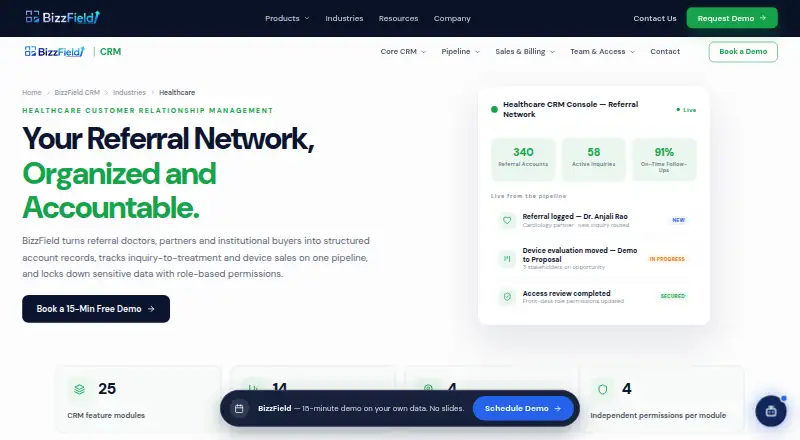
What BizzField Healthcare CRM is
BizzField Healthcare CRM helps hospitals and clinics organize referral doctors, partners, and institutional buyers as accounts, then follow inquiry-to-treatment or device-sales opportunities. Account profiles show activity timelines, and referral sources can be tagged by region, state, city, and area. Existing referral-doctor lists can be imported from Excel. A Kanban board tracks pipeline stages, opportunity types, priorities, and loss reasons, while one opportunity can include several contacts and line-item products. Permissions can separately control reading, creating, updating, and deleting records, with role templates and hierarchy-aware visibility. Reporting covers account health, sales representative and department performance, revenue forecasts, and dashboard KPIs. The healthcare page lists 25 CRM feature modules, 14 built-in reports, four location hierarchy levels, and four independent permissions per module. The CRM is available on Android, iOS, and the web; its responsive web app works in mobile and tablet browsers without installing an app. Integrations include Gmail, Outlook, Google Calendar, WhatsApp, Slack, Tally, SAP, Excel, Power BI, Mailchimp, and Zapier. Pricing depends on team size and enabled features and is provided after a demo.
Good
- Imports referral lists from Excel
- Tracks sales opportunities with a Kanban board
- Allows independent permissions for each module
- Responsive web access works in mobile browsers
Watch out
- Pricing requires a demo and custom quote
- Pricing depends on team size and enabled features
- No mobile app installation is needed, but browser access is required
Who it suits
BizzField Healthcare CRM suits hospitals and clinics managing referral networks, institutional buyers, or device and service sales pipelines. Its role-based permissions and reporting may also suit teams that need to organize access and review performance.
Verdict
BizzField Healthcare CRM focuses on healthcare referral networks and sales pipelines, with account, opportunity, and permission controls. Teams should request a demo for pricing and implementation details.
Plans and prices
From BizzField Healthcare CRM's own pricing page, checked 4 Oct 2001.
| Plan | Price | What it gives you |
|---|---|---|
| Custom quote | Priced on request | Price depends on team size and enabled features; request a quote through a demo |
The facts
Each one read from BizzField Healthcare CRM's own pages, with the date it was checked.
What it does
- Access controls
- Permissions can independently control Read, Create, Update, and Delete by module, with role templates and hierarchy-aware visibility.checked 4 Oct 2001
- Bulk import
- The healthcare page says Excel bulk import can bring in existing referral doctor lists.checked 4 Oct 2001
- Healthcare focus
- The healthcare page describes use by hospitals and clinics to manage referral networks, device or service sales pipelines, and role-based data access.checked 4 Oct 2001
- Integrations
- The CRM integrations page lists Gmail, Outlook, Google Calendar, WhatsApp, Slack, Tally, SAP, Excel, Power BI, Mailchimp, and Zapier.checked 4 Oct 2001
- Mobile access
- The healthcare CRM is described as a responsive web app usable in mobile and tablet browsers without installing an app.checked 4 Oct 2001
- Multi-stakeholder deals
- A single opportunity can include multiple contacts and line-item products for device or equipment deals.checked 4 Oct 2001
- Pipeline
- A Kanban board tracks inquiry-to-treatment or device sales cycles, with opportunity type, priority levels, and loss reasons.checked 4 Oct 2001
- Pricing
- The maker says CRM pricing depends on team size and enabled features and is provided after a demo.checked 4 Oct 2001
- Purpose
- BizzField Healthcare CRM organizes referral doctors, partners, and institutional buyers as accounts and tracks inquiry-to-treatment and device sales pipelines.checked 4 Oct 2001
- Referral records
- Account profiles include activity timelines, and referral sources can be tagged by Region, State, City, and Area.checked 4 Oct 2001
- Reporting
- The page lists Account Health, Sales Rep Performance, Department Performance, Revenue Forecast, and dashboard KPI reporting.checked 4 Oct 2001
- Scale
- The healthcare page lists 25 CRM feature modules, 14 built-in reports, four location hierarchy levels, and four independent permissions per module.checked 4 Oct 2001
- Security
- The CRM page states that customer data is encrypted in transit and at rest, access is role-scoped, and customer accounts are logically isolated.checked 4 Oct 2001
- Support and implementation
- BizzField says most CRM teams are live within 1–2 weeks with migration, pipeline and role setup, and team training; larger rollouts are scoped individually.checked 4 Oct 2001
The company
- Headquarters
- BizzField says it is based in Kanpur, Uttar Pradesh, India.checked 4 Oct 2001
The full review of BizzField Healthcare CRM
BizzField Healthcare CRM is a healthcare-focused relationship and sales pipeline system for hospitals, clinics, and commercial teams handling referrals, institutional buyers, and equipment opportunities. It is strongest when several roles need the same account and opportunity record with tightly scoped access. The trade-off is a demo-led purchase with custom pricing, so organizations must establish cost and implementation scope before committing.
Overview
The CRM turns referral doctors, partners, and institutional buyers into managed accounts rather than loose contact lists. Profiles include activity timelines, while referral sources can be classified by region, state, city, and area. Excel bulk import provides a practical way to bring an existing referral-doctor list into the system, reducing the work of recreating records.
Its healthcare orientation covers referral management, patient relationships, and provider relationships, but the described workflow is commercial and operational rather than clinical care documentation. Hospitals and clinics can follow inquiries toward treatment, while device and service teams can manage sales opportunities in the same environment.
Key features
Referral and pipeline control
A Kanban board follows inquiry-to-treatment and device-sales cycles. Opportunity type, priority, and loss reasons add useful structure: managers can separate kinds of work, focus attention on urgent cases, and review why opportunities were lost instead of recording only a final status. Workflow automation is supported, which suits teams that want repeatable movement through their process rather than purely manual updates.
One opportunity can contain multiple contacts and line-item products. That is particularly relevant to equipment or institutional deals involving several decision-makers and more than one item; a simple single-contact lead tracker would be less suitable for that pattern.
Permissions, reporting, and scale
Read, Create, Update, and Delete permissions can be set independently for each module. Role templates, hierarchy-aware visibility, and role-scoped access give administrators more control than a single team-wide permission switch, especially where departments should not see every account or action.
Reporting includes Account Health, Sales Rep Performance, Department Performance, Revenue Forecast, and dashboard KPI views. The healthcare page describes 25 CRM feature modules, 14 built-in reports, four location hierarchy levels, and four independent permissions per module. That breadth can support a multi-department rollout, although it also makes initial configuration more consequential.
Security, integrations, and implementation
Customer data is encrypted in transit and at rest, customer accounts are logically isolated, and access is role-scoped. Listed integrations include Gmail, Outlook, Google Calendar, WhatsApp, Slack, Tally, SAP, Excel, Power BI, Mailchimp, and Zapier, giving teams options for connecting communication, finance, analytics, and automation tools.
BizzField says most CRM teams are live within one to two weeks when migration, pipeline and role setup, and team training are included. Larger rollouts are scoped individually. Mobile use is through a responsive web app in phone and tablet browsers; the product is also offered on Android, iOS, and the web.
Pricing
Custom quote
Pricing is on request and depends on team size and enabled features. A demo is required to request a quote, and the offer includes a 7-day trial. This model can fit organizations that need a tailored module and permission mix, but it provides no published benchmark for budgeting and makes the trial period important for validating migration, workflows, and reporting.
There are no stated per-seat caps, renewal terms, or free-plan allowance. Teams should therefore settle those commercial terms, along with implementation scope, before selecting the CRM. The 7-day trial is short for a complex, multi-role deployment, so a prepared sample referral list and defined pipeline should be ready at the start.
Platforms
BizzField Healthcare CRM is available on Android, iOS, and the web. Its responsive web application also works in mobile and tablet browsers without an installation, which is useful for field staff or referral teams switching between devices. The browser-based mobile experience may be preferable where an organization wants one interface rather than separate installed applications.
Who it's for
This is a good fit for hospitals, clinics, and healthcare sales organizations coordinating referral doctors, partners, institutional buyers, and device or service opportunities. It is especially appropriate when several departments need hierarchy-aware visibility, detailed module permissions, structured loss reasons, and reporting across accounts and sales representatives.
It is less compelling for a small practice seeking a simple contact book, a transparent self-serve price, or a primarily clinical patient-record system. Those teams may find the custom quote and configuration-led rollout heavier than their requirements.
Pros and cons
Pros
- Healthcare-specific relationship structure: referral sources, patient and provider relationships, and inquiry-to-treatment pipelines match the work of hospitals and clinics.
- Strong access granularity: independent Read, Create, Update, and Delete controls by module support departmental separation and hierarchy-based visibility.
- Useful for complex deals: multiple contacts and line-item products keep equipment opportunities together.
- Broad operational coverage: 25 modules, 14 reports, automation, and integrations spanning email, messaging, finance, analytics, and productivity tools.
- Migration and onboarding support: Excel import plus stated migration, setup, and training assistance can shorten deployment.
Cons
- Budget uncertainty: team size and enabled features determine a custom quote, with no published plan price.
- Short evaluation window: the 7-day trial leaves limited time to test a multi-role implementation.
- Browser-based mobile use: mobile access is described as a responsive web app, not a separate installed healthcare mobile workflow.
- Potential configuration overhead: the breadth of modules, reports, and permission settings may be more than a small clinic needs.
Alternatives
Choose Zoho CRM instead if a freemium route and published entry plans matter; its free tier supports three users, with Android, iOS, web, and API access.
FrontDesk is the better alternative for a web-based practice focused on calling, texting, booking, and a basic dashboard, including a free tier with usage caps.
Pick Exeevo Omnipresence CRM when all-in-one licensing and selectable apps across Android, iOS, web, and Windows are more important than BizzField's healthcare referral structure.
TikaMobile CRM is another paid CRM option across Android, iOS, and the web.
Consider IQVIA SmartSolve Complaint Management when complaint-management is the priority; pricing is handled through sales.
LeadSquared suits teams wanting a paid sales CRM with unlimited contacts, email inclusions, permission templates, and reporting provisions.
Trail CRM is an alternative for sales organizations needing tour plans, master data, deduplication, segmentation, and campaign tools.
Choose Oracle Siebel CRM when an enterprise, self-hosted-capable platform and industry options justify its published per-user license.
For a wider comparison, browse Healthcare CRM Software.
Verdict
BizzField Healthcare CRM is a strong choice for hospitals, clinics, and healthcare commercial teams that need referral networks, complex opportunities, and finely divided access controls in one system. Its main reason to choose it is the combination of healthcare-oriented pipelines, multi-stakeholder deals, reporting, and implementation support. Look elsewhere if transparent pricing, a longer trial, or a simpler clinical or practice workflow matters more than configurable referral and sales management.
Alternatives to BizzField Healthcare CRM
- 1

Zoho CRM
Free planAndroidiOSWebAPI8.2From $14 a month - 2
LeadSquared
AndroidiOSWebAPI7.5 - 3
Oracle Siebel CRM
AndroidiOSWebAPI7.5From $68.75 a month - 4

FrontDesk
Free planWebAPI7.4From $299 a month - 5
Salesforce Health Cloud
AndroidiOSWebAPI6.9From $350 a month - 6

eCareCRM
AndroidiOSWebAPI6.8From $499 a month