Cartwheel
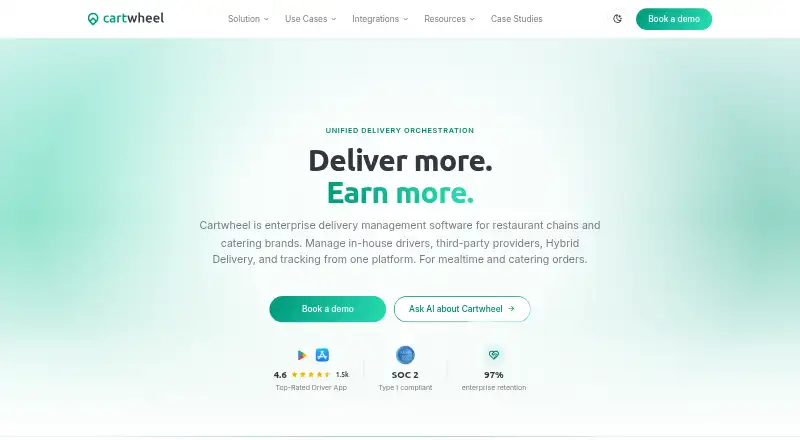
Cartwheel is enterprise delivery management software for restaurant chains and catering brands.
What Cartwheel is
Cartwheel is enterprise delivery management software for restaurant chains and catering brands. It coordinates in-house drivers and third-party providers with dispatch tools and live delivery tracking. Its rules-based Hybrid Delivery system routes orders between those driver types in less than one second. Operators can set rules around time of day, order size, driver availability, per-driver order limits, and delivery areas. Catering features include scheduled dispatch, pre-delivery checklists, photo and signature proof, branded tracking, and vehicle-type routing. Cartwheel says one integration connects to Uber Direct, DoorDash Drive, Grubhub, Skipcart, and more than 50 local fleets. Named integrations also include Toast, PAR, Olo, Qu, ChowNow, and ezCater. Store and Dispatch mobile tools are described for phones and tablets, and the platform is available on iOS and Android. Driver tools include route planning, checklists, ID verification, and proof of delivery. The listed Cartwheel plan costs $99 per month and includes 400 deliveries, then charges $0.25 per order. Cartwheel says it operates in the United States, Puerto Rico, Canada, the United Kingdom, Ireland, and Australia.
Good
- Automatically routes between in-house and third-party drivers.
- Routing rules cover time, order size, and availability.
- Catering tools include photo and signature proof.
- Connects to named delivery providers and local fleets.
- Driver app supports route planning and proof of delivery.
Watch out
- Listed plan includes 400 deliveries per month.
- Additional orders cost $0.25 each.
- Listed plan costs $99 per month.
Who it suits
Cartwheel is for restaurant chains and catering brands managing their own drivers alongside third-party delivery providers. It may fit operators who need rule-based dispatch, catering workflows, and live customer tracking.
Verdict
Cartwheel combines dispatch for multiple driver types with catering-specific tools and customer tracking. The listed plan has a delivery allowance and per-order charge beyond it.
Plans and prices
From Cartwheel's own pricing page, checked 28 Sep 2026.
| Plan | Price | What it gives you |
|---|---|---|
| Cartwheel | $65 a month | volume-based and enterprise pricing available · per location per month in the US |
| Cartwheel Demo page plan | $99 a month | Includes 400 deliveries · $0.25/order after expiry · full access to all features · self-onboarding with a setup guide · email support in under 24 hours · per location |
The facts
Each one read from Cartwheel's own pages, with the date it was checked.
What it does
- Availability
- Cartwheel says it operates in the United States, Puerto Rico, Canada, the United Kingdom, Ireland, and Australia.checked 28 Sep 2026
- Catering
- Catering tools include scheduled dispatch, pre-delivery checklists, photo and signature proof, branded live tracking, and vehicle type routing.checked 28 Sep 2026
- Customer tools
- Customer-facing features include branded tracking pages, promotional banners, and Google Reviews integration.checked 28 Sep 2026
- Delivery network
- Cartwheel says one integration connects to Uber Direct, DoorDash Drive, Grubhub, Skipcart, and more than 50 local fleets.checked 28 Sep 2026
- Dispatch rules
- Operators can configure routing by time of day, order size, driver availability, per-driver order limits, and delivery polygons or radius.checked 28 Sep 2026
- Driver tools
- Driver app features include route planning, order checklists, proof of delivery, ID verification, and photo and signature capture.checked 28 Sep 2026
- Enterprise service
- The site advertises white-glove rollout support, dedicated enterprise account management, and 24/7 live support.checked 28 Sep 2026
- Hybrid dispatch
- Its rules-based Hybrid Delivery system routes orders between in-house and third-party drivers automatically in less than one second.checked 28 Sep 2026
- Integrations
- Named integrations include Toast, PAR, Olo, Qu, ChowNow, ezCater, Uber Direct, and several other ordering, marketplace, and delivery services.checked 28 Sep 2026
- Live delivery tracking
- Yeschecked 20 Sep 2026
- Pricing economics
- The site says its pre-negotiated third-party rates can be up to 27% below direct rates and that late or cancelled delivery refund claims can be filed automatically.checked 28 Sep 2026
- Product
- Cartwheel is enterprise delivery management software for restaurant chains and catering brands, managing in-house drivers, third-party providers, dispatch, and tracking.checked 28 Sep 2026
- Security
- Cartwheel says it completed a SOC 2 audit covering controls for security and reliability.checked 28 Sep 2026
The company
- Company background
- Cartwheel says it began as a delivery restaurant in Los Angeles and then built a delivery operation serving hundreds of restaurants.checked 28 Sep 2026
- Founded
- 2012checked 23 Sep 2026
Where it runs
- Mobile apps
- Cartwheel describes Store and Dispatch mobile tools for phones and tablets and says the platform is available on iOS and Android.checked 28 Sep 2026
The full review of Cartwheel
Overview
Cartwheel is delivery management software for restaurant chains and catering businesses coordinating their own drivers with outside delivery fleets. It is best suited to operators who need rules-based dispatch and catering workflows; its fit is less clear for a small operation seeking a no-cost starting point.
Cartwheel grew out of a Los Angeles delivery restaurant and delivery operation serving hundreds of restaurants. Founded in 2012 and headquartered in Los Angeles, it operates in the United States, Puerto Rico, Canada, the United Kingdom, Ireland and Australia. For a broader category comparison, see Restaurant Delivery Management Software.
Key features
Hybrid Delivery automatically routes orders between in-house drivers and third-party providers in under a second. Operators can shape that routing around time of day, order size, driver availability, per-driver order limits and delivery zones defined by polygon or radius. That flexibility is useful for chains balancing their own fleet against outsourced capacity, though it is more capability than a single-fleet operation may need.
Catering workflows cover scheduled dispatch, pre-delivery checklists, vehicle-type routing, and photo and signature proof. Drivers get route planning, order checklists, proof of delivery and ID verification, with photo and signature capture. Together, these tools address the extra coordination and handoff evidence catering orders require.
Customer-facing tools include branded live tracking pages, promotional banners and Google Reviews integration. Cartwheel connects with ordering and delivery services including Toast, PAR, Olo, Qu, ChowNow, ezCater and Uber Direct. Its delivery network also reaches DoorDash Drive, Grubhub, Skipcart and more than 50 local fleets through one integration. The breadth can simplify provider coordination, while the value of that reach depends on which services an operator uses.
Cartwheel says its pre-negotiated third-party rates can be up to 27% below direct rates, and it can file late or cancelled delivery refund claims automatically. Those economics may offset some delivery costs, but the stated savings are a ceiling, not a guaranteed discount. Cartwheel reports completing a SOC 2 audit covering security and reliability controls. It also offers white-glove rollout support, dedicated enterprise account management and 24/7 live support.
Pricing
Cartwheel is paid software, with pricing from $65/mo. The named Cartwheel plan costs $99 a month, billed monthly, and includes 400 deliveries; each delivery beyond that costs $0.25. That allowance gives a restaurant a defined volume to budget against, but high-volume locations need to account for the per-order overage.
A second Cartwheel plan is $99 a month, billed per location. It includes 400 deliveries, full feature access, self-onboarding with a setup guide, and email support in under 24 hours; after expiry, orders cost $0.25 each. This is a clearer fit for a location seeking self-guided setup, while the monthly-billed plan states the same allowance with overage pricing but does not specify those onboarding and support terms. The two plan prices and billing terms should be compared against the number of locations and expected delivery volume.
There is no free plan among these offers. Cartwheel suits businesses prepared to pay a monthly fee and monitor delivery volume; operators with lower or uncertain demand may prefer to start with a free alternative.
Platforms
Cartwheel supports Android, iOS and web. Store and Dispatch mobile tools are described for phones and tablets, alongside a driver app with route planning and delivery documentation. That mix supports both in-store and on-the-road work across mobile devices and browsers.
Who it's for
Cartwheel is a strong match for restaurant chains and catering brands managing multiple driver types, scheduled catering dispatch and customer tracking. Its routing rules and network connections matter most when operations need to shift orders between an in-house fleet and third-party capacity. A small restaurant with straightforward dispatch needs may find the paid, delivery-count-based plans harder to justify.
Pros and cons
- Flexible hybrid dispatch: Operators can automate assignments using time, order, driver and delivery-zone rules rather than relying on a single routing approach.
- Catering-specific evidence: Checklists, vehicle routing and photo and signature proof support more involved deliveries.
- Broad delivery connections: One integration reaches named national providers and more than 50 local fleets, potentially reducing the burden of coordinating providers.
- Monthly cost plus overages: The plan allowance is 400 deliveries, after which each delivery costs $0.25; the no-free-plan model is a drawback for businesses testing demand.
Alternatives
Choose Shipday if a free entry point or a trial matters more than Cartwheel’s catering and hybrid-dispatch focus: Shipday has a free plan capped at 300 orders per month and offers a 14-day full-platform trial without a credit card. Its listed platforms are API and web.
APPY Delivery is worth considering for a free digital QR menu: its AppyQR Free plan includes up to 50 products, one active location and email support. MyOrderBox may suit a business prioritizing its own website orders, with a free Starter plan offering unlimited such orders and POS software for one terminal.
For other paid delivery-management options, consider Andromeda Delivery, BiteBerry DMS, Captain or PIE by First Delivery; their listed platforms include web and mobile. WISDOM is a paid alternative at $99 a month, with a $250 one-time setup fee and 25¢ per order; it describes fleet sizes from 3 to 300.
Verdict
Cartwheel is the better fit for restaurant chains and catering operators that need rapid dispatch across in-house and third-party drivers, with catering workflows and customer tracking in the same system. Its dispatch flexibility, broad delivery network and operational support are persuasive for complex delivery programs. Look elsewhere if you need a free plan or cannot predict whether 400 deliveries will cover your monthly volume.
Alternatives to Cartwheel
- 1

Fleetbase
Free planOpen sourceAndroidiOSWebAPI9.1From $29 a month - 2

Route4Me
Free planAndroidiOSWebAPI9.0From $79.99 a year - 3

WooCommerce
Free planOpen sourceAndroidiOSWebAPI8.8From $29 a year - 4

Routific
Free planAndroidiOSWebAPI8.7From $150 a month - 5
Onro
Free planAndroidiOSWebAPI8.6From $239 a month - 6
InstaDispatch
Free planAndroidiOSWebAPI8.5From $200 a month