
Cargo
Cargo is go-to-market infrastructure for coding agents: teams define workflows in a Git repository, and Cargo runs those workflows.
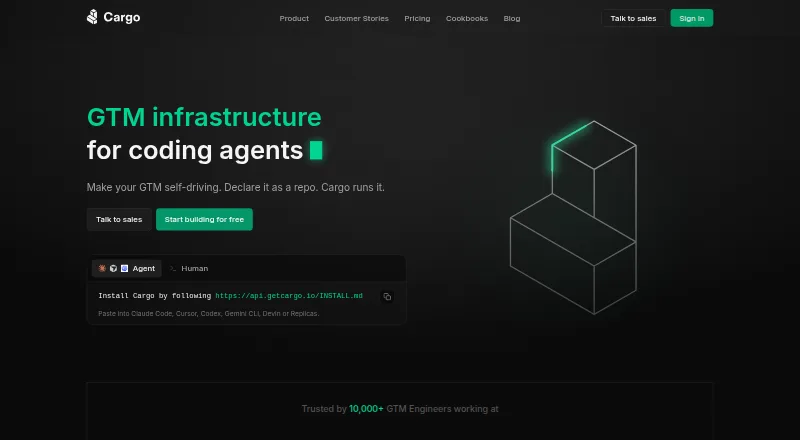
What Cargo is
Cargo is go-to-market infrastructure for coding agents: teams define workflows in a Git repository, and Cargo runs those workflows. Its listed building blocks include agents, context, tools, data models, plays, territories, and apps. Workflows can start from triggers or schedules, retry failed steps, and provide a trace of each run. The TypeScript Cargo CDK supports previewing changes, declarative deployment, and rolling back workspace resources. Cargo lists compatibility with Claude Code, Cursor, Codex, Gemini CLI, Devin, and Replicas, alongside more than 100 integrations including HubSpot, Salesforce, Slack, Apollo.io, OpenAI, and Anthropic. Credits cover enrichment actions, orchestration steps, and storage inserts; 100 orchestration steps or 1,000 storage inserts use one credit. If credits run out, existing workflows pause until more are added, and the pricing FAQ says data is not lost. Cargo says it maintains a SOC 2 Type II report and does not use Slack data or Customer Content to train foundation models.
Good
- Free plan includes 100 credits per month.
- Workflows can run on triggers or schedules.
- Failed workflow steps can be retried.
- Lists more than 100 integrations.
- TypeScript CDK supports preview, deployment, and rollback.
Watch out
- Workflows pause when credits run out.
- Credit use includes enrichment, orchestration, and storage.
Who it suits
Cargo suits teams that want to define go-to-market workflows in Git and run them with coding-agent compatibility and business-system integrations. Teams should account for credit usage because existing workflows pause when credits run out.
Verdict
Cargo combines repository-defined workflow setup with execution, traces, retries, and a broad listed integration set. Review credit consumption and plan support levels before choosing a tier.
Plans and prices
From Cargo's own pricing page, checked 28 Sep 2026.
| Plan | Price | What it gives you |
|---|---|---|
| 100 credits | Free | 100 credits · up to 100 enrichment credits · up to 10K orchestration steps · up to 100K storage inserts · community support · From $0/mo |
| Free | Free | 100 credits · up to 100 enrichment credits · up to 10K orchestration steps · up to 100K storage inserts · community support |
| Standard | $165 a month | 1.5K credits · all 100+ integrations · email support · From $165/mo |
| 1.5K credits | $165 a month | 1.5K credits · all 100+ integrations · email support · From $165/mo |
| 2.5K credits | $250 a month | 2.5K credits · all 100+ integrations · email support · From $250/mo |
| Professional | $250 a month | 2.5K credits · all 100+ integrations · email support · From $250/mo |
| Enterprise | $1,190 a month | 17K credits · all 100+ integrations · priority support · From $1,190/mo |
| 17K credits | $1,190 a month | 17K credits · all 100+ integrations · priority support · From $1,190/mo |
| 50K+ credits | $3,000 a month | 50K+ credits · all 100+ integrations · dedicated support · From $3,000/mo |
| Custom | $3,000 a month | 50K+ credits · all 100+ integrations · dedicated support · From $3,000/mo |
The facts
Each one read from Cargo's own pages, with the date it was checked.
What it does
- AI agents
- Agents can research, qualify and act on GTM signals, with prompts, tools, memory and checks on their own work.checked 15 Oct 2026
- API
- Cargo exposes an authenticated REST API at api.getcargo.io/v1 and publishes an OpenAPI 3.1 specification.checked 15 Oct 2026
- CLI and CDK
- The cargo-ai CLI initializes, plans and deploys projects, while the Cargo CDK provides declarative TypeScript definitions.checked 15 Oct 2026
- Coding-agent compatibility
- Cargo lists Claude Code, Cursor, Codex, Gemini CLI, Devin and Replicas as compatible coding agents.checked 15 Oct 2026
- Coding agents
- Cargo lists compatibility with Claude Code, Cursor, Codex, Gemini CLI, Devin, and Replicas.checked 28 Sep 2026
- Context
- Context stores ICP, persona, objection and other GTM knowledge for teams and agents to reuse.checked 15 Oct 2026
- Credit exhaustion
- When credits run out, existing workflows pause until credits are added, and the pricing FAQ says no data is lost.checked 28 Sep 2026
- Data models
- Data models unify CRM, product and enrichment data as inputs to workflows.checked 15 Oct 2026
- Developer workflow
- The Cargo CDK uses TypeScript definitions to preview changes, deploy declaratively, and roll back workspace resources.checked 28 Sep 2026
- Documentation depth
- Public documentation covers installation, authentication, project layout, connectors, workflows, agents and CLI operations with TypeScript examples.checked 15 Oct 2026
- Execution
- Cargo says workflows can run on triggers or schedules, retry failed steps, and provide a trace of each run.checked 28 Sep 2026
- Features
- Its listed primitives include agents, context, tools, data models, plays, territories, and apps.checked 28 Sep 2026
- Founders
- Y Combinator identifies Aurelien Aubert and Maxence De Villepion as Cargo founders.checked 15 Oct 2026
- Hosted execution
- Cargo runs workflows on triggers or schedules, retries failed steps with backoff and records traces of runs.checked 15 Oct 2026
- Integrations
- Cargo lists more than 100 native integrations, including Salesforce, HubSpot, Slack, LinkedIn, Apollo.io, OpenAI, Anthropic, BigQuery and PostgreSQL.checked 15 Oct 2026
- Limit: credit exhaustion
- Cargo's pricing FAQ says workflows pause when credits run out until the customer upgrades or buys more credits.checked 15 Oct 2026
- Limit: learning curve
- SyncGTM reports that production workflows require technical or GTM-engineering skills and a substantial ramp-up period.checked 15 Oct 2026
- Limit: outreach sequencing
- SyncGTM reports that Cargo lacks a native outreach sequence builder and relies on agents plus external outreach tools.checked 15 Oct 2026
The company
- Company founded
- Y Combinator lists Cargo as founded in 2023 and part of its Summer 2023 batch.checked 15 Oct 2026
- Company headquarters
- Y Combinator lists Cargo's location as San Francisco.checked 15 Oct 2026
- Company legal name
- The terms identify the provider as GetCargo Inc.checked 15 Oct 2026
- Company positioning
- Y Combinator describes Cargo as a headless interface for accessing company data and automating sales operations through segmentation, scoring and lead routing.checked 15 Oct 2026
- Company size
- Y Combinator's company profile lists a team size of five.checked 15 Oct 2026
- Company status
- Y Combinator marks Cargo as active.checked 15 Oct 2026
The full review of Cargo
Cargo is GTM infrastructure for teams that define go-to-market workflows in a Git repository and want coding agents to run them. It suits technical teams building repeatable lead and territory workflows; the credit-based plans make usage and support level central to the choice.
Overview
Cargo brings workflow definitions and execution together: teams declare resources in a repository, then run workflows on triggers or schedules. Its combination of routing capabilities, developer tooling, and a broad integration set is a strong fit for teams that want their GTM operations managed as code. It is less compelling for buyers seeking a simple, fixed-price routing tool, since usage draws from shared credits and workflows pause when those credits run out.
Key features
Cargo’s building blocks include agents, context, tools, data models, plays, territories, and apps. In practice, that gives teams a framework for defining operational workflows rather than only configuring individual routing rules. It supports lead qualification, territory routing, round-robin assignment, workflow automation, and webhooks, making it relevant to teams coordinating lead intake and follow-through.
Workflows can run on triggers or schedules, retry failed steps, and provide a trace of each run. Those capabilities help teams automate recurring work while retaining a record of execution and a way to recover from failed steps.
The Cargo CDK uses TypeScript definitions to preview changes, deploy declaratively, and roll back workspace resources. This developer-oriented workflow can make changes easier to review and reverse, but it is best suited to teams comfortable working with TypeScript and Git-based configuration. Cargo lists compatibility with Claude Code, Cursor, Codex, Gemini CLI, Devin, and Replicas, along with more than 100 integrations including HubSpot, Salesforce, Slack, Apollo.io, OpenAI, and Anthropic.
Security measures include a SOC 2 Type II report, encryption in transit and at rest, access controls, backups, monitoring, and vulnerability management. Cargo says it does not use Slack data or Customer Content to train foundation models.
Pricing
Cargo has a free plan and paid plans billed monthly. The 100 credits plan costs nothing and includes up to 100 enrichment credits, 10K orchestration steps, 100K storage inserts, and community support. It is a useful starting point, but the smaller allowance and community-only support make it a limited fit for business-critical workflows.
The 1.5K credits plan costs $165 a month; the 2.5K credits plan costs $250 a month. Both include all 100+ integrations and email support, making them the entry paid choices for teams that need broader usage and direct support. The 17K credits plan costs $1,190 a month and adds priority support. At 50K+ credits, the plan costs $3,000 a month and includes dedicated support, better suited to teams with substantial workflow volume and a need for a closer support relationship.
Credits cover enrichment actions, orchestration steps, and storage inserts: 100 orchestration steps or 1,000 storage inserts consume one credit. Because multiple kinds of work draw on the same allowance, teams should account for their expected mix of activity. When credits are exhausted, existing workflows pause until credits are added; Cargo says no data is lost. Customers unhappy within the first 14 days can contact the company for a full refund.
Platforms
Cargo is available on web and through an API. That combination suits teams building and operating programmatic workflows, rather than buyers looking only for a standalone mobile app.
Who it's for
Cargo is best for technical go-to-market teams that want repository-defined workflows, integrations with their CRM and other tools, and visibility into execution. Its routing, qualification, and automation features can support lead operations, while the CDK and coding-agent compatibility suit teams already comfortable with developer workflows. Small teams with modest needs can begin on the free tier; teams that cannot tolerate workflow pauses should size their credit allowance carefully.
Pros and cons
- Pros: Repository-defined workflows, TypeScript previews, declarative deployment, and rollback give technical teams a controlled way to manage operational changes.
- Pros: Triggers, schedules, retries, and run traces cover important parts of workflow execution and recovery.
- Pros: More than 100 integrations and compatibility with several coding agents give teams flexibility in connecting tools and workflows.
- Cons: Shared credits cover different kinds of activity, so teams need to monitor usage rather than rely on a single simple workflow quota.
- Cons: Workflows pause when credits run out, which makes choosing an adequate tier important for ongoing operations.
- Cons: The entry free tier offers community support; priority and dedicated support require substantially higher-priced tiers.
Alternatives
For a broader comparison of routing tools, browse Lead Routing Software.
InstaChime is a web-based freemium alternative with a free tier for one workspace, two users, and 50 leads per month, including basic routing, email alerts, and a live lead dashboard. Pick it when that bounded routing setup is a better fit than Cargo’s repository-defined workflow approach.
Gradient Works is another freemium alternative, available through API and web. Choose it if you are comparing another option for lead routing and territory operations.
Lead Dispatcher offers a free web plan for up to five reps, with smart routing rules, Slack dispatch, HubSpot integration, and basic analytics. It is a practical alternative when those specific routing and dispatch needs are enough.
LeadExec is a freemium API and web alternative. Consider it when comparing a lead distribution platform with usage-based lead and ping allowances.
Lead Distro AI is a paid API and web option with a free trial. Its Call Tracking Only plan costs $147 a month for three campaigns, five sources and destinations, and two seats, with call usage billed separately; choose it when call tracking is the priority.
boberdoo is a paid alternative available on Android, iOS, web, and API. 91Leads CRM is another paid option across Android, iOS, web, and API. Distribution Engine is a paid web alternative.
Verdict
Choose Cargo if your team wants to define GTM workflows in a repository and needs integrated execution, traces, retries, and routing capabilities. Its developer tooling and integration breadth are the main reasons to choose it; credit-based usage and pauses on exhaustion are the main reasons to look elsewhere or budget for a larger tier.
Getting started
- Visit https://www.getcargo.ai/.
- Choose the free 100-credit plan or a paid plan starting at $165/mo.
- Use the Git repository workflow model and Cargo CDK to define and deploy workspace resources.
- Connect supported services through Cargo's listed integrations.
- Set workflows to run on triggers or schedules.
Limits worth knowing
The free plan provides 100 credits, up to 100 enrichment credits, up to 10K orchestration steps, and up to 100K storage inserts. One credit covers 100 orchestration steps or 1,000 storage inserts; when credits run out, workflows pause until credits are added.
Questions
Is Cargo free?
Yes. The 100-credit plan costs nothing and includes community support.
How much do paid plans cost?
Listed tiers include 1.5K credits at $165 a month, 2.5K credits at $250 a month, 17K credits at $1,190 a month, and 50K+ credits at $3,000 a month.
What platforms does Cargo support?
Cargo lists API and web platforms.
Which coding agents and integrations are listed?
Compatibility includes Claude Code, Cursor, Codex, Gemini CLI, Devin, and Replicas. Cargo lists more than 100 integrations, including HubSpot, Salesforce, Slack, Apollo.io, OpenAI, and Anthropic.
What happens when credits run out?
Existing workflows pause until credits are added. Cargo's pricing FAQ says no data is lost.
What security and privacy measures does Cargo describe?
Cargo says it maintains a SOC 2 Type II report, encrypts data in transit and at rest, and does not use Slack data or Customer Content to train foundation models.
Alternatives to Cargo
- 1

Mixdesk
Free planAndroidiOSWebAPI8.1From $49 a month - 2

91Leads CRM
Free planAndroidiOSWebAPI7.9From ₹199 a month - 3

Leadspace
Free planWebAPIExtension7.7From $49 a month - 4
Chili Piper
AndroidiOSWebAPI7.6From $12 a month - 5

Gradient Works
Free planWebAPI7.5From $799 a month - 6
Lead Dispatcher
Free planWeb7.2From $199 a month