
Aimeos
Aimeos is an open-source PHP e-commerce framework for Laravel and TYPO3.
What Aimeos is
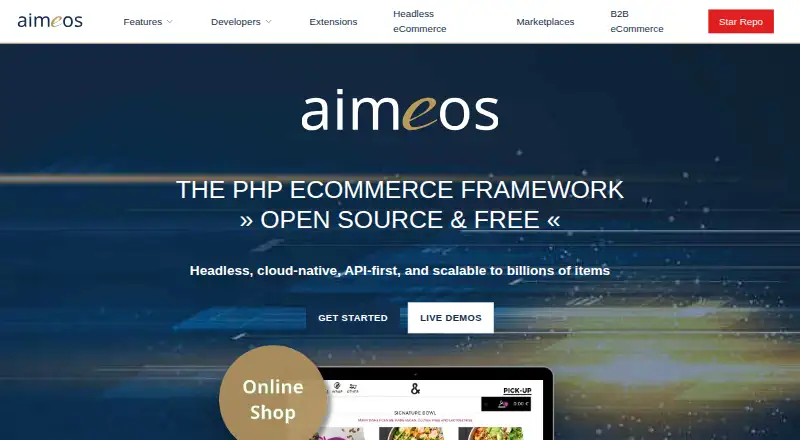
Aimeos is an open-source PHP e-commerce framework for Laravel and TYPO3. Developers can use it to build online shops, headless frontends, marketplaces, and B2B platforms. Its commerce functions include product variants, bundles, vouchers, downloads, events, subscriptions, recurring payments, and configurable goods. The framework supports multi-vendor, multi-channel, and multi-warehouse operations, as well as multiple tenant shops in one installation. Custom storefronts and apps can use its JSON:API REST API and GraphQL admin API. Aimeos lists more than 100 payment providers through Omnipay and database support for MySQL, PostgreSQL, Oracle, Microsoft SQL Server, and DB2. The stated capacity is up to 100,000 products out of the box with standard MySQL, and more than one billion with SOLR or Elasticsearch. Core packages are free for commercial use, with no recurring license fees for self-run stores or client projects. Paid support subscriptions have a 12-month minimum and do not cover implementation or custom development.
Good
- Core packages are free for commercial use
- Supports multi-vendor and multi-tenant commerce
- Offers REST and GraphQL APIs
- Lists more than 100 payment providers
Watch out
- Paid support subscriptions require a 12-month minimum
- Support excludes implementation and custom development
- Standard MySQL capacity is listed up to 100,000 products
Who it suits
Aimeos suits developers, agencies, and enterprises building online stores, marketplaces, or B2B commerce platforms. It is aimed at teams able to work with a PHP framework.
Verdict
Aimeos provides a broad set of commerce building blocks with a free commercial-use core. Teams considering paid support should note its minimum term and service exclusions.
Plans and prices
From Aimeos's own pricing page, checked 22 Sep 2026.
| Plan | Price | What it gives you |
|---|---|---|
| Core framework | — | Open source · Free for commercial use · No license or transaction fees |
| Open-source core | Free | MIT/LGPLv3 · commercial use · no recurring licence fee |
| Aimeos core | Free | Open source (LGPLv3) · free for commercial use |
| Extended long term support | $99 a month | 12 month minimum · bugfixes and security updates for Aimeos LTS versions · Laravel, TYPO3, and Symfony · from 1 $ 99.00 per month + VAT · yearly payments |
| Extended long-term support | $99 a month | LTS bug fixes and security updates · Laravel/TYPO3/Symfony · up to five years · + VAT · yearly · 12-month minimum |
| Basic subscription | $179 a month | Email support · direct developer support · 24-business-hour response · weekdays · + VAT · 12-month minimum |
| Basic support subscription | $179 a month | 12 month minimum · email and direct developer support · 24 business hour response · English and German · from 1 $ 179.00 per month + VAT |
| Professional support package | $259, paid once | Personal email and direct developer support · web or SSH support · 24 business hour response · English and German · from 1 $ 259.00 + VAT · 2 hours |
| Professional support | $259, paid once | 2 hours · email/developer support · remote web/SSH · 24-business-hour response · + VAT |
| Extended subscription | $379 a month | Email support · callback calls · 12-business-hour response · weekdays · + VAT · 12-month minimum |
| Extended support subscription | $379 a month | 12 month minimum · email, direct developer, and telephone/video callback support · 12 business hour response · English and German · from 1 $ 379.00 per month + VAT |
| Premium subscription | $569 a month | Email · callback · web/SSH support · 8-business-hour response · 7 days · + VAT · 12-month minimum |
| Premium support subscription | $569 a month | 12 month minimum · remote web or SSH, callback, email, and direct developer support · 8 business hour response · English and German · from 1 $ 569.00 per month + VAT |
The facts
Each one read from Aimeos's own pages, with the date it was checked.
What it does
- 2026 release news
- The 2026.04 release added Laravel 13 and Symfony 8 support plus GraphQL complexity limits and stronger permission checks.checked 14 Oct 2026
- APIs
- Aimeos offers a JSON:API REST API and a GraphQL admin API for custom frontends, progressive web apps, and mobile apps.checked 29 Sep 2026
- Catalog scale
- The vendor claims support for catalogues exceeding one billion products when Elasticsearch or distributed architectures are used.checked 14 Oct 2026
- Commerce features
- It supports product variants, bundles, vouchers, downloads, events, subscriptions, recurring payments, and configurable goods.checked 29 Sep 2026
- Database support
- Documented databases include MySQL, MariaDB, PostgreSQL, SQL Server, Oracle and DB2.checked 14 Oct 2026
- Documentation depth
- Documentation covers frontend components, checkout, imports, extension creation, APIs, administration and upgrade paths.checked 14 Oct 2026
- Extensibility
- Developers are instructed to create project extensions and override templates instead of modifying core files.checked 14 Oct 2026
- Framework integrations
- Official integrations are provided for Laravel and TYPO3, with packages installable through Composer.checked 14 Oct 2026
- G2 availability
- G2 lists Aimeos with zero reviews and says there is insufficient review data for buying insight.checked 14 Oct 2026
- GraphQL administration
- The admin GraphQL API has existed since version 2022.10 and can access shop data subject to administrator permissions.checked 14 Oct 2026
- Headless APIs
- The platform exposes JSON:API REST endpoints and a GraphQL administration API for headless storefronts and apps.checked 14 Oct 2026
- Installation
- A standalone shop can be created with Composer using the aimeos/aimeos project command, while existing Laravel apps use aimeos/aimeos-laravel.checked 14 Oct 2026
- Intended users
- Aimeos describes the framework as intended for developers, agencies, and enterprises building stores, marketplaces, or B2B platforms.checked 29 Sep 2026
- Language support
- The project provides multi-language and multi-currency operation with translations in about 30 languages.checked 14 Oct 2026
- Licence
- The shop system is distributed under MIT and LGPLv3 terms and is free to use commercially.checked 14 Oct 2026
- License
- The core Aimeos packages are open source and free for commercial use with no recurring license fees for self-run stores or client projects.checked 29 Sep 2026
- Limit: administration UI
- Reviewers say the back-office is functional but can feel dated, unattractive or less user friendly than alternatives.checked 14 Oct 2026
- Limit: learning curve
- Several Capterra reviews describe the architecture as difficult to learn and documentation as extensive but sometimes unclear.checked 14 Oct 2026
- MCP integration
- The distribution includes an MCP endpoint that lets authorized Claude or ChatGPT clients manage products, orders and other shop data.checked 14 Oct 2026
The company
- Company founding
- Implisense lists Aimeos GmbH as founded on 10 September 2015 in Hamburg.checked 14 Oct 2026
- Company legal identity
- The maker is Aimeos GmbH, registered in Hamburg, Germany, with Norbert Sendetzky listed as managing director.checked 14 Oct 2026
- Headquarters
- Hamburg, Germanychecked 28 Sep 2026
Money
- Free plan
- Yeschecked 22 Sep 2026
- Limit: reported bugs and support cost
- A one-star Trustpilot review alleges buggy Laravel software, expensive hourly support, slow email responses and version-tied Elasticsearch extensions.checked 14 Oct 2026
The full review of Aimeos
Overview
Aimeos is an open-source PHP commerce framework for Laravel and TYPO3, aimed at developers and organizations building their own stores, marketplaces, or B2B platforms. It is best suited to teams that can work with a self-run framework rather than buyers seeking a ready-made hosted storefront.
Key features
The commerce toolkit covers product variants, bundles, vouchers, downloads, events, subscriptions, recurring payments, and configurable goods. Multi-vendor, multi-channel, multi-warehouse, and multi-tenant support lets teams bring several selling operations into one installation, a practical advantage for complex businesses but more capability than a simple shop may need.
For custom storefronts and apps, Aimeos provides a JSON:API REST API and a GraphQL admin API. It connects to more than 100 payment providers through Omnipay, including PayPal, Authorize.net, Mollie, and Stripe. Gateway-based payments are described as PCI compliant; security measures include reviewed code, SQL injection allowlists, and Content Security Policy support against cross-site scripting.
Database support spans MySQL, PostgreSQL, Oracle, Microsoft SQL Server, and DB2. Standard MySQL supports up to 100,000 products out of the box; SOLR or Elasticsearch can take that beyond one billion. The latter scale depends on those search technologies and the gigacommerce extension, so it is a credible option for very large catalogs, not a turnkey performance guarantee.
Pricing
The core packages are free for commercial use, with no recurring license or transaction fees for self-run stores and client projects. Aimeos Core is listed as free under the LGPLv3; the Core framework plan is also open source and free for commercial use. In practice, the license removes a recurring software charge, but teams still need to build and operate their own commerce stack.
Paid support is optional and has a 12-month minimum for subscriptions. Extended long term support costs $99 a month, billed yearly, plus VAT, for bug fixes and security updates to LTS versions across Laravel, TYPO3, and Symfony. Basic support is $179 a month plus VAT, with email and direct developer support and a 24 business hour response. Extended support is $379 a month plus VAT, adding telephone or video callback support and a 12 business hour response. Premium is $569 a month plus VAT, adding remote web or SSH support and an 8 business hour response. All three support subscriptions are a better fit for teams that value a defined response channel; the annual minimum makes them a commitment, not casual help.
For a smaller, one-off need, the Professional support package costs $259, paid once plus VAT for two hours, with personal email, direct developer support, web or SSH support, and a 24 business hour response. Paid support excludes implementation and custom development, so it will not replace a delivery team.
Platforms
Aimeos is available for Linux, web, API, and self-hosted deployments. That suits organizations choosing their own infrastructure and frontend architecture, rather than those wanting a platform confined to a single hosted environment.
Who it's for
Developers, agencies, and enterprises building custom stores, marketplaces, or B2B commerce are the natural audience. The breadth of selling models, APIs, databases, and multi-tenant features rewards teams with varied requirements; organizations seeking an out-of-the-box storefront or included implementation should look elsewhere.
Pros and cons
- Pros: Commercial use of the open-source core carries no license or transaction fees, keeping the software itself accessible for self-run projects.
- Pros: Broad catalog, multi-tenant, and API capabilities can support varied commerce models in one framework.
- Pros: Database choices and support for very large catalogs give teams room to scale beyond a basic MySQL deployment.
- Cons: Aimeos is a framework for teams building stores, not a ready-made hosted storefront.
- Cons: Subscribed support requires a 12-month minimum and does not include implementation or custom development.
Alternatives
Bagisto is another free, self-hosted open-source option, with its published requirements including PHP 8.3+, MySQL 8.0.32+ or MariaDB 10.3+, and at least 4 GB RAM. Unchained Engine is worth comparing for a free open-source option with no licensing or per-transaction fees, though hosting infrastructure remains the user's cost. Commerce Layer offers a free plan with published caps of two users, two markets, 1,000 SKUs, and 100 free live orders per month, so readers who want those explicit limits can compare it against Aimeos's self-run model. Crystallize has a free Particle plan with one tenant per project, 25 orders, 100 items, and 5 GB bandwidth; that may suit a project whose needs fit those allowances. Sylius offers an open-source MIT-licensed edition with community support for teams comparing another on-premise option. Solidus has a free DIY edition for customer-managed infrastructure. Medusa is another freemium API and self-hosted option, with its Develop plan starting at $29 a month. Fabric Commerce Platform is a paid API and web alternative. For broader browsing, see Headless Ecommerce Platforms and Ecommerce platforms.
Verdict
Aimeos is a strong choice for technically capable teams that need a flexible, self-run commerce framework with extensive catalog and multi-store capabilities, and want to avoid recurring core license fees. Look elsewhere if you need a hosted storefront or implementation bundled with support; its paid support is a separate, year-long commitment and does not take on custom development.
Getting started
- Visit https://aimeos.org/ to learn about the framework.
- Choose a Laravel or TYPO3 project for the framework.
- Select a self-hosted deployment or use the APIs for a custom frontend.
- Use the free core packages, or review paid support options if needed.
Limits worth knowing
The core framework is free for commercial use. Paid support subscriptions have a 12-month minimum and exclude implementation and custom development; the listed extended support option is $99 a month plus VAT with yearly payments.
Questions
Is Aimeos free?
Yes. Its core packages are open source and free for commercial use, without recurring license or transaction fees for self-run stores and client projects.
What platforms does Aimeos support?
The listed platforms are API, Linux, self-hosted, and web. It is a PHP framework for Laravel and TYPO3.
Which APIs are available?
Aimeos offers a JSON:API REST API and a GraphQL admin API.
Can Aimeos handle marketplaces and B2B commerce?
Yes. It supports marketplaces, B2B platforms, multi-vendor commerce, and multiple tenant shops in one installation.
What does paid support cost?
Listed options include extended long term support at $99 a month plus VAT, basic support at $179 a month plus VAT, and other support subscriptions or packages. Support subscriptions have a 12-month minimum.
Alternatives to Aimeos
- 1

WooCommerce
Free planOpen sourceAndroidiOSWebAPI9.4From $29 a year - 2
nopCommerce
Free planOpen sourceAndroidiOSWebAPI9.4$499 one-time - 3

Sylius
Free planOpen sourceAndroidiOSWebAPI9.2From €800 a year - 4

Wix eCommerce
Free planAndroidiOSWebAPI8.9From $17.77 a month - 5

Payhip
Free planAndroidiOSWebAPI8.8From $29 a month - 6

Tiendanube
Free planAndroidiOSWebAPI8.8From 27,999 ARS a month