
Crystallize
Crystallize is a composable commerce platform that combines a Product Universe, Commerce Engine, and headless architecture.
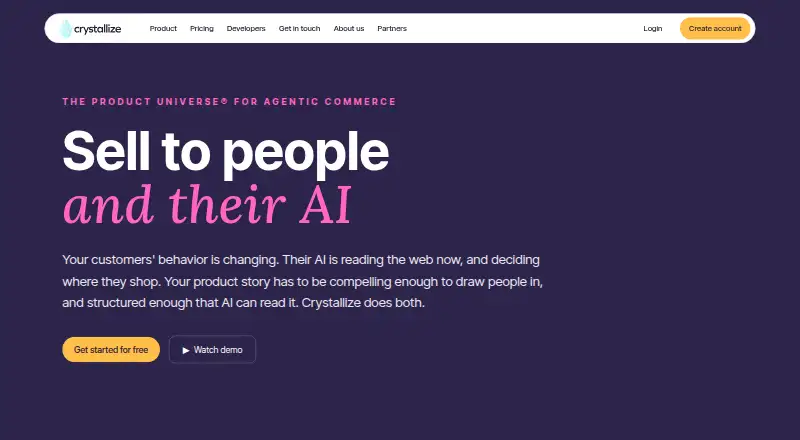
What Crystallize is
Crystallize is a composable commerce platform that combines a Product Universe, Commerce Engine, and headless architecture. Its unified model, admin, and API bring products, content, media, and commerce together. The commerce engine supports product and pricing models, subscriptions, customer hierarchies, fulfillment pipelines, and checkout analytics. APIs and webhooks connect external ERP, CRM, payment, and logistics systems. GraphQL and MCP interfaces let AI agents read catalogs, draft quotes, configure subscriptions, and fill carts. The platform is headless and platform-agnostic, supporting frontends for web, mobile, kiosk, and other platforms. Particle includes one tenant per project, while Atom also allows one tenant and costs $949 a month plus metering. Crystal includes three tenants for production, staging, and development. Crystallize states that it is compliant with GDPR and CCPA. The company was founded in 2017 and is based in Skien, Telemark, Norway.
Good
- Brings products, content, media, and commerce into one model.
- Supports subscriptions, customer hierarchies, and fulfillment pipelines.
- APIs and webhooks connect business and logistics systems.
- Headless architecture supports varied frontend platforms.
Watch out
- Particle and Atom are limited to one tenant per project.
- Atom costs $949 a month plus metering.
- Particle and Crystal have no listed price.
Who it suits
Crystallize suits commerce teams seeking a unified product, content, media, and commerce model with API-based connections to other systems. Its headless approach supports teams building web, mobile, kiosk, or other frontends.
Verdict
Crystallize brings catalog, content, and commerce capabilities into a composable platform with API-first connections. Compare the one-tenant plans with Crystal’s three-tenant setup and account for Atom’s listed price and metering.
Plans and prices
From Crystallize's own pricing page, checked 28 Sep 2026.
| Plan | Price | What it gives you |
|---|---|---|
| Atom | $949 a month | 1 tenant per project · unlimited users · full feature set · unlimited languages · 500 orders · 5000 items · 50 GB bandwidth · 500000 API calls · + metering/month |
| Particle | Free | 1 tenant per project · unlimited users · full feature set · unlimited languages · 25 orders · 100 items · 5 GB bandwidth · 25000 API calls · + metering / month |
| Crystal | Priced on request | 3 tenants included · unlimited users · unlimited languages · enterprise features · SAML / SSO · tenant cloning · + metering / month |
The facts
Each one read from Crystallize's own pages, with the date it was checked.
What it does
- Abandoned cart recovery
- Yeschecked 20 Sep 2026
- AI interfaces
- The platform exposes GraphQL and MCP natively so AI agents can read catalogs, draft quotes, configure subscriptions, and fill carts.checked 28 Sep 2026
- API architecture
- Crystallize is composable and API-first, with APIs and webhooks for connecting ERP, CRM, payment, and logistics systems.checked 28 Sep 2026
- Authentication
- Login is passwordless through magic links or OAuth social connections managed with AWS Cognito.checked 28 Sep 2026
- Commerce capabilities
- The commerce engine supports product and pricing models, subscriptions, customer hierarchies, fulfillment pipelines, and checkout analytics.checked 28 Sep 2026
- Developer tooling
- The Crystallize CLI is open source, detects the operating system, downloads the latest CLI from GitHub, and supports CI/CD automation.checked 28 Sep 2026
- Digital products
- Yeschecked 20 Sep 2026
- Hosting model
- hostedchecked 20 Sep 2026
- Infrastructure
- Crystallize is hosted on Amazon Web Services, databases run on MongoDB Atlas, and search indexes run on Elasticsearch Cloud.checked 28 Sep 2026
- Integrations
- Official integration documentation lists payment gateways including Stripe, Klarna, Vipps, Dintero, Adyen, Mollie, Montonio, Quickpay, Two, and Razorpay.checked 28 Sep 2026
- Paid from
- 949checked 20 Sep 2026
- Product type
- Crystallize is a composable commerce platform built around the Product Universe, Commerce Engine, and headless architecture.checked 28 Sep 2026
- Sales channels
- omnichannelchecked 20 Sep 2026
- Security compliance
- Crystallize states that it is fully compliant with GDPR and CCPA.checked 28 Sep 2026
- Support
- Particle includes community support and online docs, Atom adds a Pro SLA, and Crystal includes a dedicated engineering Slack channel, Enterprise SLA, professional services, advisory access, and roadmap access.checked 28 Sep 2026
- Tenant limit
- Particle and Atom allow only one tenant per project or store, while Crystal includes three tenants for production, staging, and development.checked 28 Sep 2026
- Transaction fee
- varieschecked 20 Sep 2026
- Unified stack
- The Product Universe combines products, content, media, and commerce in one model, admin, and API.checked 28 Sep 2026
Where it runs
- App marketplace
- Yeschecked 20 Sep 2026
- Frontend platforms
- Crystallize is headless and platform-agnostic, supporting frontends for web, mobile, kiosk, and other platforms.checked 28 Sep 2026
The company
- Company history
- Crystallize was founded in 2017 and is a New Normal Group company.checked 28 Sep 2026
- Founded
- 2017checked 28 Sep 2026
- Headquarters
- Skien, Telemark, Norwaychecked 28 Sep 2026
Money
- Free plan
- Yeschecked 20 Sep 2026
The full review of Crystallize
Crystallize is a hosted, headless commerce platform for teams that need product data, content, and sales operations in one composable system. It suits businesses building across multiple channels, especially those with developer resources to connect and shape their own storefronts. Its strength is the breadth of its commerce model; its main trade-off is that Atom starts at $949 a month, with metering on top.
Overview
Crystallize brings products, content, media, and commerce together through its Product Universe, Commerce Engine, and shared admin and API. The commerce engine handles product and pricing models, subscriptions, customer hierarchies, fulfillment pipelines, and checkout analytics. That makes it a more complete commerce foundation than a catalog-only system, though the headless approach means teams need to build or connect their customer-facing experiences.
Its APIs and webhooks are designed to connect with ERP, CRM, payment, and logistics systems. Official payment integrations include Stripe, Klarna, Vipps, Dintero, Adyen, Mollie, Montonio, Quickpay, Two, and Razorpay. Crystallize also exposes GraphQL and MCP for AI agents to read catalogs, draft quotes, configure subscriptions, and fill carts. These interfaces open up automation possibilities, but are most useful to teams able to build around them.
The platform is hosted on AWS, with databases on MongoDB Atlas and search indexes on Elasticsearch Cloud. Login uses passwordless magic links or OAuth social connections managed through AWS Cognito. Crystallize states that it complies with GDPR and CCPA. Founded in 2017, the company is based in Skien, Telemark, Norway, and is part of New Normal Group.
Key features
Unified product and content model
The Product Universe puts products, content, and media in a shared model, admin, and API. That can reduce the need to manage catalog and related content separately, particularly for teams delivering across channels.
Composable commerce and integrations
Subscriptions, customer hierarchies, fulfillment pipelines, and checkout analytics complement its product and pricing models. APIs and webhooks support connections to business systems, while the payment gateway roster covers a range of providers. This flexibility is valuable when commerce needs to fit an existing stack, but it also puts integration decisions and implementation work on the team.
AI interfaces and developer tooling
GraphQL and MCP give AI agents ways to interact with catalogs and commerce tasks, including quote drafting and cart filling. The open-source CLI detects the operating system, downloads the latest version from GitHub, and supports CI/CD automation. These are practical tools for developer-led operations, not substitutes for a ready-made storefront.
Pricing
Crystallize uses a freemium model. Particle is the free plan, while Atom costs $949 a month, billed monthly plus metering. Crystal has custom pricing.
| Plan | Includes | Best fit |
|---|---|---|
| Particle | One tenant per project, unlimited users and languages, 25 orders, 100 items, and 5 GB bandwidth. | Evaluation or a small project that can stay within the order, item, and bandwidth caps. |
| Atom | One tenant, unlimited users and languages, full feature set, 500 orders, 5,000 items, 50 GB bandwidth, and 500,000 API calls. | Teams needing the full feature set and larger quotas, provided metering and the monthly fee fit their budget. |
| Crystal | Three tenants, unlimited users and languages, and tailored orders, items, and bandwidth. | Organizations that need separate production, staging, and development tenants plus tailored capacity. |
Particle and Atom both allow only one tenant per project, so they do not provide Crystal’s three-environment arrangement. Particle’s low quotas make it a constrained starting point rather than an obvious production tier for substantial catalogs or order volume. Atom raises those limits but retains a single tenant and adds metering to its monthly bill. Crystal’s tailored quotas and three tenants suit more demanding setups, but require custom pricing.
Platforms
Crystallize is hosted and API-first, with platform-agnostic frontends for web, mobile, kiosks, and other platforms. Its listed platforms include API, macOS, web, and Windows. The headless model provides room to choose a frontend, but does not remove the work of creating or integrating one.
Who it's for
Crystallize is a strong fit for commerce teams that need one model for content and catalog data, support for subscriptions or customer hierarchies, and the freedom to compose a broader technology stack. Its API, webhook, GraphQL, MCP, and CLI capabilities particularly favor organizations with developers who can take advantage of them. Smaller sellers seeking a complete, low-cost storefront or predictable costs without metering should look elsewhere.
Pros and cons
- Pros: Products, content, media, and commerce share a model and API, which suits omnichannel operations.
- Pros: Commerce capabilities include subscriptions, customer hierarchies, fulfillment pipelines, and checkout analytics.
- Pros: GraphQL, MCP, APIs, webhooks, and an open-source CLI support custom integrations and automation.
- Cons: Particle caps usage at 25 orders, 100 items, and 5 GB bandwidth, limiting its headroom.
- Cons: Particle and Atom each have only one tenant, while three tenants require Crystal.
- Cons: Atom costs $949 a month plus metering, a significant commitment before usage charges.
Alternatives
Aimeos is worth considering when open-source, commercially free software and self-hosting are priorities; its core framework has no license or transaction fees.
Medusa may suit teams seeking a freemium, self-hosted option, with its Develop plan starting at $29 a month and including defined infrastructure allowances.
Sylius offers an open-source MIT-licensed standard edition with community support and on-premise distribution, making it an option for teams favoring that model.
Saleor is another freemium commerce platform, with free sandboxes for prototyping and development and paid plans including Select at $1,599 a month.
Unchained Engine is a free, open-source choice with no licensing or per-transaction fees, though users pay for hosting infrastructure.
Solidus offers a free DIY edition with customer-managed infrastructure, a fit for teams that want to operate the platform themselves.
Vendure provides an open-source ecommerce framework and a platform tier with B2B buying, pricing, catalogues, and search.
Commerce Layer offers a free Developer plan with limits including one organization, two users, two markets, and 100 free live orders per month.
For broader comparisons, browse Headless Ecommerce Platforms or Ecommerce platforms.
Verdict
Choose Crystallize if you need composable, omnichannel commerce built around a unified product and content model, and have the technical capacity to connect it to your stack. Its commerce depth and API-first design are compelling; the single-tenant limits on lower tiers and Atom’s $949.00 USD monthly price plus metering are strong reasons to compare alternatives before committing.
Getting started
- Visit the Crystallize website.
- Choose a plan: Particle, Atom, or Crystal.
- Use the hosted platform through its API, web, macOS, or Windows options.
- Connect external systems using APIs and webhooks, or select a listed payment integration.
- Build a frontend for web, mobile, kiosk, or another platform.
Limits worth knowing
Particle includes one tenant, 25 orders, 100 items, and 5 GB of bandwidth. Atom includes one tenant, 500 orders, 5,000 items, 50 GB of bandwidth, and 500,000 API calls; it costs $949 a month plus metering. Crystal includes three tenants, while its orders, items, and bandwidth are tailored.
Questions
Is Crystallize free?
Yes. Its pricing model is freemium, and the Particle plan has no price listed. The listed paid starting price is $949/mo; Atom is $949 a month plus metering.
Which platforms does Crystallize support?
The listed platforms are API, macOS, web, and Windows. Its headless approach also supports frontends for mobile, kiosks, and other platforms.
What is included in the Particle plan?
Particle allows one tenant per project or store, unlimited users and languages, 25 orders, 100 items, and 5 GB of bandwidth.
What payment systems can it connect to?
Listed payment integrations include Stripe, Klarna, Vipps, Dintero, Adyen, Mollie, Montonio, Quickpay, Two, and Razorpay.
Who makes Crystallize?
Crystallize is made by Crystallize, a New Normal Group company founded in 2017 and headquartered in Skien, Telemark, Norway.
Alternatives to Crystallize
- 1

WooCommerce
Free planOpen sourceAndroidiOSWebAPI9.4From $29 a year - 2
nopCommerce
Free planOpen sourceAndroidiOSWebAPI9.4$499 one-time - 3

Sylius
Free planOpen sourceAndroidiOSWebAPI9.2From €800 a year - 4

Wix eCommerce
Free planAndroidiOSWebAPI8.9From $17.77 a month - 5

Payhip
Free planAndroidiOSWebAPI8.8From $29 a month - 6

Tiendanube
Free planAndroidiOSWebAPI8.8From 27,999 ARS a month