
Commerce Layer
Commerce Layer is a hosted transactional commerce API for brands building shoppable digital experiences across online and in-store channels.
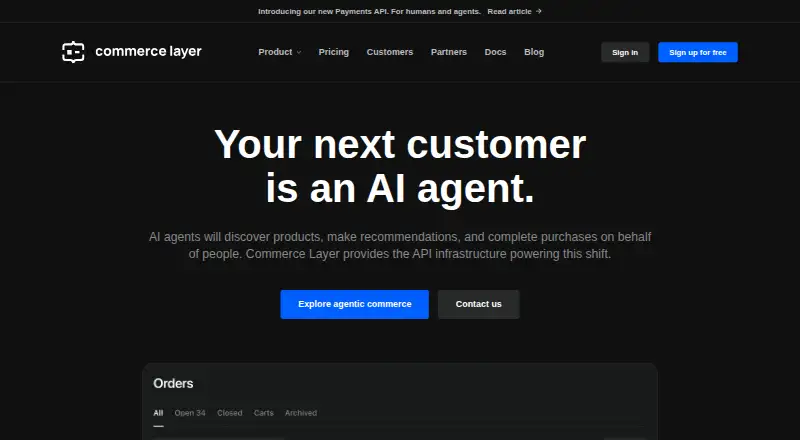
What Commerce Layer is
Commerce Layer is a hosted transactional commerce API for brands building shoppable digital experiences across online and in-store channels. Its stateless checkout supports multiple markets and currencies and can connect to payment gateways and tax calculators. A distributed order management system provides a unified inventory view across locations and automates order steps from reservation through shipping. Teams can configure market-specific promotions using a visual editor or JSON-based DSL. The point-of-sale system uses the same API as online channels, with support for store inventory, endless aisle, and shareable selling links. Commerce Layer lists 400+ API endpoints and real-time webhooks with 100+ trigger events. It states an average API response time below 90 ms and guaranteed uptime of 99.99%. Its listed security certifications include SOC 2 Type 2, PCI DSS Level 1 Provider, and ISO 27001; OAuth 2.0 and resource-level permissions control API access. The platform supports third-party integrations, including a documented Zapier app. The Developer plan includes 100 free live orders per month and unlimited test orders. There is no trial period, and on-premise deployment is not offered.
Good
- Checkout supports multiple markets and currencies.
- Order management unifies inventory across locations.
- POS shares the API used by online channels.
- Developer plan includes 100 free live orders monthly.
- OAuth 2.0 and resource-level permissions control API access.
Watch out
- No trial period is offered.
- On-premise deployment is not available.
- Enterprise orders are custom quoted.
Who it suits
Commerce Layer suits brands creating headless ecommerce sites, mobile apps, or omnichannel retail experiences. Its API and order-management features may also fit teams connecting commerce across markets and store locations.
Verdict
Commerce Layer combines checkout, order management, promotions, and point-of-sale capabilities through a transactional API. The Developer plan has defined order allowances, while Enterprise orders require a custom quote.
Plans and prices
From Commerce Layer's own pricing page, checked 14 Oct 2026.
| Plan | Price | What it gives you |
|---|---|---|
| Developer | Free | 1 organization · 2 users · 2 markets · 1,000 SKUs · 10 links · unlimited test orders · 100 free live orders/month · Core API · community support |
| Enterprise | Priced on request | unlimited organizations · unlimited users · unlimited markets · unlimited SKUs · unlimited links · custom orders/year · Metrics API · Provisioning API · dedicated support · custom roles · custom identity provider · enterprise SLAs |
The facts
Each one read from Commerce Layer's own pages, with the date it was checked.
What it does
- Access controls
- Commerce Layer uses OAuth 2.0 and resource-level permissions to control API access.checked 4 Oct 2026
- API and events
- The homepage lists 400+ API endpoints and real-time webhooks with 100+ trigger events.checked 4 Oct 2026
- API format
- The REST API follows JSON:API 1.0 and supports compound documents, sparse fieldsets, relationships, filtering, sorting and pagination.checked 14 Oct 2026
- Authentication
- API authorization uses OAuth 2.0 with sales-channel, integration and webapp credential types.checked 14 Oct 2026
- Checkout
- Its API-first, stateless checkout supports multiple markets and currencies and can connect to payment gateways and tax calculators.checked 4 Oct 2026
- CLI
- The official CLI installs through npm or Yarn and includes plugins for resources, imports, webhooks, orders, checkout, exports, links, provisioning and metrics.checked 14 Oct 2026
- Distributed OMS
- The distributed order-management system provides real-time inventory views, allocation by region or customer segment, and order workflows from reservation through shipping.checked 14 Oct 2026
- Documentation depth
- The developer portal provides onboarding, a 100-plus-endpoint reference, 400-plus CRUD operations, how-to guides, data-model diagrams, OpenAPI schemas, Postman collections, SDKs, CLI documentation and changelog entries.checked 14 Oct 2026
- Funding
- TechCrunch reported on May 26, 2021 that Commerce Layer raised a $16 million Series B led by Coatue, with Benchmark and Mango Capital also participating.checked 14 Oct 2026
- Hosting model
- hostedchecked 20 Sep 2026
- In-store commerce
- The POS system uses the same API as online channels and supports store inventory, endless aisle, and shareable selling links.checked 4 Oct 2026
- Integrations
- Documented payment integrations include Adyen, Axerve, Braintree, Checkout.com, Klarna, PayPal and Stripe, with external gateways available for custom providers.checked 14 Oct 2026
- Latest changelog
- The changelog records a dated October 13, 2026 update stream and provides links to upcoming breaking changes and the 2025 archive.checked 14 Oct 2026
- Licence
- The official JavaScript SDK and CLI repositories are released under the MIT licence.checked 14 Oct 2026
- Limit: deployment
- The pricing FAQ explicitly says there is no on-premise version of Commerce Layer.checked 14 Oct 2026
- Limit: technical complexity
- Independent SoftwareWorld assessment said the API-first and headless model requires strong developer resources and can create complexity for merchants without technical teams.checked 14 Oct 2026
- Notable news
- The 2021 funding report said the company planned a developer dashboard, CLI, order-management system, hosted checkout, metrics API and reporting application.checked 14 Oct 2026
- Open-source components
- Commerce Layer publishes SDKs, CLI tools, React components, micro-frontends and dashboard applications as open-source projects, while its hosted commerce API remains a commercial service.checked 14 Oct 2026
- Order management
- Its distributed OMS provides a unified view of inventory across locations and automates order steps from reservation through shipping.checked 4 Oct 2026
The company
- Company facts
- LinkedIn lists Commerce Layer as privately held, founded in 2017, headquartered in Prato, Italy, with 11–50 employees.checked 14 Oct 2026
- Company identity
- Crunchbase lists the legal entity as Commerce Layer, Inc., founded by Filippo Conforti and Massimo Scardellato.checked 14 Oct 2026
Money
- Free access terms
- The pricing FAQ says there is no time-limited trial; developer access is permanently free and Enterprise trials can be discussed with sales.checked 14 Oct 2026
- Free plan
- Yeschecked 20 Sep 2026
Where it runs
- Limit: POS and order editing
- The TrustRadius reviewer said specific POS functions were still on the roadmap, payment flexibility was limited for a full POS deployment, and editing approved orders was constrained.checked 14 Oct 2026
The full review of Commerce Layer
Commerce Layer is a hosted commerce platform for brands adding buying to websites, apps, stores, and other digital touchpoints. It is best for teams building across markets and channels who can integrate through APIs. Its shared checkout, order, promotion, and in-store capabilities are compelling, but the low-volume Developer allowance and hosted-only model narrow its fit.
Overview
Commerce Layer supplies commerce functions for teams to connect to their own customer experiences rather than centering on a single storefront. It supports headless ecommerce, existing websites, mobile apps, omnichannel retail, subscriptions, shoppable links, and connected devices. That flexibility suits brands that need commerce to work across touchpoints; it is less apt for teams seeking a ready-made storefront or an on-premise system.
The hosted service brings checkout, order management, promotions, and POS together behind a transactional API. Its stated average API response time is below 90 ms, with guaranteed uptime of 99.99%. The breadth makes it relevant to international operations, though adopting it means building around an API-led platform.
Key features
Checkout and order operations
The stateless checkout supports multiple markets and currencies and can connect to payment gateways and tax calculators. Commerce Layer integrates with commonly used payment providers and also supports manual or external payment services. Its distributed order management system unifies inventory across locations and automates order steps from reservation through shipping. This combination is useful when orders and stock need to move across channels, not just through one online shop.
Promotions and point of sale
Promotion rules can be tailored by market and configured with a visual editor or JSON-based DSL. That gives teams a choice between a visual workflow and a more code-oriented approach. The POS uses the same API as online channels, with store inventory, endless aisle, and shareable selling links; this makes it a stronger fit for retailers joining store and digital commerce than for businesses needing only a basic web checkout.
Integration, security, and support
The platform has more than 400 API endpoints and real-time webhooks with over 100 trigger events, supporting teams that need to connect commerce workflows to other services. Documentation describes a Zapier app, and OAuth 2.0 with resource-level permissions controls API access. Its stated certifications include SOC 2 Type 2, PCI DSS Level 1 Provider, and ISO 27001. The homepage advertises 24/7 support, while plan-level support differs: community support for Developer and dedicated support for Enterprise.
Pricing
Commerce Layer uses a freemium model, but neither plan has a listed price. There is no general free trial; Enterprise trial options can be discussed with sales. The hosted service has no on-premise version.
| Plan | Included limits | Best fit |
|---|---|---|
| Developer | 1 organization, 2 users, 2 markets, 1,000 SKUs, 10 links, 100 free live orders per month, and unlimited test orders | A small team evaluating or operating a limited-volume implementation |
| Enterprise | Unlimited organizations, users, markets, SKUs, and links; custom orders per year | Brands needing broader scale and dedicated support |
Developer’s free live-order allowance is a meaningful constraint: it can support evaluation and modest activity, but growing commerce will quickly require a different arrangement. Its two-user and two-market caps also limit team size and international reach. Enterprise removes those stated organization, user, market, SKU, and link ceilings, but order volume is custom quoted, so teams need a sales conversation to establish fit and cost.
Platforms
Commerce Layer is hosted and supports web, iOS, Android, and API use. Its API orientation is central to the product, while the mobile platforms provide routes for commerce experiences beyond the web.
Who it's for
Commerce Layer suits brands with developers or technical partners who want to add commerce to multiple digital and physical channels, coordinate inventory across locations, and tailor promotions by market. It is particularly relevant where a shared API and order system can serve both online and store selling. It is a weaker choice for teams that want a packaged storefront, need on-premise deployment, or expect more than 100 live orders monthly without moving beyond the Developer plan.
Pros and cons
- Pro: One API supports checkout, distributed order management, promotions, and POS, helping align online and in-store operations.
- Pro: Multi-market checkout and market-specific promotions suit international selling.
- Pro: Developer includes unlimited test orders, allowing testing without consuming its 100 monthly live-order allowance.
- Con: Developer is capped at two users and two markets, limiting team and market growth.
- Con: Enterprise order volume is custom quoted, and neither plan has a listed price, making budget planning less direct.
- Con: Hosted-only deployment rules out organizations that require on-premise software.
Alternatives
For a broader shortlist, browse Headless Ecommerce Platforms or Ecommerce platforms.
- Crystallize is another freemium API and web option, with a Particle plan that includes one tenant per project, unlimited users and languages, 25 orders, 100 items, and 5 GB bandwidth.
- Aimeos is a free, open-source option for teams that want commercial use without license or transaction fees and can work with its Linux, web, API, or self-hosted platforms.
- Spree Commerce offers a self-hosted open-source Community Edition for DTC, B2B, and marketplace commerce, with a free trial also available.
- Bagisto is a free open-source choice for teams prepared to self-host and meet its PHP 8.3+, database, and 4 GB RAM requirements.
- Solidus offers a free DIY Edition for users bringing their own infrastructure, as well as a Starter Cloud plan with 10 solutions-architect hours per month.
- Sylius provides an open-source MIT-licensed edition with community support and on-premise distribution; Sylius Plus is priced at €800 a year.
- Vendure has an open-source ecommerce framework under GPLv3 and a separate platform offering B2B buying and pricing.
- Unchained Engine is a free, open-source, self-hosted option without licensing or per-transaction fees, though hosting infrastructure is paid by the user.
Verdict
Choose Commerce Layer if your brand needs one API-led commerce foundation for international checkout, distributed orders, promotions, and store selling. Its main advantage is connecting those capabilities across channels; its main drawback is the combination of a tightly capped Developer plan, custom-priced Enterprise orders, and no self-hosted option. Teams that need an off-the-shelf or self-managed platform should compare alternatives before committing.
Getting started
- Visit https://commercelayer.io/
- Choose the Developer plan or contact sales about Enterprise
- Create an organization and configure markets, users, and SKUs
- Connect checkout with payment gateways or tax calculators
- Integrate channels through the API and available third-party connections
Limits worth knowing
The Developer plan includes one organization, two users, two markets, 1,000 SKUs, 10 links, and 100 free live orders per month, with unlimited test orders. Enterprise orders are custom quoted, and Enterprise trial options can be discussed with sales.
Questions
What does the Developer plan include?
It includes one organization, two users, two markets, 1,000 SKUs, 10 links, 100 free live orders monthly, and unlimited test orders.
Is there a trial period?
There is no standard trial period. Enterprise trial options can be discussed with sales.
Can Commerce Layer be self-hosted?
No on-premise version is offered; Commerce Layer is hosted.
Which integrations are available?
The platform supports third-party integrations, documents a Zapier app, connects with commonly used payment providers, and allows manual or external payment services.
Which platforms and channels does it support?
Listed platforms are Android, API, iOS, and web. Its sales-channel model is omnichannel, covering online and in-store experiences.
Alternatives to Commerce Layer
- 1

WooCommerce
Free planOpen sourceAndroidiOSWebAPI9.4From $29 a year - 2
nopCommerce
Free planOpen sourceAndroidiOSWebAPI9.4$499 one-time - 3

Sylius
Free planOpen sourceAndroidiOSWebAPI9.2From €800 a year - 4

Wix eCommerce
Free planAndroidiOSWebAPI8.9From $17.77 a month - 5

Payhip
Free planAndroidiOSWebAPI8.8From $29 a month - 6

Tiendanube
Free planAndroidiOSWebAPI8.8From 27,999 ARS a month