
Spree Commerce
Spree Commerce is an open-source eCommerce platform for B2B businesses, marketplaces, and enterprise commerce.
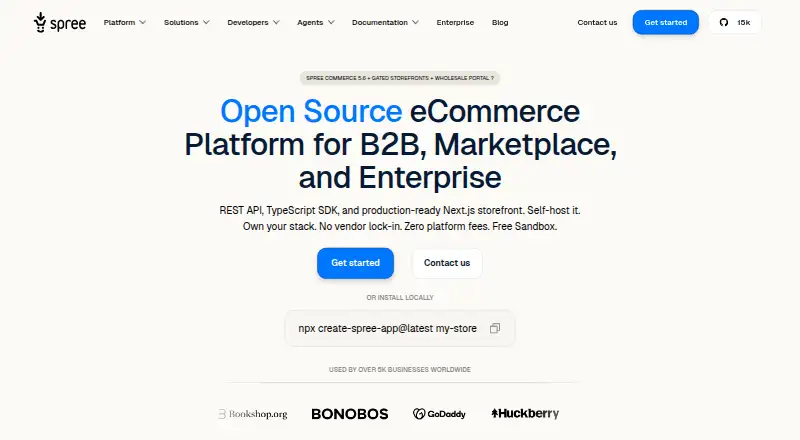
What Spree Commerce is
Spree Commerce is an open-source eCommerce platform for B2B businesses, marketplaces, and enterprise commerce. It supports multi-vendor marketplaces, multi-tenant and multi-store setups, regional and omnichannel selling, digital products, and subscriptions. Its catalog tools handle unlimited products and variants, product properties, and rich media. Pricing options include price lists, volume tiers, customer-specific rates, and timed promotions. For international commerce, Spree includes multiple currencies and languages, regional tax rules, and EU Omnibus compliance.
Developers can work with Store and Admin REST APIs, OpenAPI 3.0 documentation, typed TypeScript SDKs, and a production-ready Next.js storefront. Payment Sessions connect to Stripe, Adyen, PayPal, or a merchant’s own provider; 3D Secure and webhooks work across gateways. Community Edition can be self-hosted on cloud infrastructure or on-premises and is Docker-ready. Enterprise Edition adds multi-tenant white-label commerce, approval workflows, seller sync with Shopify and WooCommerce, and dedicated SLA support. A free sandbox provides an admin dashboard and API without requiring a credit card.
Good
- Supports unlimited products and variants.
- Includes multilingual and multi-currency support.
- Payment Sessions connect to several named gateways.
- Free sandbox access requires no credit card.
Watch out
- White-label commerce is an Enterprise Edition addition.
- Approval workflows are an Enterprise Edition addition.
- Dedicated SLA support is an Enterprise Edition addition.
Who it suits
Spree Commerce suits businesses building B2B stores, marketplaces, or multi-store commerce across regions and channels. Developers can use its APIs and storefront options, while organizations needing enterprise support can consider Enterprise Edition.
Verdict
Spree Commerce covers catalog, pricing, international selling, payments, and developer tooling in a self-hosted platform. Its free sandbox offers a way to explore the admin dashboard and API, while several advanced capabilities are reserved for Enterprise Edition.
Plans and prices
From Spree Commerce's own pricing page, checked 15 Oct 2026.
| Plan | Price | What it gives you |
|---|---|---|
| Community Edition | Free | self-hosted · open source · DTC, B2B and marketplace · Store/Admin/Seller APIs · TypeScript SDKs · CLI · webhooks |
| Enterprise Edition | Priced on request | self-hosted or private cloud · multi-tenant · approval workflows · Shopify/WooCommerce seller sync · SLA support · enterprise license |
The facts
Each one read from Spree Commerce's own pages, with the date it was checked.
What it does
- APIs and storefront
- Spree provides Store and Admin REST APIs, OpenAPI 3.0 documentation, typed TypeScript SDKs, and a production-ready Next.js storefront.checked 7 Oct 2026
- B2B
- B2B functions include account-specific price lists, buyer organizations, approval workflows, net terms and gated catalogs.checked 15 Oct 2026
- Compliance
- Spree says its architecture supports SOC 2 Type 2, ISO/IEC 27001, GDPR, CCPA, HIPAA, and PCI DSS requirements.checked 7 Oct 2026
- Customer segmentation
- Customer groups can use segments, order history and custom attributes for personalized pricing and experiences.checked 15 Oct 2026
- Databases
- The documentation states that Spree works with PostgreSQL, MySQL and SQLite.checked 15 Oct 2026
- Digital products
- Yeschecked 20 Sep 2026
- Documentation
- Documentation covers installation, platform concepts, catalog, checkout, fulfillment, events, webhooks, SDKs, CLI and API references.checked 15 Oct 2026
- Extensibility
- Events, webhooks, dependency injection and extension points allow components to be replaced without changing core code.checked 15 Oct 2026
- Hosting
- Community Edition can be self-hosted on cloud infrastructure or on-premises, and the platform is Docker-ready.checked 7 Oct 2026
- Hosting model
- self-hostedchecked 20 Sep 2026
- Installation requirements
- The create-spree-app route requires Node.js 20 or newer and Docker; manual setup uses Ruby on Rails and libvips.checked 15 Oct 2026
- Integrations
- Official integration listings include Google Pay, Razorpay, PayPal, Braintree, Stripe, Apple Pay, Shippo, USPS, Elasticsearch, Mailchimp, Klaviyo and Yotpo.checked 15 Oct 2026
- International commerce
- The platform includes multiple currencies, languages, regional tax rules, translations and EU Omnibus support.checked 15 Oct 2026
- License
- The backend uses BSD-3-Clause and frontend code uses MIT; Enterprise-only code is under a commercial license.checked 15 Oct 2026
- Limit: customization effort
- A G2 reviewer says substantial rewriting of pages and stylesheets may be needed for store personalization and that database schemas are difficult to understand.checked 15 Oct 2026
- Limit: out-of-box scope
- TrustRadius reviewers report that the platform lacks enough ready-made options and that its CMS can feel clumsy.checked 15 Oct 2026
- Limit: search performance
- G2 reviewers report slow searches when order or email datasets become very large.checked 15 Oct 2026
The company
- Company headquarters
- Crunchbase lists headquarters in Bethesda, Maryland, United States.checked 15 Oct 2026
- Company history
- Crunchbase says the open-source platform began in 2008 and names Brian Quinn and Sean Schofield as founders.checked 15 Oct 2026
- Company legal name
- Crunchbase lists the legal entity as Spree Commerce Inc.checked 15 Oct 2026
- Company size
- Crunchbase reports a company headcount range of 11 to 50 employees.checked 15 Oct 2026
Money
- Free plan
- Yeschecked 20 Sep 2026
- Free sandbox
- The site offers free sandbox access to an instance with an admin dashboard and API, with no credit card required.checked 7 Oct 2026
- Limit: developer cost
- A TrustRadius reviewer says supporting Spree can be expensive from a developer perspective.checked 15 Oct 2026
The full review of Spree Commerce
Spree Commerce is a self-hosted, open-source commerce platform for B2B operations, marketplaces and enterprise teams. It fits organizations that need complex pricing, multiple regions or deep control of APIs and hosting. The trade-off is operational responsibility: this is a platform for teams prepared to run and tailor their commerce stack.
Overview
Spree handles more than a single storefront. Its supported models include B2B, multi-vendor marketplaces, multi-tenant and multi-store commerce, omnichannel selling, digital products and subscriptions. That breadth is valuable when one business serves different brands, regions or sales channels, but it is more infrastructure than a small, single-catalog shop usually needs.
The catalog accommodates unlimited products and variants, product properties and rich media. Price lists, volume tiers, customer-specific prices and time-based promotions provide the controls needed for negotiated B2B deals and differentiated offers. There is no transaction fee, although hosting and implementation remain the operator’s responsibility.
Key features
International selling and payments
Multi-currency and multi-language support, regional tax rules and EU Omnibus compliance make the platform suitable for cross-border catalogs. Payment Sessions can connect Stripe, Adyen, PayPal or a merchant’s own provider, with 3D Secure and webhooks working across gateways. Listed integrations also include Google Pay, Razorpay, Braintree and Apple Pay, alongside Mailchimp and Klaviyo for marketing. The range is useful for businesses with varied payment or campaign requirements rather than a fixed, one-provider setup.
APIs and storefronts
Store and Admin REST APIs, OpenAPI 3.0 documentation and typed TypeScript SDKs give development teams a structured integration surface. A production-ready Next.js storefront provides a starting point for headless builds, while the self-hosted architecture leaves deployment and ongoing maintenance with the customer.
Security and operations
Enterprise security features include encryption in transit and at rest, single sign-on, role-based access controls and audit logging. Spree says its architecture can support SOC 2 Type 2, ISO/IEC 27001, GDPR, CCPA, HIPAA and PCI DSS requirements; meeting those requirements still depends on how an organization deploys and operates the system.
Pricing
Spree uses a freemium model with a free sandbox that requires no credit card and exposes an admin dashboard and API. It is a practical way to evaluate the interface and integration approach before committing infrastructure, but it is not a substitute for running a production store.
| Plan | Price | Best for |
|---|---|---|
| Community Edition | Custom pricing | Self-hosted, open-source deployments for DTC, B2B and marketplace commerce |
| Enterprise Edition | Custom pricing | Self-hosted or private-cloud deployments needing enterprise support and multi-tenant capabilities |
Community Edition can run on cloud infrastructure or on-premises and is Docker-ready. Enterprise Edition adds source-available licensing with enterprise support, a dedicated success manager, SLA-backed response times, direct engineer access, long-term support releases and priority fixes. Multi-tenant white-label commerce, approval workflows, Shopify and WooCommerce seller synchronization and dedicated SLA support are Enterprise additions, so teams needing those functions should budget for the paid edition rather than assume they are part of the community option.
Platforms
Spree supports Android, iOS, web and API access, with self-hosted deployment as its hosting model. Community deployments can use cloud infrastructure or on-premises servers, while Enterprise also offers private-cloud deployment. Docker readiness helps standardize deployment, but the platform remains a build-and-operate choice rather than a fully managed storefront service.
Who it's for
Choose Spree when your business needs B2B pricing logic, multiple stores or tenants, marketplace workflows, international catalogs, digital goods or subscriptions and has developers to own the platform. Its APIs, SDKs and Next.js storefront are particularly relevant to teams building custom customer experiences or connecting several sales channels.
Look elsewhere if you want a managed store with minimal infrastructure work, a published subscription price or a tightly guided setup. Enterprise-only workflows also make the edition choice important for larger seller networks and approval-heavy organizations.
Pros and cons
Pros
- Unlimited products and variants support large or frequently changing catalogs.
- Price lists, volume tiers and customer-specific pricing suit negotiated B2B commerce.
- Multi-currency, multi-language and regional tax capabilities support international selling.
- REST APIs, OpenAPI documentation, typed SDKs and a Next.js storefront support headless development.
- No transaction fee and self-hosting provide control over deployment and payment architecture.
Cons
- Self-hosting shifts infrastructure, upgrades and operational work to the customer.
- Multi-tenant white-label features, approval workflows, seller sync and SLA support require Enterprise Edition.
- Both main plans use custom pricing, making costs harder to compare before contacting Spree.
Alternatives
For a broader comparison, see Ecommerce platforms and Headless Ecommerce Platforms.
- Spwig is a freemium alternative with a community plan covering a full platform, storefront, admin, page builder, POS UI and providers across self-hosted and desktop platforms.
- Lightspeed eCom suits readers wanting a free-forever account with no credit card requirement.
- Wix eCommerce is the more guided choice, with a free plan, hosting, drag-and-drop editing and no-code design tools.
- nopCommerce is a free, open-source, self-hosted option for teams that do not need a paid enterprise edition.
- Shoptet fits smaller catalogs through a free 10-product plan and tiered paid plans.
- Commerce Layer offers a developer plan capped at one organization, two users, two markets, 1,000 SKUs and 100 free live orders per month.
- Big Cartel is aimed at small catalogs, with a free five-product plan and a $15 monthly 50-product tier.
- OroCommerce is another open-source, self-hosted option with a free-to-use community edition for technical teams.
Verdict
Spree Commerce is a strong choice for developer-led businesses that need extensible B2B, marketplace or international commerce without transaction fees. Choose it for its catalog scale, pricing engine and API-first flexibility; look elsewhere if managed hosting, transparent pricing or a simpler launch matters more than control.
Alternatives to Spree Commerce
- 1

WooCommerce
Free planOpen sourceAndroidiOSWebAPI9.4From $29 a year - 2
nopCommerce
Free planOpen sourceAndroidiOSWebAPI9.4$499 one-time - 3

Sylius
Free planOpen sourceAndroidiOSWebAPI9.2From €800 a year - 4

Wix eCommerce
Free planAndroidiOSWebAPI8.9From $17.77 a month - 5

Payhip
Free planAndroidiOSWebAPI8.8From $29 a month - 6

Tiendanube
Free planAndroidiOSWebAPI8.8From 27,999 ARS a month