Spwig
Spwig is an open-source e-commerce platform for running an online store and managing its operations.
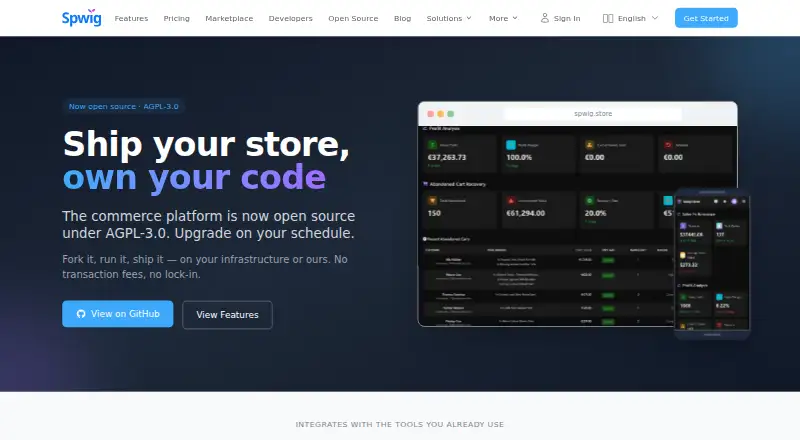
What Spwig is
Spwig is an open-source e-commerce platform for running an online store and managing its operations. Merchants can use order workflows, inventory across locations, customer profiles, point of sale, analytics, and report exports. It supports eight product types, including digital, bundle, customizable, booking, and gift card products. Marketing tools include SEO metadata, coupons, loyalty points, referral rewards, affiliate commissions, email campaigns, and automated notifications. Listed payment integrations include Stripe, PayPal, Square, and Revolut; shipping providers include FedEx, UPS, and USPS. The platform also offers a RESTful API, event-driven webhooks, a component architecture, and a developer portal for themes and integrations. Point of sale is included at no cost in every install and runs on a tablet or browser. Spwig can be self-hosted on a merchant’s infrastructure or run through managed hosting. The self-hosted Community edition has no usage caps, while hosted tiers specify product, staff, storage, and email allowances. The platform has no transaction fee and is available across mobile, desktop, web, API, and self-hosted environments.
Good
- Supports eight product types, including digital and booking.
- Includes point of sale at no cost.
- No transaction fee is listed.
- Self-hosted Community has no usage caps.
- Offers integrations for payments and shipping.
Watch out
- Hosted tiers specify product, staff, storage, and email limits.
- The commerce platform uses an AGPL-3.0 license.
Who it suits
Spwig suits merchants who want to manage products, orders, inventory, and marketing in one platform. Self-hosting is an option for merchants who want to keep customer data on their own infrastructure.
Verdict
Spwig combines store operations, marketing, integrations, and developer tools, with both self-hosted and managed deployment options. Check the allowances on hosted tiers, or consider the uncapped self-hosted Community edition.
Plans and prices
From Spwig's own pricing page, checked 20 Sep 2026.
| Plan | Price | What it gives you |
|---|---|---|
| Community | — | Full platform, storefront, admin, page builder, POS UI, and providers · Themes and page builder · Rate-limited GeoIP, geocoder, and push |
| Pro edition | — | Hosted email gateway · Higher hosted-service rate limits · Priority support |
| Enterprise edition | — | Enterprise SSO with Azure AD and Okta · Highest hosted-service rate limits · Dedicated onboarding |
| Starter | €35 a month | 1,000 products · 3 staff accounts · 25GB media storage · 3,000 emails/mo · billed annually |
| Growth | €59 a month | 5,000 products · 10 staff accounts · 100GB media storage · 10,000 emails/mo · billed annually |
| Pro hosting | €99 a month | Unlimited products · 25 staff accounts · 250GB media storage · 25,000 emails/mo · billed annually |
| Self-Host / Community | Free | No usage caps · Full platform, storefront and admin · POS · Community support · Free forever; self-hosted on your own infrastructure. |
| Starter (Hosted) | €35 a month | 1,000 products · 3 staff accounts · 25GB media storage · 3,000 emails/mo · Basic reporting · Email support (48h) · €35/mo billed annually · €40 billed monthly |
| Growth (Hosted) | €59 a month | 5,000 products · 10 staff accounts · 100GB media storage · 10,000 emails/mo · REST API access · Email support (24h) · €59/mo billed annually · €69 billed monthly |
| Pro (Hosted) | €99 a month | Unlimited products · 25 staff accounts · 250GB media storage · 25,000 emails/mo · REST API + webhooks · Priority support (12h) · €99/mo billed annually · €115 billed monthly |
| Pro Plus | €149 a month | Unlimited products · Unlimited staff · 500GB media storage · 50,000 emails/mo · billed annually |
| Pro Plus (Hosted) | €149 a month | Unlimited products · Unlimited staff · 500GB media storage · 50,000 emails/mo · REST API + webhooks + SLA · POS included · €149/mo billed annually · €175 billed monthly |
| Pro (Edition) | Priced on request | Hosted email gateway · Higher hosted-service rate limits · Priority support · TBC; renewable licence key |
| Enterprise (Edition) | Priced on request | Enterprise SSO · Highest hosted-service rate limits · Dedicated onboarding · TBC; contact for pricing; renewable licence key |
The facts
Each one read from Spwig's own pages, with the date it was checked.
What it does
- Abandoned cart recovery
- Yeschecked 20 Sep 2026
- Deployment
- Spwig can be self-hosted for free on the merchant’s infrastructure or run through its managed hosting service.checked 11 Oct 2026
- Developer tools
- The platform offers a RESTful API, event-driven webhooks, a component architecture, and a developer portal for publishing themes and integrations.checked 11 Oct 2026
- Digital products
- Yeschecked 20 Sep 2026
- Hosting limits
- Hosted tiers specify product, staff, media-storage, and monthly email limits; the self-hosted Community edition is described as having no usage caps.checked 11 Oct 2026
- Integrations
- The features page lists payment integrations including Stripe, PayPal, Square, and Revolut, and shipping providers including FedEx, UPS, and USPS.checked 11 Oct 2026
- Intended users
- The hosted plans describe use cases from launching a first store to growing sales, established businesses needing dedicated performance, and multi-location operations.checked 11 Oct 2026
- Licensing
- The commerce platform is licensed under AGPL-3.0, while the SDKs are Apache-licensed.checked 11 Oct 2026
- Marketing and SEO
- Marketing tools include SEO metadata, coupons, loyalty points, referral rewards, affiliate commissions, email campaigns, and automated notifications.checked 11 Oct 2026
- Product
- Spwig is an open-source e-commerce platform for running an online store and managing its commerce operations.checked 11 Oct 2026
- Product types
- It supports eight product types, including simple, variable, digital, bundle, customizable, configurable, booking, and gift card products.checked 11 Oct 2026
- Sales channels
- multichannelchecked 20 Sep 2026
- Security and privacy
- The about page says self-hosting keeps customer data with the merchant and describes Spwig as privacy-first.checked 11 Oct 2026
- Store operations
- Built-in store management includes order workflows, multi-location inventory, customer profiles, point of sale, analytics, and report exports.checked 11 Oct 2026
- Support
- Community support is free, and Pro and Enterprise licences include priority email support with defined response times.checked 11 Oct 2026
- Telemetry
- Community installs send one anonymous daily telemetry ping with install and feature information; Spwig says no IPs or customer data are stored and telemetry can be disabled with SPWIG_TELEMETRY=0.checked 11 Oct 2026
- Transaction fee
- nonechecked 20 Sep 2026
Where it runs
- App marketplace
- Yeschecked 20 Sep 2026
- POS
- The pricing page says point of sale is included at no cost in every Spwig install and runs on any tablet or browser.checked 11 Oct 2026
Money
- Free plan
- Yeschecked 20 Sep 2026
The company
- Headquarters
- Singaporechecked 28 Sep 2026
The full review of Spwig
Overview
Spwig is an open-source commerce platform for merchants who want store operations, marketing and point of sale in one system. It is a strong fit for businesses with varied products or multiple sales locations; hosted plans, however, impose clear product, staff, storage and email limits.
The choice between self-hosting and managed hosting is consequential: Community offers uncapped use on your own infrastructure, while hosted tiers trade that responsibility for service limits and support. Merchants should weigh operational control against the convenience and ceilings of hosting.
Key features
Eight product types cover simple and variable items as well as digital, bundled, customizable, configurable, booking and gift-card products. That breadth suits stores with mixed catalogs; a merchant selling only straightforward goods may have less reason to value it.
Order workflows, inventory across multiple locations, customer profiles, analytics and report exports bring core store operations together. POS is included at no cost in every install and runs in a browser or on a tablet, making Spwig relevant to merchants combining online and in-person sales. The platform also states it charges no transaction fee.
Marketing covers SEO metadata, coupons, loyalty points, referral rewards, affiliate commissions, email campaigns and automated notifications. Abandoned-cart recovery and an app marketplace add further tools for retaining customers and extending the store. Named payment integrations include Stripe, PayPal, Square and Revolut; shipping providers include FedEx, UPS and USPS.
Developers get a RESTful API, event-driven webhooks, a component architecture and a portal for publishing themes and integrations. API access and webhooks differ by hosted tier, so teams needing them should check the plan-level distinctions rather than assume every hosted plan includes the same access.
Self-hosted Community installs send one anonymous daily ping about installation and feature information; Spwig says it stores neither IP addresses nor customer data, and telemetry can be disabled with SPWIG_TELEMETRY=0. The commerce platform uses AGPL-3.0, while its SDKs are Apache-licensed. Community support is free; Pro and Enterprise licences include priority email support with defined response times.
Pricing
Self-Host / Community is free forever at no cost, with no usage caps, the full platform, storefront and admin, POS, and community support. It is the clearest choice for merchants able to run their own infrastructure and comfortable with community rather than priority support.
Hosted Starter costs €35 a month billed annually or €40 monthly. Its caps are 1,000 products, 3 staff accounts, 25GB of media and 3,000 emails per month; it includes basic reporting and email support with a 48-hour response time. This suits a first store with a small team, but the product and staff ceilings can constrain growth.
Hosted Growth costs €59 a month billed annually or €69 monthly. It raises the limits to 5,000 products, 10 staff, 100GB and 10,000 emails per month, and adds REST API access and 24-hour email support. Growing stores get substantially more room and developer access, though monthly email and storage remain capped.
Hosted Pro costs €99 a month billed annually or €115 monthly. It removes the product cap and allows 25 staff, 250GB and 25,000 emails per month, with REST API and webhooks plus priority support with a 12-hour response time. It is better suited to established businesses, but its staff, media and email limits still matter.
Hosted Pro Plus costs €149 a month billed annually or €175 monthly. It includes unlimited products and staff, 500GB and 50,000 emails per month, plus REST API, webhooks, an SLA and POS. This is the strongest fit among the hosted options for larger teams, though media and email quotas still apply.
Starter, Growth, Pro hosting and Pro Plus editions are also shown at 35.00 EUR, 59.00 EUR, 99.00 EUR and €149 a month respectively, billed annually. Their stated product, staff, media and email allowances match the corresponding hosted tiers. Community, Pro edition and Enterprise edition licences have custom pricing: Pro adds a hosted email gateway, higher hosted-service rate limits and priority support; Enterprise adds SSO with Azure AD and Okta, the highest hosted-service rate limits and dedicated onboarding. The Community licence description includes the full platform, storefront, admin, page builder, POS UI and providers, plus rate-limited GeoIP, geocoder and push services.
Platforms
Spwig supports Android, iOS, Linux, macOS, Windows, web, API and self-hosted deployments. Its wide platform coverage suits merchants and development teams working across devices and infrastructure, while self-hosting requires the merchant to manage its own environment.
Who it's for
Spwig is best for merchants who need more than a basic storefront: varied product formats, multi-location inventory, POS and built-in marketing make it applicable from a first shop through established and multi-location operations. Developers benefit from the API, webhooks and publishing portal. It is less compelling for a small, simple catalog if the extra operational breadth is unnecessary, or for merchants who want hosted service without quotas.
Pros and cons
- Pros: Uncapped self-hosted Community edition avoids hosted product and usage ceilings.
- Pros: POS is included at no cost in every install, supporting online and in-person selling without a separate POS charge.
- Pros: Eight product types and multi-location inventory suit complex catalogs and operations.
- Pros: No transaction fee, alongside a broad set of marketing tools and named payment and shipping integrations.
- Cons: Hosted plans cap staff, media storage and monthly email, even when product counts are unlimited.
- Cons: Self-hosting places infrastructure responsibility on the merchant, and Community support is not priority support.
- Cons: Hosted plans cost more when billed monthly than annually, so the lower annual rates require a billing commitment.
Alternatives
For a broader comparison, see Ecommerce platforms. Lightspeed eCom is another freemium option with a free-forever account and Android, iOS, API and web support. Wix eCommerce is worth considering if a free plan with reliable hosting, a drag-and-drop editor and thousands of templates better suits a no-code storefront. nopCommerce is a free, open-source, self-hosted alternative for merchants who prefer that deployment model.
Spree Commerce is another open-source option, with a self-hosted Community Edition and an Enterprise Edition. Shoptet offers a free plan capped at 10 products, a more limited starting point for a small catalog. Commerce Layer has a Developer plan with 1 organization, 2 users, 2 markets, 1,000 SKUs, 10 links and 100 free live orders per month. Big Cartel offers a free Gold plan capped at 5 products and one customizable store template. Bagisto is a free open-source self-hosted alternative with stated PHP, database and memory requirements.
Verdict
Choose Spwig if your store needs varied product types, built-in POS and substantial commerce operations, especially if you can self-host and want uncapped use. Its main advantage is the combination of breadth and deployment choice; look elsewhere if you need hosted service without quotas or want a simpler storefront with fewer operational demands.
Getting started
- Visit the Spwig website.
- Choose between self-hosting on your infrastructure and managed hosting.
- For self-hosting, use the free Community edition; for managed hosting, select a hosted plan.
- Install Spwig and use its storefront, admin, and point-of-sale tools.
- Connect payment and shipping providers as needed.
Limits worth knowing
Self-hosted Community is described as having no usage caps. Hosted plans set product, staff, media-storage, and monthly email allowances: Starter includes 1,000 products, 3 staff accounts, 25GB storage, and 3,000 emails; higher tiers increase these allowances, with Pro Plus offering unlimited products and staff, 500GB storage, and 50,000 emails per month.
Questions
Is Spwig free?
Yes. The self-hosted Community edition is free forever and has no usage caps.
What does Starter hosting cost?
Starter (Hosted) costs €35/mo billed annually or €40 billed monthly. It includes 1,000 products, 3 staff accounts, 25GB media storage, and 3,000 emails per month.
Which platforms does Spwig support?
Its listed platforms are Android, API, iOS, Linux, macOS, self-hosted, web, and Windows.
Is Spwig open source?
The commerce platform is licensed under AGPL-3.0. Its SDKs use an Apache license.
What payment and shipping integrations are listed?
Payment integrations include Stripe, PayPal, Square, and Revolut. Listed shipping providers include FedEx, UPS, and USPS.
Does Spwig charge transaction fees?
No. Spwig’s transaction fee is listed as none.
Alternatives to Spwig
- 1

WooCommerce
Free planOpen sourceAndroidiOSWebAPI9.4From $29 a year - 2
nopCommerce
Free planOpen sourceAndroidiOSWebAPI9.4$499 one-time - 3

Sylius
Free planOpen sourceAndroidiOSWebAPI9.2From €800 a year - 4

Wix eCommerce
Free planAndroidiOSWebAPI8.9From $17.77 a month - 5

Payhip
Free planAndroidiOSWebAPI8.8From $29 a month - 6

Tiendanube
Free planAndroidiOSWebAPI8.8From 27,999 ARS a month