Bagisto
Bagisto is an open-source Laravel eCommerce platform for online stores, multi-vendor marketplaces, B2B commerce, and multi-tenant SaaS stores.
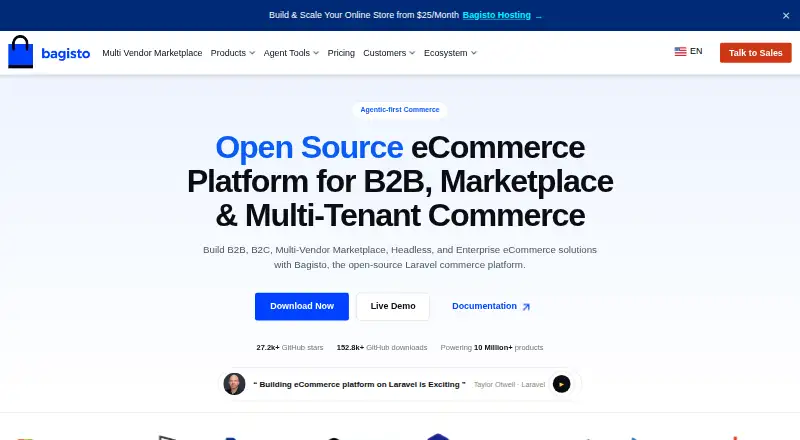
What Bagisto is
Bagisto is an open-source Laravel eCommerce platform for online stores, multi-vendor marketplaces, B2B commerce, and multi-tenant SaaS stores. It is self-hosted and supports web, Linux, Windows, and API environments. The free Bagisto plan is a self-hosted download listed as free; its stated minimums include PHP 8.3 or higher, MySQL 8.0.32 or higher or MariaDB 10.3 or higher, and at least 4 GB of RAM. Its headless setup separates storefront from backend, supporting frontends built with React, Vue, Angular, or Next.js. Retail POS can synchronize orders and inventory between physical outlets and the online store in real time. Bagisto supports digital products and multichannel sales and includes an app marketplace. Integrations cover marketplaces, payments, shipping, analytics, CRM, ERP, and PIM, with examples such as Amazon, eBay, PayPal, Stripe, FedEx, Google Analytics, and Akeneo. REST and GraphQL APIs cover cart, checkout, shipping, and payment. Deployment options include Composer installation, a source package, and cloud or AWS deployment.
Good
- Free, open-source Laravel eCommerce platform.
- Supports marketplaces, B2B, and multi-tenant stores.
- Headless storefronts can use React, Vue, Angular, or Next.js.
- Retail POS synchronizes orders and inventory in real time.
- REST and GraphQL APIs cover core commerce functions.
Watch out
- Requires self-hosted infrastructure and specified software.
- Requires at least 4 GB of RAM.
- Abandoned cart recovery is not available.
Who it suits
Bagisto may suit merchants and developers building self-hosted stores, marketplaces, or B2B commerce sites. Its headless options and APIs may also fit teams building custom storefronts.
Verdict
Bagisto combines store, marketplace, and B2B capabilities with headless options and commerce APIs. It is free to download, but requires a self-hosted environment that meets its stated requirements.
Plans and prices
From Bagisto's own pricing page, checked 4 Oct 2026.
| Plan | Price | What it gives you |
|---|---|---|
| Bagisto | Free | Free open-source download · self-hosted requirements: PHP 8.3+, MySQL 8.0.32+ or MariaDB 10.3+, 4 GB RAM or higher |
| Bagisto Open Source | Free | self-hosted Laravel eCommerce platform · source code included · no subscription fee |
The facts
Each one read from Bagisto's own pages, with the date it was checked.
What it does
- Abandoned cart recovery
- Nochecked 20 Sep 2026
- Access control
- Administrators can create roles with granular permissions and enable two-factor authentication.checked 15 Oct 2026
- API
- Bagisto exposes REST and GraphQL APIs with CRUD operations, pagination and token authentication.checked 15 Oct 2026
- API limits
- Shop API storefront keys default to 100 requests per minute, with configurable limits up to 5,000 or unlimited.checked 15 Oct 2026
- API package
- REST and GraphQL APIs are supplied through the separate Composer package bagisto/bagisto-api.checked 15 Oct 2026
- API use cases
- The APIs are documented for headless storefronts, mobile apps, third-party integrations, PWAs and custom admin interfaces.checked 15 Oct 2026
- Deployment
- The download page offers Composer installation, a source package, and cloud or AWS deployment options.checked 4 Oct 2026
- Digital products
- Yeschecked 20 Sep 2026
- Documentation
- Separate merchant and developer documentation covers setup, administration, extensions, integrations, themes, APIs and architecture.checked 15 Oct 2026
- Extensibility
- The developer architecture documents 42 feature packages inside packages/Webkul under a Laravel application shell.checked 15 Oct 2026
- Generative AI
- Magic AI can draft product descriptions, generate product images and translate reviews.checked 15 Oct 2026
- Headless
- Its headless platform separates the storefront from the backend and supports frontends built with React, Vue, Angular, or Next.js.checked 4 Oct 2026
- Hosting model
- self-hostedchecked 20 Sep 2026
- Installation
- Supported installation paths include Composer, a web installer and Docker production images.checked 15 Oct 2026
- Integrations
- Official integration listings cover Amazon, eBay, AliExpress, Walmart, PayPal, Stripe, Razorpay, Adyen, ShipRocket, FedEx, DHL, UPS, Google Analytics, Segment, Mixpanel and Hotjar.checked 15 Oct 2026
- International selling
- Bagisto documents 22 languages with right-to-left support, multiple currencies and exchange rates.checked 15 Oct 2026
- Inventory
- Inventory can be tracked across warehouses and physical stores.checked 15 Oct 2026
- Licence
- The Bagisto repository is released under the permissive MIT License.checked 15 Oct 2026
- Limit: learning curve
- Capterra reviewers say theme customization and advanced changes require developer knowledge and that documentation can be deeper.checked 15 Oct 2026
Where it runs
- App marketplace
- Yeschecked 20 Sep 2026
- Google Play app
- Bagisto Native Commerce is a Webkul Android shopping app with smart search, barcode and QR scanning, cart, checkout and website synchronization.checked 15 Oct 2026
The company
- Company identity
- LinkedIn lists Bagisto as a software-development company headquartered in Noida, Uttar Pradesh, founded in 2018, with 501–1,000 employees.checked 15 Oct 2026
- Headquarters
- Noida, Uttar Pradesh, Indiachecked 28 Sep 2026
Money
- Free plan
- Yeschecked 20 Sep 2026
The full review of Bagisto
Bagisto is an open-source commerce platform built on Laravel for businesses creating online stores, marketplaces, or B2B sites. It suits teams with the technical capacity to operate their own infrastructure and tailor the storefront. Its range of commerce models and APIs is a strong foundation, but self-hosting and the absence of abandoned cart recovery are meaningful trade-offs.
Overview
Bagisto supports multi-vendor marketplaces, B2B commerce, and multi-tenant SaaS stores alongside online retail. That breadth makes it more adaptable than a single-store solution for businesses with several sales models. It also supports multichannel selling, digital products, and an app marketplace. Abandoned cart recovery is not included, which may matter to retailers relying on automated follow-up to recapture incomplete orders.
The platform is self-hosted, so the software's free price does not remove the work of provisioning and maintaining a suitable environment. Composer installation, a source package, and cloud or AWS deployment options give technical teams several routes to get started, but do not turn Bagisto into a managed service.
Key features
Headless storefront and commerce APIs
Bagisto separates the storefront from the backend and supports frontends built with React, Vue, Angular, or Next.js. This is useful for teams that need control over the customer-facing experience; it is a less natural fit for operators who want a unified, turnkey storefront. REST and GraphQL APIs cover commerce functions including cart, checkout, shipping, and payment, giving custom frontends access to core transaction flows.
Retail, integrations, and security
Retail POS synchronizes orders and inventory in real time between physical outlets and the online store, a practical advantage for businesses managing both channels. Listed integrations span marketplaces, payments, shipping, analytics, CRM, ERP, and PIM, with examples including Amazon, eBay, PayPal, Stripe, FedEx, Google Analytics, and Akeneo.
Bagisto says sensitive data is encrypted in transit and at rest and describes its practices as GDPR-aligned and SOC 2 aligned. Version 2.4.0 adds two-factor authentication for administrators and upgrades bot protection to reCAPTCHA Enterprise. The headless platform page offers three months of free support, a useful initial window for teams adopting that setup.
Pricing
Bagisto — free. The plan is a free open-source download for self-hosting. Its stated requirements include PHP 8.3 or later, MySQL 8.0.32 or later or MariaDB 10.3 or later, and at least 4 GB of RAM. The broader environment requirements also call for Apache 2 or NGINX, a 1 GHz or faster processor, Node 18.12.0 LTS or later, and Composer 2.5 or later. This is a sensible option for teams able to supply that stack; readers seeking hosted infrastructure or a hands-off deployment should consider another approach.
Platforms
Bagisto supports web, Linux, Windows, API, and self-hosted environments. Its deployment model puts infrastructure responsibility on the operator, so platform breadth should not be mistaken for a hosted service.
Who it's for
Bagisto is best suited to technically capable businesses that need a customizable commerce foundation across retail, marketplace, B2B, or multi-tenant models. It is particularly compelling when a team wants to control its frontend and connect commerce workflows through APIs. It is a weaker fit for small operators who need managed hosting or built-in abandoned cart recovery without assembling and maintaining their own stack.
Pros and cons
- Pros: One open-source platform supports marketplaces, B2B, and multi-tenant SaaS stores, reducing the need to choose a narrow store model from the outset.
- Pros: Headless frontend choices, REST and GraphQL APIs, and a broad integration range give development teams room to shape storefronts and connect commerce systems.
- Pros: Retail POS synchronizes online and physical-store orders and inventory in real time, useful for merchants operating both channels.
- Cons: Self-hosting and substantial software and server requirements place setup and ongoing infrastructure duties on the business.
- Cons: Abandoned cart recovery is absent, leaving merchants who depend on that capability to find another solution.
Alternatives
Aimeos is another free, self-hosted option for teams comparing open-source commerce frameworks. Choose Medusa if a freemium platform with a paid Develop plan at $29 a month is a better fit. Sylius offers an open-source Standard edition and a Plus plan at €800 a year. Saleor has free Sandboxes for prototyping and development, with paid plans including Select at $1,599 a month. Solidus offers a free DIY Edition for customer-managed infrastructure. Unchained Engine is free and open source, with hosting infrastructure paid by the user. Commerce Layer offers a free Developer tier with limits including two users, two markets, and 100 free live orders per month. Vendure provides an open-source ecommerce framework under the GPLv3 license.
For broader comparisons, browse Headless Ecommerce Platforms or Ecommerce platforms.
Verdict
Choose Bagisto if your business needs a flexible open-source base for several commerce models and you have the technical resources to run it. Its headless options, APIs, and retail synchronization stand out without a software subscription. Look elsewhere if you need managed hosting or abandoned cart recovery as part of the platform.
Getting started
- Open the Bagisto website
- Choose Composer installation, the source package, or cloud or AWS deployment
- Prepare Apache 2 or NGINX with at least 4 GB RAM and a 1 GHz processor
- Install PHP 8.3 or higher with MySQL 8.0.32 or higher or MariaDB 10.3 or higher
- Install Node 18.12.0 LTS or higher and Composer 2.5 or higher
- Deploy the self-hosted application
Limits worth knowing
The free Bagisto plan is a self-hosted download, so you provide the required server environment. Its listed requirements include PHP 8.3+, MySQL 8.0.32+ or MariaDB 10.3+, and at least 4 GB RAM, plus the stated web server, processor, Node, and Composer requirements.
Questions
How much does Bagisto cost?
The Bagisto plan costs nothing. It is a free open-source download.
Where can Bagisto run?
Bagisto supports web, Linux, Windows, and API environments. Its hosting model is self-hosted.
Which frontend frameworks can its headless platform use?
The headless setup supports frontends built with React, Vue, Angular, or Next.js.
Does Bagisto provide commerce APIs?
Yes. REST and GraphQL APIs cover cart, checkout, shipping, payment, and other commerce functions.
What installation methods are available?
The download page offers Composer installation, a source package, and cloud or AWS deployment options.
Does Bagisto include abandoned cart recovery?
No. Abandoned cart recovery is not provided.
Alternatives to Bagisto
- 1

WooCommerce
Free planOpen sourceAndroidiOSWebAPI9.4From $29 a year - 2
nopCommerce
Free planOpen sourceAndroidiOSWebAPI9.4$499 one-time - 3

Sylius
Free planOpen sourceAndroidiOSWebAPI9.2From €800 a year - 4

Wix eCommerce
Free planAndroidiOSWebAPI8.9From $17.77 a month - 5

Payhip
Free planAndroidiOSWebAPI8.8From $29 a month - 6

Tiendanube
Free planAndroidiOSWebAPI8.8From 27,999 ARS a month