
Activepieces
Activepieces is an AI automation platform for teams creating workflows and AI agents with governance and security controls.
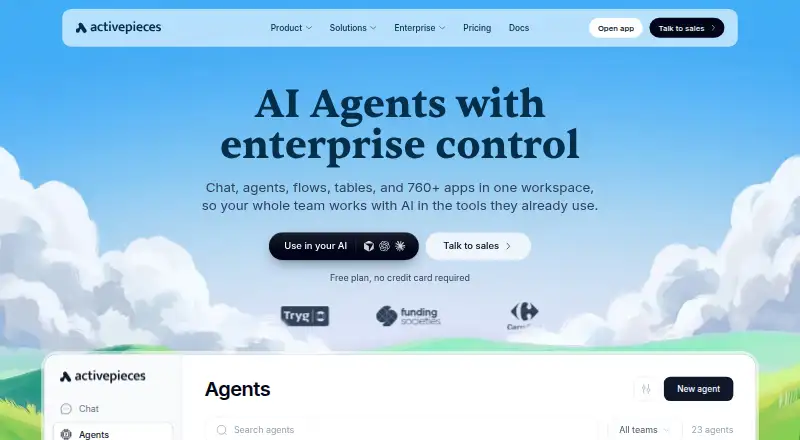
What Activepieces is
Activepieces is an AI automation platform for teams creating workflows and AI agents with governance and security controls. Users can describe a desired outcome in chat and have it build a flow or agent. Flows support branching, retries, waitpoints, subflows, error handling, human approvals, and inline TypeScript. The integrations catalog lists 764 pieces, including Gmail, Slack, OpenAI, Notion, Google Sheets, HubSpot, and Salesforce; integrations are included on every plan, including free cloud and self-hosted use. The platform can run on its cloud, customer infrastructure, or in an air-gapped environment. The company says customer automations, runs, documents, and prompts are not used to train models. Free costs nothing and includes 1,000 monthly credits and one user. Plus is $20 a month; Team is $200 a month. When Free credits run out, additional runs wait until the next day's refresh. It is available via web, API, and self-hosting.
Good
- Flows support branching, retries, and human approvals.
- 764 integrations are listed.
- Self-hosted and air-gapped deployment options are available.
- Integrations are included on every plan.
Watch out
- Free plan is limited to one user.
- Free runs wait when monthly credits run out.
Who it suits
It suits teams that want to build multi-step automations or AI agents and choose between cloud and self-hosting. The free tier is geared to a single user with a monthly credit limit.
Verdict
Activepieces combines workflow controls, a broad listed integration catalog, and several deployment options. Teams should account for the Free plan's one-user and credit limits.
Plans and prices
From Activepieces's own pricing page, checked 30 Sep 2026.
| Plan | Price | What it gives you |
|---|---|---|
| Free | Free | 1,000 credits a month · Unlimited flows · Just you · Community support · Free forever |
| Plus | $20 a month | 10,000 credits a month · Up to 5 users · Unlimited flows · $0.007/credit over quota · $20/mo |
| Team | $200 a month | 50,000 credits a month · 25 users · Unlimited flows · Unlimited projects · Email support · $200/mo |
| Embed | $36,000 a year | White-label builder · One SDK · Your pieces and templates · From $36k a year |
| Enterprise control | Priced on request | Self-hosted or air-gapped · SSO and SCIM · Custom RBAC · Audit logs · Secret managers · Custom |
| Ultimate | Priced on request | Credits sized to you, yearly · Unlimited users and flows · Dedicated workers · Dedicated support · Custom |
The facts
Each one read from Activepieces's own pages, with the date it was checked.
What it does
- AI and MCP
- Connected apps can be exposed through one Activepieces MCP server for use by Claude, Cursor, Windsurf, and other MCP clients.checked 30 Sep 2026
- Chat-built automation
- Users can describe an outcome in chat and have Activepieces build a flow or agent.checked 30 Sep 2026
- Conditional logic
- Yeschecked 20 Sep 2026
- Credential handling
- Agents reference connections by name, and the platform resolves credentials inside the worker while a step runs.checked 30 Sep 2026
- Data use
- The company says customer automations, runs, documents, and prompts are never used to train models.checked 30 Sep 2026
- Deployment
- Activepieces can run on its cloud, on customer infrastructure, or in an air-gapped environment.checked 30 Sep 2026
- Integration pricing
- Every piece is included on every plan, including the free cloud tier and self-hosted deployments.checked 30 Sep 2026
- Integrations
- The integrations catalog lists 764 pieces, including Gmail, Slack, OpenAI, Notion, Google Sheets, HubSpot, and Salesforce.checked 30 Sep 2026
- Minimum run interval
- 5_minuteschecked 20 Sep 2026
- Multi-step workflows
- Yeschecked 20 Sep 2026
- Native connectors
- 764checked 20 Sep 2026
- Paid from
- 20checked 20 Sep 2026
- Product
- Activepieces is an AI automation platform for teams to build workflows and AI agents with governance and security controls.checked 30 Sep 2026
- Regions
- Activepieces Cloud runs in Frankfurt by default, with other regions available on request; self-hosted deployments can use a region the customer chooses.checked 30 Sep 2026
- Security
- The security page states that the platform has SOC 2 Type 2, AES-256 encryption at rest, TLS in transit, and a 2026 penetration test.checked 30 Sep 2026
- Self-hosting requirement
- The recommended Docker Compose self-hosting install requires Docker Compose v2 and at least 2 vCPU and 4 GB RAM.checked 30 Sep 2026
- Support
- The pricing page lists community support for Free and Plus, email support for Team, and dedicated support for Ultimate.checked 30 Sep 2026
- Webhook triggers
- Yeschecked 20 Sep 2026
- Workflow capabilities
- Flows support branching, retries, waitpoints, subflows, error handling, human approvals, and inline TypeScript.checked 30 Sep 2026
Money
- Free plan
- Yeschecked 20 Sep 2026
- Free-plan limits
- The Free plan has 1,000 credits and one user; when credits run out, additional runs wait until credits refresh the next day.checked 30 Sep 2026
The full review of Activepieces
Overview
Activepieces is an automation platform for building team workflows and AI agents, with options to run it in the cloud or on your own infrastructure. It suits teams that need branching workflows, integrations, and tighter control over deployment and credentials.
Flows can be built by describing an outcome in chat, then shaped with branching, retries, waitpoints, subflows, error handling, human approvals, and inline TypeScript. That range makes Activepieces more than a simple connector tool: teams can handle exceptions and approval steps as part of an automation. The trade-off is that its Free plan is for one user and pauses additional runs when its monthly credits run out.
Key features
The catalog contains 764 integrations, including Gmail, Slack, OpenAI, Notion, Google Sheets, HubSpot, and Salesforce. Every piece is included on every plan, including Free and self-hosted deployments, so integration access does not require upgrading. Multi-step workflows, conditional logic, and webhook triggers support automations that respond to events and route work through different paths. The minimum run interval is five minutes, which makes it a poor fit for tasks that require more frequent scheduled runs.
Connected apps can be exposed through one Activepieces MCP server to Claude, Cursor, Windsurf, and other MCP clients. Agents refer to connections by name; credentials are resolved inside the worker while a step runs. Activepieces says customer automations, runs, documents, and prompts are not used to train models. Its security page states SOC 2 Type 2, AES-256 encryption at rest, TLS in transit, and a 2026 penetration test.
Deployment is flexible: use Activepieces Cloud, customer infrastructure, or an air-gapped environment. Cloud runs in Frankfurt by default, with other regions available on request; self-hosted deployments can use a customer-chosen region. The recommended Docker Compose installation requires Docker Compose v2, at least 2 vCPU, and 4 GB RAM, so self-hosting brings infrastructure responsibility as well as control.
Pricing
The Free plan costs nothing, forever. It includes 1,000 credits a month, unlimited flows, one user, and community support. That is enough to explore or run modest personal automations, but it is restrictive for a team: there is no second seat, and runs wait until credits refresh the next day once the monthly allowance is exhausted.
Plus costs $20 a month and includes 10,000 credits a month, up to five users, unlimited flows, and community support. Additional usage is $0.007/credit over quota. It is the practical step up for small teams that need shared access and more volume, though the over-quota charge makes high or unpredictable usage worth monitoring.
Team costs $200 a month for 50,000 credits a month, 25 users, unlimited flows, unlimited projects, and email support. It suits teams that need project separation and a larger shared allowance; the price jump from Plus is substantial, so smaller groups should weigh the extra seats and projects against their actual usage.
Ultimate has custom pricing and includes unlimited users and flows, with dedicated support. Embed has custom pricing and includes 760+ integrations. Enterprise control has custom pricing and includes SSO and SCIM, custom RBAC, audit logs, and secret managers. These are options for broader deployment or governance needs rather than low-cost extensions of the entry plans. There is no free trial.
Platforms
Activepieces is available on web and API, and can be self-hosted. Its cloud option reduces the need to run infrastructure, while self-hosting offers control over deployment location, including air-gapped use. The latter is best for organizations able to meet the stated Docker Compose, CPU, and memory requirements.
Who it's for
Activepieces is a strong fit for teams building multi-step automations that need branching, human approvals, or AI agents alongside broad app connectivity. It is particularly compelling when deployment location, credential handling, or model-training boundaries matter. Solo users can start free, but the one-user cap, 1,000-credit allowance, and five-minute minimum run interval rule it out for larger teams or time-sensitive schedules. Organizations that want a hosted, lower-maintenance setup can use its cloud; those that need infrastructure control should be prepared to operate a self-hosted deployment.
Pros and cons
- Pros: All 764 catalog integrations are included on every plan, so moving to self-hosted or Free does not narrow connector access.
- Pros: Branching, retries, approvals, and error handling allow flows to cover exceptions rather than only straight-through tasks.
- Pros: Cloud, self-hosted, and air-gapped deployment options accommodate different infrastructure and data-control requirements.
- Cons: Free is limited to one user and 1,000 monthly credits; after exhaustion, runs wait for the next day's refresh.
- Cons: The five-minute minimum run interval is too slow for automations that need more frequent scheduled execution.
- Cons: The recommended self-hosting setup requires Docker Compose v2 and at least 2 vCPU and 4 GB RAM, making it a managed-infrastructure choice rather than a zero-operations option.
Alternatives
Consider Camunda if its self-managed development plan and broader listed platform support better match your development environment; its free plan covers local development and testing, while production usage is also listed.
Relevance AI is another freemium web option; its Free plan includes 100 credits per day, one user, and 10MB of knowledge, making it worth comparing if those limits suit your workload.
Latenode offers a free plan with 10,000 CPU seconds per month, five active workflows, and one parallel execution. Pick it if those execution limits are a better fit for your needs.
n8n is a freemium alternative with a self-hosted Community Edition available through GitHub; consider it if that distribution model is your priority.
Flowable offers Apache 2.0-licensed engines written in Java, making it the alternative to consider when that open-source engine foundation matters.
Flozic has a $9 a month Standard plan with 8,000 tasks a month, 40 AI agents, and a five-minute run interval; compare it if those task and agent allowances fit your use.
Vellum offers a free tier with first tasks included and pay-as-you-go credits, plus a $30 a month Mighty plan; consider it if that pricing structure better matches your starting workload.
Tray.ai is a paid alternative with a free trial and plans that include workspace and insights allowances; compare it if those controls are more relevant to your team.
Browse more options in AI Workflow Automation Software, Task Automation Software, Integration Platform as a Service Software, and Workflow automation tools.
Verdict
Choose Activepieces if your team wants flexible workflow logic, a large integration catalog included across plans, and meaningful deployment and security controls. Its main advantage is combining those controls with cloud, self-hosted, and air-gapped options; look elsewhere if you need more frequent than five-minute runs, a generous shared free tier, or a simpler self-hosting commitment.
Getting started
- Open the Activepieces website
- Choose Activepieces Cloud or a self-hosted deployment
- For self-hosting, prepare Docker Compose v2 with at least 2 vCPU and 4 GB RAM
- Create an account or configure the deployment
- Describe an automation in chat or build a flow with connectors
Limits worth knowing
Free includes 1,000 credits per month and one user. When credits run out, additional runs wait until credits refresh the next day. Plus provides 10,000 credits and up to five users for $20 a month; Team provides 50,000 credits and 25 users for $200 a month.
Questions
Is Activepieces free?
Yes. The Free plan costs nothing and includes 1,000 credits monthly for one user.
What does Plus cost?
Plus costs $20 a month and includes 10,000 credits monthly and up to five users.
Which platforms are supported?
Activepieces is available on the web, through an API, and as a self-hosted deployment.
Are integrations included in the free plan?
Yes. Every piece is included on every plan, including the free cloud tier and self-hosted deployments.
Can Activepieces run in an air-gapped environment?
Yes. It can run in its cloud, on customer infrastructure, or in an air-gapped environment.
Alternatives to Activepieces
- 1

Make
Free planAndroidiOSWebAPI8.9From $9 a month - 2

Kestra
Free planOpen sourceWebAPILinuxmacOS8.7Free plan - 3

Azure Logic Apps
Free planWebAPILinuxmacOS8.7Free plan - 4

Informatica Intelligent Data Management Cloud
Free planWebAPIExtensionLinux8.6From £26,550 a year - 5
Workato Agent Studio
Free planiOSWebAPILinux8.6Free plan - 6

Nango
Free planOpen sourceWebAPISelf-hosted8.4Free plan