Zotero
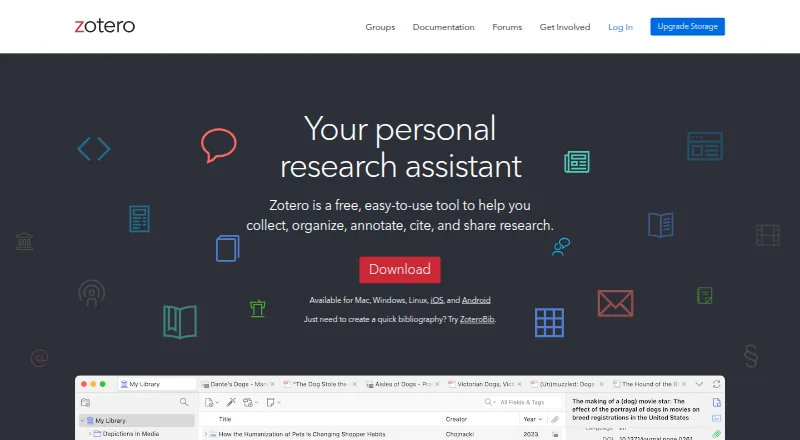
Zotero is a free, open-source tool for collecting, organizing, annotating, citing, and sharing research.
What Zotero is
Zotero is a free, open-source tool for collecting, organizing, annotating, citing, and sharing research. Its browser Connector can identify research items while browsing and save them to a library. Collections, keyword tags, and saved searches help organize material; a PDF reader and note editor support document work. Zotero offers more than 9,000 citation styles and integrates with Microsoft Word, LibreOffice, and Google Docs.
The desktop app stores research locally by default, and syncing is optional. Optional Zotero Storage syncs PDFs, images, web snapshots, and other files across devices and gives access through an online library. Libraries can be shared with any number of people at no cost, and groups support shared collections. Zotero says synced data is encrypted in transit and newly created accounts' data is encrypted at rest with AES-256. The data server is open source, but self-hosting can be technically challenging and is not supported by Zotero.
Good
- Free, open-source research tool.
- Supports over 9,000 citation styles.
- Integrates with Word, LibreOffice, and Google Docs.
- Library sharing has no cost limit on people.
Watch out
- Free storage is limited to 300 MB.
- Self-hosting is technically challenging and unsupported.
Who it suits
Zotero suits researchers and cultural heritage institutions organizing sources and citations. It also supports shared libraries and groups, with optional storage syncing across devices.
Verdict
Zotero combines source capture, organization, PDF annotation, and citation tools, with optional syncing and shared libraries. The free plan includes 300 MB; users needing more storage can choose paid plans starting at $20/year.
Plans and prices
From Zotero's own pricing page, checked 14 Oct 2026.
| Plan | Price | What it gives you |
|---|---|---|
| Free storage | Free | 300 MB storage · desktop app free |
| 300 MB | Free | 300 MB storage · Free |
| 2 GB | $20 a year | 2 GB storage · $20/year (equal to $1.67 per month) |
| 2 GB storage | $20 a year | 2 GB storage · $20/year (equal to $1.67 per month) |
| 6 GB storage | $60 a year | 6 GB storage · $60/year (equal to $5 per month) |
| 6 GB | $60 a year | 6 GB storage · $60/year (equal to $5 per month) |
| Unlimited | $120 a year | Unlimited storage · $120/year (equal to $10 per month) |
| Unlimited storage | $120 a year | Unlimited storage · $120/year (equal to $10 per month) |
The facts
Each one read from Zotero's own pages, with the date it was checked.
What it does
- API
- The Web API uses HTTPS at api.zotero.org, while the desktop client exposes a local API at localhost:23119/api/.checked 14 Oct 2026
- API authentication
- Web API access supports API keys and OAuth 1.0a; Zotero 10 local write requests require a local API key.checked 14 Oct 2026
- Citation styles
- Zotero supports more than 9,000 citation styles and can create references and bibliographies inside Word, LibreOffice, and Google Docs.checked 14 Oct 2026
- Citation tools
- Zotero supports over 9,000 citation styles and integrates with Microsoft Word, LibreOffice, and Google Docs.checked 29 Sep 2026
- Collaboration
- Users can share a Zotero library with as many people as they like at no cost, and groups support shared collections.checked 29 Sep 2026
- Connector requirements
- Connector support covers current Chrome and Edge, Firefox 115+, and Safari 18+ on macOS 13 Ventura or later.checked 14 Oct 2026
- Data location
- Zotero states that its server data is stored in the United States in AWS us-east-1.checked 29 Sep 2026
- Documentation and support
- Documentation is extensive and most support is public through forums where developers and community experts answer questions.checked 14 Oct 2026
- Extensibility
- Community plugins add features and integrations, but plugins have full access to Zotero and the computer and there is no official directory yet.checked 14 Oct 2026
- Google Docs integration
- The Google Docs connector inserts and refreshes citations and bibliographies and supports more than 10,000 styles.checked 14 Oct 2026
- Groups
- Group libraries support co-writing, course-material distribution, and shared bibliographies without an extra group fee.checked 14 Oct 2026
- Intended audience
- Zotero is developed for researchers and cultural heritage institutions by a global community.checked 29 Sep 2026
- License
- Zotero source code is released under AGPLv3 unless a source file states otherwise.checked 14 Oct 2026
- Limit: interface and learning curve
- Reviewers mention dated aesthetics, a learning curve, and the need for more self-training to use Zotero effectively.checked 14 Oct 2026
- Limit: metadata and collaboration
- TrustRadius reviews cite imperfect metadata extraction from some academic sites and a desire for stronger shared-library functionality.checked 14 Oct 2026
- Limit: mobile maturity
- Reviewers report that the iPad app needs more iteration and that formatted desktop notes are not fully supported on iPad.checked 14 Oct 2026
- Limit: Word Online
- A Trustpilot reviewer says Zotero does not work with Word Online.checked 14 Oct 2026
- Organization
- Libraries can be arranged with collections, keyword tags, and saved searches that update automatically.checked 14 Oct 2026
- PDF and EPUB reading
- Zotero provides readers for PDFs and EPUB files with highlighting, notes, images, and ink annotations.checked 14 Oct 2026
- PDF tools
- Zotero includes a PDF reader and note editor.checked 29 Sep 2026
The company
- Company facts
- LinkedIn lists Digital Scholar as a nonprofit founded in 2009, headquartered in Falls Church, Virginia, with 11–50 employees.checked 14 Oct 2026
- Maker organization
- Zotero is a project of the nonprofit Corporation for Digital Scholarship, created at George Mason University's Roy Rosenzweig Center with foundation funding.checked 14 Oct 2026
Money
- Limit: free storage
- Reviewers complain that the free cloud quota is small, particularly once PDF collections grow.checked 14 Oct 2026
Where it runs
- Platforms
- Zotero offers downloads for Windows, macOS, Linux, iOS, and Android, and a browser Connector for desktop browsers.checked 29 Sep 2026
The full review of Zotero
Overview
Zotero is a reference manager for building a research library from web sources, PDFs, and other materials. It suits researchers who want capture, reading, organization, and citations in one open-source tool. Its strongest case is a flexible library and broad citation support; its main trade-off is that storing files across devices can require a paid plan.
The desktop app keeps research locally by default, with syncing optional. Zotero also fits the Citation Management Software and Reference Management Software categories.
Key features
- Browser capture: The Zotero Connector recognizes research items as you browse and saves them to your library, reducing the work of collecting sources manually.
- Library organization: Collections, keyword tags, and saved searches offer useful ways to group and retrieve material as a library grows.
- PDF reading and annotation: A built-in PDF reader and note editor keep reading and note-taking alongside references.
- Citations: Support for over 9,000 citation styles and integration with Microsoft Word, LibreOffice, and Google Docs make Zotero a strong fit for varied academic writing requirements.
- Sync and online access: Optional Zotero Storage syncs PDFs, images, web snapshots, and other files across devices and makes them accessible through the online library. The free tier's 300 MB can be restrictive for people who keep many files with their references.
- Sharing and groups: A library can be shared with any number of people at no cost, and groups support shared collections. That makes collaboration possible without buying seats.
- Privacy and self-hosting: Desktop data stays local unless syncing is enabled. Data sent to Zotero is encrypted in transit; data for newly created accounts is encrypted at rest with AES-256. Server data is stored in AWS us-east-1 in the United States. The open-source data server can be run locally, but Zotero warns this is technically challenging and does not support such installations.
- API and imports: The Web API defaults to version 3, recommended for new development. Zotero supports a wide range of import formats, including BibTeX, RIS, EndNote XML, MARC, MEDLINE/nbib, and Zotero RDF.
Pricing
Zotero is freemium. The free plan includes 300 MB of storage, and library sharing has no per-person charge. Storage plans add room for synced files; choose based on how much material you need available across devices.
- 300 MB: free (billed Free). Best for users whose synced files fit within the cap; larger libraries may need to store files elsewhere or upgrade.
- 2 GB: $20 a year (billed $20/year (equal to $1.67 per month)). A modest step up for users who need more than the free allowance without paying for a large archive.
- 6 GB: $60 a year (billed $60/year (equal to $5 per month)). Suits users with a larger collection of synced PDFs and other files.
- Unlimited: $120 a year (billed $120/year (equal to $10 per month)). The straightforward option for users who do not want to manage a storage quota.
The paid tiers change storage capacity; Zotero's no-cost library sharing is useful for groups regardless of tier. The free plan is less suitable when cross-device access to a sizable file collection is essential.
Platforms
Zotero is available on Android, iOS, Linux, macOS, and Windows, as well as on the web. It also offers a browser extension, an API, and a self-hosted option. The self-hosted server is open source, but running it locally can be technically challenging and is not supported by Zotero.
Who it's for
Zotero is a strong choice for researchers and cultural heritage institutions that need to collect sources, organize a reference library, annotate PDFs, and produce citations in common writing applications. It also suits groups that want shared collections without a per-person library-sharing charge. Readers who need substantial synced file storage should budget for a paid tier; those who require a supported, straightforward self-hosted server should look elsewhere.
Pros and cons
- Pro: Over 9,000 citation styles and integrations with Word, LibreOffice, and Google Docs cover a broad range of writing workflows.
- Pro: No-cost library sharing for any number of people makes collaboration accessible without seat charges.
- Pro: Local-by-default storage and optional syncing give users control over whether research is sent to Zotero's servers.
- Con: The free plan's 300 MB storage cap may not cover a large collection of synced PDFs and other files.
- Con: Self-hosting is technically challenging and unsupported, so it is not a practical route for everyone seeking server control.
- Con: Most support takes place in public Zotero Forums, which may not suit users who want another support channel.
Alternatives
- Mendeley Reference Manager is worth considering if its free plan's 2GB storage is a better fit for your file needs; it also includes five Reading Assistant questions.
- EndNote may suit users who prefer a one-time purchase: its Upgrade License is $94, paid once, with the offer shown for EndNote 21 or earlier users and EndNote 2025.
- Sciwand is another freemium option, with core reading, organizing, and writing tools free and AI free for seven days.
- JabRef is a free, open-source alternative for readers who want software with no paid plan.
- Lean Library Workspace may fit users who want a free basic plan for up to three projects, with up to three invitations per shared project.
- Bookends is an alternative for readers looking for reference-management software on iOS or macOS.
- Petal offers a free plan with 1 GB cloud storage, one seat, three guests, and two collections; citation export is not included in that tier.
- ReadCube Papers is a paid alternative with a free trial and an Essentials plan priced at $10 a month.
Verdict
Choose Zotero if you want an open-source research library that links source capture, PDF work, collaboration, and extensive citation support, especially if local storage and optional syncing matter to you. Its no-cost sharing is a clear advantage for groups. Look elsewhere if 300 MB is too little and paid storage does not fit your budget, or if you need a supported self-hosted server.
Getting started
- Visit https://www.zotero.org/.
- Choose among the Android, iOS, Linux, macOS, web, or Windows options, or use the browser extension.
- Use the browser Connector to save research items to a library.
- Organize items with collections, keyword tags, or saved searches.
- Use the PDF reader, note editor, and citation integrations as needed.
- Keep the desktop library local or enable optional syncing with a Zotero Storage plan.
Limits worth knowing
The free plan includes 300 MB of storage. Paid plans provide 2 GB for $20/year, 6 GB for $60/year, or unlimited storage for $120/year.
Questions
Is Zotero free?
Yes.
What does Zotero Storage cost?
Plans are 2 GB for $20/year, 6 GB for $60/year, and unlimited storage for $120/year.
Which platforms does Zotero support?
Listed platforms include Android, iOS, Linux, macOS, web, Windows, an API, browser extension, and self-hosted options.
Is Zotero open source?
Yes. Zotero is open source, and its data server can be run locally, though self-hosting can be technically challenging and is unsupported by Zotero.
Can Zotero be used with word processors?
Yes. It integrates with Microsoft Word, LibreOffice, and Google Docs.
Can I share a Zotero library?
Yes. You can share a library with any number of people at no cost, and groups support shared collections.
Alternatives to Zotero
- 1
Sciwand
Free planiOSExtensionLinuxmacOS7.7$29.99 one-time - 2
refbase
Free planOpen sourceWebAPILinuxmacOS7.5Free plan - 3
Avidemux
Free planOpen sourceWebLinuxmacOSWindows7.3Free plan - 4

JabRef
Free planOpen sourceAPIExtensionLinuxmacOS7.3Free plan - 5

Mendeley Reference Manager
Free planWebExtensionLinuxmacOS7.2From $55 a year - 6
ReadCube Papers
AndroidiOSWebAPI7.2From $95 a year