Sciwand
Sciwand is a desktop app for reference management, document reading, research analysis, and academic writing.
What Sciwand is
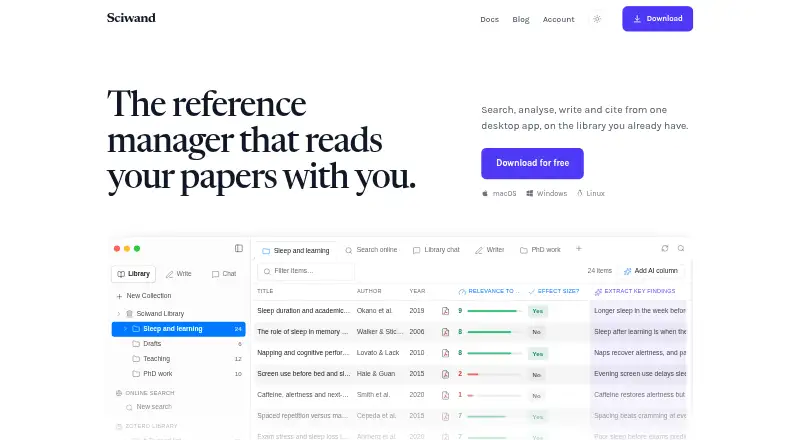
Sciwand is a desktop app for reference management, document reading, research analysis, and academic writing. Its AI columns can score papers, screen them as yes or no, extract findings, and build structured datasets across documents. Library chat answers cite source sentences and point to the relevant page. Users can search academic databases and screen results with AI. A Markdown writer supports more than 10,000 citation styles; the Microsoft Word add-in for Windows and macOS is described as being in beta. Supported documents include PDF, Word, EPUB, Markdown, plain text, and saved web pages. Sciwand syncs one-way with Zotero, EndNote, Mendeley, and Bookends without modifying the existing reference library. The site says library files, notes, and annotations stay on the user's disk, with optional configurable cloud sync. Hosted AI sends request text to the provider whose key the user supplies; local models send nothing to a provider. The Free plan costs nothing, billed forever, with core reading, organizing, and writing tools; AI is free for seven days. The Lifetime license costs $29.99, paid once and requires users to bring their own API key for AI features, or use local models.
Good
- AI columns can screen and extract findings across papers.
- Library chat cites source sentences and relevant pages.
- Supports multiple document and reference-import formats.
- Library, notes, and annotations are stored on the user's disk.
- Free plan includes core reading, organizing, and writing tools.
Watch out
- AI is free for seven days on the Free plan.
- Lifetime AI use requires an API key or local models.
- Word add-in is described as being in beta.
Who it suits
Sciwand suits researchers working on literature reviews, paper screening, source analysis, and academic writing. It may fit users who want local library storage and configurable cloud sync or who use reference libraries it can sync one-way.
Verdict
Sciwand combines reading, reference organization, analysis, and writing with AI features for research workflows. The free tier retains core tools, while ongoing AI use on the Lifetime license depends on a user-supplied key or local models.
Plans and prices
From Sciwand's own pricing page, checked 14 Oct 2026.
| Plan | Price | What it gives you |
|---|---|---|
| Free | Free | 9+ academic databases · data tables · PDF annotation · literature graphs · Markdown writer · 10,000+ citation styles · AI full access for 7 days · forever |
| Lifetime | $29.99, paid once | Unlimited AI · own API key · provider costs paid directly · lifetime updates · one payment |
The facts
Each one read from Sciwand's own pages, with the date it was checked.
What it does
- Academic search
- It searches ten academic databases, including PubMed, Google Scholar, arXiv, Semantic Scholar, Europe PMC, OpenAlex, Crossref, CORE and the Library of Congress.checked 14 Oct 2026
- AI analysis
- AI columns can score papers, screen them yes or no, extract findings and create structured datasets across documents.checked 2 Oct 2026
- AI payment model
- For the lifetime AI licence, users bring their own API key and pay AI providers directly; the site also says local models can be used.checked 2 Oct 2026
- AI privacy
- The site says hosted AI sends the text needed for a request to the provider whose key the user supplied; local models send nothing to a provider.checked 2 Oct 2026
- AI providers
- Supported provider connections include OpenAI, Anthropic Claude, Google Gemini, DeepSeek, xAI Grok, OpenRouter, Ollama and LM Studio.checked 14 Oct 2026
- AI screening
- AI columns can score, classify, summarize and extract structured information from papers and search results.checked 14 Oct 2026
- Audience
- The site presents Sciwand as research tooling and describes use cases including literature review, paper screening, source analysis and academic writing.checked 2 Oct 2026
- Auto-updates
- The application checks the GitHub repository at launch, downloads updates in the background and applies them after restart.checked 14 Oct 2026
- Citation traceability
- Citations can open the source PDF at the page containing the supporting sentence.checked 14 Oct 2026
- Cited answers
- The site says library chat answers cite source sentences and let users jump to the relevant page in a paper.checked 2 Oct 2026
- Cloud sync
- Cloud sync is optional and configurable by category; the GitHub README describes it as third-party hosted with free and paid tiers planned.checked 14 Oct 2026
- Custom endpoint
- The documentation lists a custom endpoint option for chat-model connections.checked 14 Oct 2026
- Datasets
- The dataset mode creates multiple rows from one paper, such as patients, study arms or experimental conditions.checked 14 Oct 2026
- Data storage
- The privacy policy says libraries, PDFs, annotations, embeddings, notes and prompts remain on the user's computer and are not stored on Sciwand servers.checked 14 Oct 2026
- Development stage
- The repository describes Sciwand as a public alpha and warns users to expect rough edges and error messages.checked 14 Oct 2026
- Document writer
- The built-in writer supports inline citations, bibliography generation, figures, tables and more than 10,000 citation styles.checked 14 Oct 2026
- File formats
- Sciwand reads PDFs, Word files, EPUB, Markdown, plain text and saved web pages.checked 14 Oct 2026
- File support
- Sciwand accepts PDF, Word, EPUB, Markdown, plain text and saved web pages.checked 2 Oct 2026
- Installers
- Downloads are provided as a universal macOS DMG, Windows x64 installer and Linux AppImages for x86_64 and arm64.checked 14 Oct 2026
- Integrations
- Sciwand syncs one-way with Zotero, EndNote, Mendeley and Bookends, leaving the existing reference library unmodified.checked 2 Oct 2026
- Latest release
- GitHub lists Sciwand v0.12.0 as released on 31 August 2026.checked 14 Oct 2026
The company
- Company
- AA1 Labs describes itself as an independent software studio based in Newcastle, United Kingdom.checked 14 Oct 2026
- Company ownership context
- AA1 Labs says the retired ZotAI product became part of Sciwand while preserving Zotero connectivity.checked 14 Oct 2026
- Company product date
- AA1 Labs lists Sciwand as active from May 2026.checked 14 Oct 2026
The full review of Sciwand
Overview
Sciwand is a desktop research app for reading papers, managing references, analysing sources and writing academic work. It is best for researchers handling literature reviews or paper screening who want those tasks in one workflow. Its breadth is appealing, but its ongoing AI use on the Lifetime plan requires a provider key or local models.
Key features
Sciwand searches academic databases within the app and can use AI to screen search results. That can help focus a literature search, while leaving the researcher responsible for deciding which papers belong in the final review.
Across a library, AI columns can score papers, mark screening decisions yes or no, extract findings and create structured datasets. Library chat answers cite source sentences and link to the relevant page, which gives readers a way to check an answer against its paper. These features suit source comparison and review work better than a workflow centred on occasional reading.
The built-in Markdown writer supports more than 10,000 citation styles. A Microsoft Word add-in for Windows and macOS is in beta, so researchers who depend on Word should weigh that less-settled route against the built-in writer. Sciwand accepts PDF, Word, EPUB, Markdown, plain text and saved web pages, and supports PDF annotation.
One-way syncing with Zotero, EndNote, Mendeley and Bookends leaves those existing libraries unmodified. The library, annotations and notes are stored on the user's disk; optional cloud sync can be configured by category. For AI requests, hosted processing sends the necessary text to the provider associated with the user's key, while local models send nothing to a provider.
Pricing
The Free plan costs nothing, billed forever. It includes core reading, organizing and writing tools, with AI free for 7 days. That makes it a practical way to keep the main research workflow without a continuing software charge, but ongoing AI use is not included.
Lifetime costs $29.99, paid once, billed as one payment, and includes unlimited AI features and lifetime updates. The licence does not cover AI provider charges: users bring their own API key and pay providers directly, or use local models. Researchers should account for that ongoing AI cost or setup, even though the software licence itself is a one-time payment. A licence can be moved to a new computer by deactivating the old device, and device coverage can be upgraded by paying the difference.
Platforms
Sciwand is available for iOS, Linux, macOS and Windows. The Word add-in is for Windows and macOS and remains in beta.
Who it's for
Sciwand is aimed at researchers doing literature reviews, paper screening, source analysis and academic writing. It is a strong fit when the value lies in moving between a reference library, analysis tools and citation-aware drafting. Readers seeking only a straightforward reference manager may not need its broader AI workflow, and those unwilling to supply an API key or use local models should not choose Lifetime for ongoing AI.
Pros and cons
- Pros: Reading, reference organization, analysis and writing share one app, reducing the need to split a research workflow across separate tools.
- Pros: AI answers cite source sentences and point to the relevant paper page, helping researchers verify claims.
- Pros: Local library storage and optional category-based cloud sync give users control over where their research materials are stored.
- Cons: Lifetime's unlimited AI features still require a user-supplied key and provider payments, or local models.
- Cons: The Word add-in is in beta, which makes it a less settled choice for Word-dependent drafting.
- Cons: The Free plan's AI allowance lasts only 7 days, so continued AI-assisted work requires another arrangement.
Alternatives
For a reference-management comparison, see Reference Management Software or Citation Management Software.
- Zotero is a freemium option with a free plan, 300 MB storage on its free tier and apps across mobile, desktop, web and other listed platforms; choose it if those platform options and storage-based plans better suit your reference workflow.
- Mendeley Reference Manager offers a free plan with 2GB storage and five Reading Assistant questions; it may suit readers who want a reference manager with a defined free storage allowance.
- JabRef is free and open-source with no paid plan; choose it if that model is a better fit.
- Lean Library Workspace has a free basic plan capped at three projects and three invitations per shared project; consider it if that project-sharing setup fits your needs.
- Logically has a free plan with daily AI limits and 100MB of reference and file storage; it may fit users whose needs fall within those caps.
- Qiqqa offers a Premium plan shown at $6.67 a month and is available on Android, self-hosted, web and Windows; compare it if those platforms are a priority.
- Databyss is a free, non-commercial open-source application; it may suit users seeking that model.
- Petal has a free plan with one seat, 1 GB cloud storage and 400 AI credits; consider it if those limits fit your work.
Verdict
Choose Sciwand if your research involves screening and comparing papers and you want analysis, reading, references and citation-aware writing together. Its strongest case is the connected workflow, supported by source-linked answers and local library storage. Look elsewhere if you want ongoing AI included without separate provider costs or prefer a mature Word integration.
Getting started
- Open the Sciwand website
- Download the app for Windows, macOS, or Linux
- Install the iOS app if needed
- Choose the Free plan or Lifetime license
- Import references using BibTeX, RIS, Zotero, Mendeley, EndNote, or Citavi
- Add documents such as PDFs, Word files, EPUB, Markdown, text, or saved web pages
- Connect a hosted AI provider key or use a local model
Limits worth knowing
The Free plan includes AI for seven days; its core reading, organizing, and writing tools remain free forever. The Lifetime license requires users to bring their own API key for hosted AI, while local models are also available.
Questions
Is Sciwand free?
Yes. The Free plan costs nothing, is billed forever, and includes core reading, organizing, and writing tools. AI is free for seven days.
What does Lifetime cost?
The Lifetime license costs $29.99, paid once, billed as one payment, with unlimited AI features and lifetime updates.
Which operating systems are supported?
Sciwand supports iOS, Linux, macOS, and Windows.
Does it work with Microsoft Word?
A Microsoft Word add-in for Windows and macOS is described as being in beta.
How is AI paid for?
For the Lifetime AI license, you provide your own API key and pay AI providers directly. Local models can be used instead.
Is cloud storage required?
No. The library, annotations, and notes are stored on the user’s disk, while cloud sync is optional and configurable by category.
Alternatives to Sciwand
- 1
Zotero
Free planOpen sourceAndroidiOSWebAPI8.6From $20 a year - 2
refbase
Free planOpen sourceWebAPILinuxmacOS7.5Free plan - 3
Avidemux
Free planOpen sourceWebLinuxmacOSWindows7.3Free plan - 4

JabRef
Free planOpen sourceAPIExtensionLinuxmacOS7.3Free plan - 5

Mendeley Reference Manager
Free planWebExtensionLinuxmacOS7.2From $55 a year - 6
ReadCube Papers
AndroidiOSWebAPI7.2From $95 a year