
Zluri
Zluri is an identity governance platform that helps organizations discover, manage, and govern identities and applications.
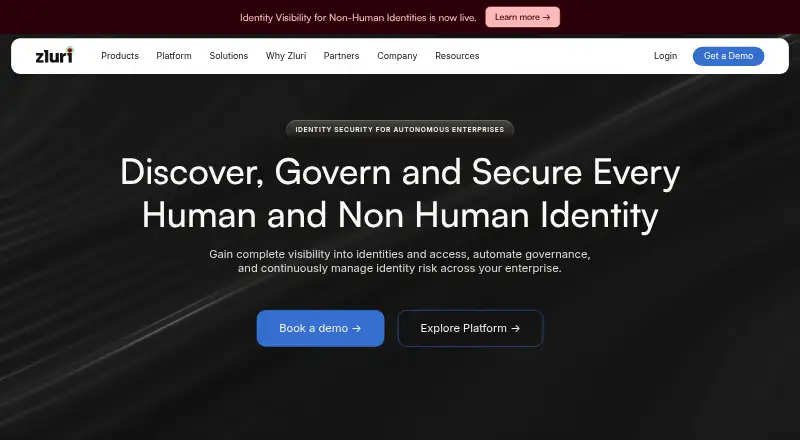
What Zluri is
Zluri is an identity governance platform that helps organizations discover, manage, and govern identities and applications. Its discovery product consolidates identity information from sources such as SSO, HR, finance, CASB, MDM, directories, endpoints, APIs, and on-premises systems into a unified inventory. The platform can identify dormant, orphaned, and overprivileged identities and score risk by impact and exposure. It also provides lifecycle visibility and ownership controls for service accounts, tokens, bots, workloads, and AI agents. Listed capabilities include automatic app discovery, license reclamation, renewal tracking, usage analytics, and access workflows. Zluri lists more than 300 out-of-the-box connectors, including Google Workspace, Slack, Zoom, Microsoft 365, Jira, Azure AD, Okta, GitHub, and BambooHR. Integration options include SDKs, secure CSV imports, SCIM, webhooks, and an action builder with more than 1,000 pre-built actions. The platform supports API, macOS, web, and Windows. Pricing is on request; the pricing page offers a personalized discovery session but shows no prices or trial terms.
Good
- Consolidates identity data from many source types.
- Identifies dormant, orphaned, and overprivileged identities.
- Provides controls for non-human identities.
- Lists more than 300 out-of-the-box connectors.
- Includes license reclamation and renewal tracking.
Watch out
- Pricing is available only on request.
- Pricing page shows no trial terms.
- Customer data may be retained up to 90 days after contract end.
Who it suits
Zluri is aimed at security leaders, IT and access teams, cloud and DevSecOps teams, and audit and compliance teams seeking identity visibility. It may suit organizations managing both application access and non-human identities.
Verdict
Zluri focuses on identity discovery, risk visibility, and governance across applications and non-human identities. Organizations should request pricing details and assess its stated data-retention period against their requirements.
Plans and prices
From Zluri's own pricing page, checked 3 Oct 2026.
| Plan | Price | What it gives you |
|---|---|---|
| Custom pricing | Priced on request | Personalized discovery session; pricing not shown on the opened page |
The facts
Each one read from Zluri's own pages, with the date it was checked.
The company
- Company founding
- A Zluri company announcement says the company was founded in 2020 by Chaithanya Yembari, Ritish Puttaparthi, and Sethu Meenakshisundaram.checked 3 Oct 2026
- Founded
- 2020checked 28 Sep 2026
- Headquarters
- Milpitas, California, United Stateschecked 28 Sep 2026
What it does
- Compliance
- Zluri says it complies with GDPR, NIST, SOC 2 Type II, PCI-DSS, ISO/IEC 27001, and ISO 27701.checked 3 Oct 2026
- Data retention
- Zluri says it retains customer data for up to 90 days after a contract ends and disposes of it according to NIST 800-88 guidelines.checked 3 Oct 2026
- Identity discovery
- Its discovery product brings identity data from sources such as SSO, HR, finance, CASB, MDM, directories, endpoints, APIs, and on-premises systems into a unified inventory.checked 3 Oct 2026
- Identity risk
- The platform identifies dormant, orphaned, and overprivileged identities and scores risk by impact and exposure.checked 3 Oct 2026
- Integration methods
- Zluri lists custom integration builder SDKs, secure CSV imports, SCIM support, webhooks, and an action builder with 1000+ pre-built actions.checked 3 Oct 2026
- Integrations
- The integrations page lists 300+ out-of-the-box connectors and names Google Workspace, Slack, Zoom, Microsoft 365, Jira, Azure AD, Okta, GitHub, and BambooHR among its integrations.checked 3 Oct 2026
- Intended users
- Zluri identifies security leaders, IT and access teams, cloud and DevSecOps teams, and audit and compliance teams as users of its identity visibility product.checked 3 Oct 2026
- Non-human identities
- Zluri says it provides lifecycle visibility and ownership controls for service accounts, tokens, bots, workloads, and AI agents.checked 3 Oct 2026
- Pricing availability
- The pricing URL redirects to a page inviting visitors to schedule a personalized discovery session; that page shows no prices or trial terms.checked 3 Oct 2026
- Security controls
- Zluri says its security measures include tokenization, BYOK, TLS encryption, multi-tenant isolation, credential rotation, SAML-based SSO, mandatory MFA, and granular role-based access controls.checked 3 Oct 2026
- Security testing
- Zluri says it performs quarterly third-party penetration testing through a CERT-In Empanelled organization.checked 3 Oct 2026
- What it does
- Zluri describes itself as an identity governance platform that helps organizations discover, manage, and govern identities and applications.checked 3 Oct 2026
The full review of Zluri
Overview
Zluri is an identity governance platform for organizations that need a consolidated view of their applications, user identities, and non-human accounts. It is best suited to security, IT, cloud operations, and compliance teams managing access across a broad software estate. Its strength is the breadth of discovery and risk visibility; the trade-off is custom pricing and a sales-led buying process.
Key features
Zluri pulls identity data from sources including SSO, HR, finance, CASB, MDM, directories, endpoints, APIs, and on-premises systems into a unified inventory. That breadth can help teams spot accounts that are otherwise scattered across departments and systems, though the value depends on connecting the sources that matter to the organization.
Automatic app discovery, usage analytics, renewal tracking, and license reclamation give IT teams a way to connect visibility with software housekeeping. In practice, those functions make Zluri relevant not only to access governance but also to finding unused licenses and keeping an eye on renewals.
The platform identifies dormant, orphaned, and overprivileged identities, then scores risk by impact and exposure. This gives security and access teams a basis for prioritizing review rather than treating every account as equally urgent. Zluri also provides lifecycle visibility and ownership controls for non-human identities such as service accounts, tokens, bots, workloads, and AI agents—a useful scope for teams whose identity inventory extends beyond employees.
Zluri lists 300+ out-of-the-box connectors, including Google Workspace, Slack, Zoom, Microsoft 365, Jira, Azure AD, Okta, GitHub, and BambooHR. Custom integration builder SDKs, secure CSV imports, SCIM, webhooks, and an action builder with 1000+ pre-built actions provide additional routes for connecting systems and automating work. That flexibility is an advantage for varied environments, although it also makes connector fit a sensible point to clarify before purchase.
Stated security measures include tokenization, BYOK, TLS encryption, multi-tenant isolation, credential rotation, SAML-based SSO, mandatory MFA, and granular role-based access controls. Zluri says it complies with GDPR, NIST, SOC 2 Type II, PCI-DSS, ISO/IEC 27001, and ISO 27701, and performs quarterly third-party penetration testing through a CERT-In Empanelled organization. Customer data may be retained for up to 90 days after a contract ends, then disposed of according to NIST 800-88 guidelines; organizations with stricter exit requirements should account for that period.
Pricing
Zluri uses paid, custom pricing. Its pricing path invites buyers to schedule a personalized discovery session, and no trial terms are stated. This approach may suit organizations that need a tailored deployment, but it gives smaller teams no published price to compare against a budget before engaging sales.
There are no published seat or application quotas, renewal terms, or plan tiers to weigh. Buyers should establish the scope, pricing, and any relevant usage limits during the discovery process. Without public pricing or a trial, Zluri is harder to assess as a low-commitment option.
Platforms
Zluri supports web, macOS, Windows, and API access. That mix accommodates browser-based administration, desktop environments, and integrations built around APIs.
Who it's for
Zluri is aimed at security leaders, IT and access teams, cloud and DevSecOps teams, and audit and compliance groups. It is a stronger fit for organizations that need identity visibility across many systems—including non-human identities—than for buyers seeking a narrowly scoped app catalog or a self-serve tool with a clear entry price.
Pros and cons
- Pros: Broad identity discovery across cloud, endpoint, and on-premises sources can give teams a more unified inventory.
- Pros: Risk scoring for dormant, orphaned, and overprivileged identities helps focus access reviews on higher-impact exposure.
- Pros: Non-human identity lifecycle visibility and ownership controls cover accounts that employee-focused inventories can miss.
- Pros: Automatic app discovery, usage analytics, renewal tracking, and license reclamation connect governance to practical software management.
- Cons: Custom pricing and a discovery-session sales path make costs difficult to compare before engaging.
- Cons: Up to 90 days of post-contract data retention may not fit organizations that require faster data removal.
Alternatives
For broader category browsing, compare Zluri with SaaS Management Platforms, Employee Offboarding Software, IT Vendor Management Software, and IT Asset Management Software.
BetterCloud is worth considering if a free plan or a 21-day File Governance trial is important; its Spend Optimization Basic plan covers license utilization and contract management.
ManageEngine SaaS Manager Plus offers a free option for up to two applications after trial and a $250 a year plan for up to five applications, making it a more bounded, price-visible choice for smaller app portfolios.
Vendr suits readers who want a free Chrome extension with pricing insights for 20,000+ software products; that is a different starting point from Zluri's identity governance focus.
Torii is another paid, web-based option to compare.
Corma may suit buyers who want a free tier capped at 10 apps and support for self-hosted environments, alongside API, extension, web, and Windows platforms.
Zylo is a paid web-based alternative whose Zylo Core plan centers on app discovery, spend visibility, usage data connections, integrations, alerts, reports, and app comparisons.
Nudge Security is worth comparing for buyers seeking a stated Growth price of $5 a month, billed annually, for 150–1,500 users, or an Essential plan at $750 a month, billed annually; it also offers a free trial.
Josys is another paid, web-based alternative.
Verdict
Choose Zluri if your organization needs one platform to discover identities across a complex software environment, assess account risk, and govern both human and non-human access. Its breadth and connected app-management features are the clearest reasons to consider it. Look elsewhere if you need transparent pricing, a trial before commitment, or a shorter stated post-contract data-retention window.