
Corma
Corma is a software asset and identity access management platform for companies that need to track software use, manage licenses, and control access to appli…
What Corma is
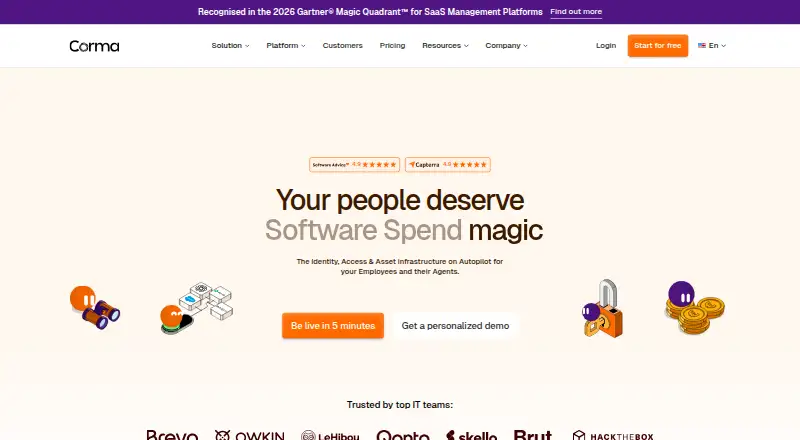
Corma is a software asset and identity access management platform for companies that need to track software use, manage licenses, and control access to applications. Its tools include automatic app discovery, usage analytics, renewal tracking, license reclamation, and access workflows. For SaaS apps whose admin pages expose details that standard APIs do not, its Extractor Agent uses browser automation to capture roles and activity. Provisioning can run through API integrations or browser-based agents, including for apps without API, SSO, or SCIM support. Corma also offers access reviews, approval flows, audit-ready PDF and CSV reports, contract and invoice scanning, unused-license discovery, and expense dashboards. The Freemium plan is listed as free and covers 10 apps; Essential costs €3 a month on an annual engagement and includes unlimited apps. Pro and Enterprise prices are not listed. Corma lists web, Windows, API, extension, and self-hosted availability, and says service data is encrypted in transit and at rest.
Good
- Automatic app discovery and usage analytics
- Tracks renewals and reclaims licenses
- Browser agents cover some apps without APIs
- Access reviews and audit-ready reports
- Free plan includes 10 apps
Watch out
- Freemium is limited to 10 managed apps
- Pro and Enterprise prices are not listed
- Essential is billed on an annual engagement
Who it suits
Corma suits small teams, finance and visibility users, and organizations looking to automate IT governance. Its plans also include options aimed at large organizations.
Verdict
Corma combines license visibility, access controls, provisioning, and cost-management tools. Check plan limits and the listed pricing carefully, especially if you need more than 10 apps or features reserved for higher tiers.
Plans and prices
From Corma's own pricing page, checked 14 Oct 2026.
| Plan | Price | What it gives you |
|---|---|---|
| Freemium | Free | Identity provider connection · Browser extension · SSO connection |
| Essential | €3 a month | Unlimited admins · IdP integration · Shadow IT detection · Financial data input · Browser agents · Up to 10 direct integrations · annual engagement |
| Enterprise | Priced on request | Multi-SSO and multi-tenant · Custom integrations · Dedicated account manager · Advanced security · Custom SLAs · On-premise hosting |
| Pro | Priced on request | Automated access reviews · Employee self-serve store · Automated provisioning · 200+ integrations · Communication bot |
The facts
Each one read from Corma's own pages, with the date it was checked.
What it does
- Access requests
- Employees can request applications through a self-service catalog with policy-based approval and automatic provisioning.checked 14 Oct 2026
- Access reviews
- Access-review campaigns assign reviewers, send reminders, record decisions and produce audit-ready reports.checked 14 Oct 2026
- API availability
- Corma's plan comparison includes open APIs, and its privacy policy says it uses Google's Directory API for instructed provisioning changes.checked 14 Oct 2026
- Authentication
- All pricing plans include Google SSO and Microsoft SSO authentication methods.checked 14 Oct 2026
- Automated onboarding
- Corma offers zero-touch employee provisioning and deprovisioning through native APIs and browser agents.checked 14 Oct 2026
- Connector methods
- Integrations use native APIs, customer-supplied API credentials, browser agents or custom agents built with Automation Builder.checked 14 Oct 2026
- Custom SDK
- The Enterprise plan lists a custom integration SDK as available on request.checked 14 Oct 2026
- Data protection
- Corma says service data is encrypted in transit and at rest, and that its web servers and databases run in secure data centers inside the European Union.checked 30 Sep 2026
- Documentation
- The help center includes setup, employee, browser-extension, MSI deployment, custom-agent, connector and settings guides.checked 14 Oct 2026
- Hosting and deployment
- Corma says it uses AWS for hosting and compute, and lists on-premise hosting as an Enterprise setup option available upon request.checked 30 Sep 2026
- Hosting location
- Corma says customer data is hosted in France on AWS Paris-region infrastructure.checked 14 Oct 2026
- Integration breadth
- The pricing page advertises more than 200 integrations on the Pro plan, while GetApp lists 48 integrations.checked 14 Oct 2026
- Integrations
- The integrations directory lists app, HR, finance, identity provider, ITSM, and browser extension connections, including Google Workspace, Workday, Xero, and Microsoft Edge.checked 30 Sep 2026
- Intended users
- Corma describes its plans for small teams, visibility and finance users, teams automating IT governance, and large organizations.checked 30 Sep 2026
- Licence
- The Firefox add-on is marked All Rights Reserved, indicating proprietary licensing rather than open source.checked 14 Oct 2026
- Limit: automation setup
- A Gartner Peer Insights review was titled that greater SaaS visibility improved license management but automation setup posed challenges.checked 14 Oct 2026
Where it runs
- App visibility
- The product provides organization-wide SaaS usage visibility and detects shadow IT through browser, identity-provider and financial data sources.checked 14 Oct 2026
- Browser extension data
- The Firefox extension requests browsing-history, tab, navigation-activity and all-website-data permissions and reports aggregated browsing and website activity.checked 14 Oct 2026
The company
- Company facts
- LinkedIn lists Corma as privately held, founded in 2023, headquartered in Paris and employing 11–50 people.checked 14 Oct 2026
- Company location
- Corma lists its address as 96bis Bd Raspail, Paris.checked 30 Sep 2026
- Founded
- 2023checked 28 Sep 2026
- Headquarters
- Paris, Francechecked 28 Sep 2026
Money
- Cost management
- Corma lists centralized SaaS contracts, invoice and contract scanning, unused license discovery, expense dashboards, and pricing benchmarks among its features.checked 30 Sep 2026
- Cost optimization
- Corma says its software-usage monitoring can reduce software costs by up to 30 percent.checked 14 Oct 2026
The full review of Corma
Corma suits organizations that need one view of SaaS access, usage, and spend, particularly where some apps lack standard integrations. Its breadth is compelling, but the free tier is capped at 10 apps and key governance automation sits above the entry plan.
Overview
Corma brings software asset management and identity access management together: it tracks application licenses and usage while helping organizations control access. Automatic app discovery, license reclamation, renewal tracking, usage analytics, and access workflows make it relevant to both IT and finance teams.
Founded in 2023 and based in Paris, Corma supports small teams through large organizations. It says it is ISO/IEC 27001:2022 certified and adheres to GDPR; service data is encrypted in transit and at rest, and its web servers and databases run in EU data centers. AWS hosts its service, with on-premise hosting available on request as an Enterprise setup option.
Key features
Application visibility and access
Corma’s Extractor Agent uses browser automation to collect roles and activity from SaaS administration pages when standard APIs do not expose them. That can help surface access information from apps that would otherwise be harder to monitor. Provisioning can use native API integrations or browser-based agents, including for apps without API, SSO, or SCIM support. Automated provisioning is a Pro feature, however, so the breadth of the approach does not mean it is included in the entry paid tier.
Reviews, reporting, and spending
Automated access reviews, approval flows, and audit-ready PDF and CSV reports support governance work. Corma also centralizes SaaS contracts, scans invoices and contracts, identifies unused licenses, and provides expense dashboards and pricing benchmarks. These tools make the product more than an access directory: they connect license oversight with spending decisions.
Integrations and support
The integrations directory spans app, HR, finance, identity provider, ITSM, and browser extension connections, including Google Workspace, Workday, Xero, and Microsoft Edge. Pro includes 200+ integrations. A Help Center covers extensions, the OS Agent, AI Agents, integrations, administration, and helpdesk topics.
Pricing
Corma uses a freemium model. Freemium costs nothing and includes identity-provider connection, a browser extension, SSO connection, and 10 apps. The pricing page also caps this tier at 10 direct integrations. It is a sensible way to begin assessing visibility, but the app and integration limits constrain broader rollouts.
Essential costs €3 a month, billed on annual engagement. It includes unlimited admin seats and apps, IdP integration, shadow IT detection, financial data input, and browser agents. The unlimited app allowance and shadow IT detection suit teams seeking broader visibility without paying for Pro-level automation; the annual commitment is the important trade-off.
Pro has custom pricing and includes automated access reviews, an employee self-serve store, automated provisioning, a communication bot, 200+ integrations, and unlimited apps. It is the relevant step up for teams automating IT governance, but the price must be obtained before comparing its total cost with Essential.
Enterprise has custom pricing starting at 1.000 users. It adds multi-SSO and multi-tenant support, custom integrations, a dedicated account manager, advanced security, and custom SLAs. This is aimed at large organizations with more complex deployment needs, not smaller teams seeking a simple low-cost tier.
Platforms
Corma lists API, extension, self-hosted, web, and Windows platforms. On-premise hosting is an Enterprise setup option available on request.
Who it's for
Corma is a strong fit for organizations that need to connect software usage, access governance, and SaaS cost management, especially when browser-based collection can fill gaps left by standard APIs. Small teams can start with Freemium, while finance and visibility users may find Essential’s unlimited apps and shadow IT detection more useful. Teams needing automated reviews or provisioning should assess Pro; large organizations needing multi-tenant support or custom deployment arrangements should consider Enterprise.
It is less suited to buyers who need unrestricted integrations on a free plan, or who require automated reviews and provisioning at the entry paid price.
Pros and cons
- Pro: Browser automation can collect role and activity data where standard APIs fall short, including apps without API, SSO, or SCIM support.
- Pro: License, access, renewal, and spending tools sit in one platform, giving IT and finance teams a shared view of SaaS use and cost.
- Pro: Essential offers unlimited admin seats and apps, avoiding per-admin seat limits on that tier.
- Con: Freemium is limited to 10 apps and 10 direct integrations, which can restrict evaluation across a larger software estate.
- Con: Automated access reviews and provisioning are Pro features, and Pro and Enterprise require custom pricing.
- Con: Essential is tied to an annual engagement despite its monthly price presentation.
Alternatives
ManageEngine SaaS Manager Plus is worth considering if a web-based freemium option with a free trial is preferable; its free tier is limited to two applications after trial, with each app counting toward the license limit.
Teisko may suit a buyer who wants a free-forever option across extension and web, with unlimited apps, one admin account, up to 100 managed users, 20 invoice extractions per month, and up to three access reviews.
SpendVera is a narrower cost-management alternative for small teams: its free plan covers up to 10 subscriptions and core cost transparency, while Growth costs €29 a month for up to 50 subscriptions.
Vendr is an alternative if the priority is a free Chrome extension offering pricing insights for 20,000+ software products.
1Password is a paid alternative for buyers focused on password management across Android, iOS, Linux, macOS, web, and Windows.
Matrix42 FastViewer is a paid alternative with a free trial and support for Android, iOS, macOS, self-hosted, web, and Windows.
BetterCloud is another freemium alternative, with a Spend Optimization Basic tier for license utilization and contract management and a 21-day File Governance trial.
Block 64 is a paid alternative with a free trial and API, Linux, macOS, web, and Windows platforms.
See also SaaS Management Platforms and Identity Governance Software for category comparisons.
Verdict
Choose Corma if your organization needs license visibility, access controls, and spend management together, particularly where browser agents can bridge integration gaps. Its strongest case is the combination of broad app oversight and governance tools; look elsewhere if the 10-app free cap is too restrictive or if you need automated reviews and provisioning without moving to custom-priced Pro.
Getting started
- Visit https://www.corma.io/.
- Start with Freemium for up to 10 apps, or choose Essential at €3 a month on an annual engagement.
- Connect an identity provider or SSO connection on Freemium.
- Add the browser extension if using Freemium.
- For broader app coverage, consider Essential, which lists unlimited apps and browser agents.
Limits worth knowing
Freemium includes 10 apps, a browser extension, an SSO connection, and identity provider connection. Essential is listed at €3 a month on an annual engagement and includes unlimited apps; Pro and Enterprise prices are not shown.
Questions
How much does Corma cost?
Freemium is listed as free. Essential costs €3 a month on an annual engagement; Pro and Enterprise pricing is not shown.
What is included in the free plan?
Freemium includes identity provider connection, a browser extension, SSO connection, and 10 apps.
Which platforms does Corma support?
Its listed platforms are API, extension, self-hosted, web, and Windows.
Can Corma provision users for apps without standard access integrations?
Corma says it can automate provisioning through native API integrations or browser-based agents, including for apps without API, SSO, or SCIM support.
What integrations are listed?
The integrations directory spans app, HR, finance, identity provider, ITSM, and browser extension connections, including Google Workspace, Workday, Xero, and Microsoft Edge.
What does Corma say about security and hosting?
Corma says it is ISO/IEC 27001:2022 certified, adheres to GDPR, and encrypts data in transit and at rest. It says servers and databases run in secure EU data centers; on-premise hosting is an Enterprise option available upon request.
Alternatives to Corma
- 1

Evolveum midPoint
Free planOpen sourceWebAPILinuxmacOS7.8Free plan - 2
Microsoft Defender for Business
AndroidiOSAPImacOS7.5 - 3

IBM Verify
AndroidiOSWebAPI7.3From $15,899.29 a year - 4

Oracle Cloud Infrastructure Secret Management
Free planWebAPI7.0Free plan - 5
Soffid Identity Governance Administration
Free planWebAPILinuxSelf-hosted6.9Free plan - 6
Stitchflow
Free planWeb6.7From $1,000 a month