
VSee
VSee provides configurable telehealth software and workflows for healthcare organizations and clinicians.
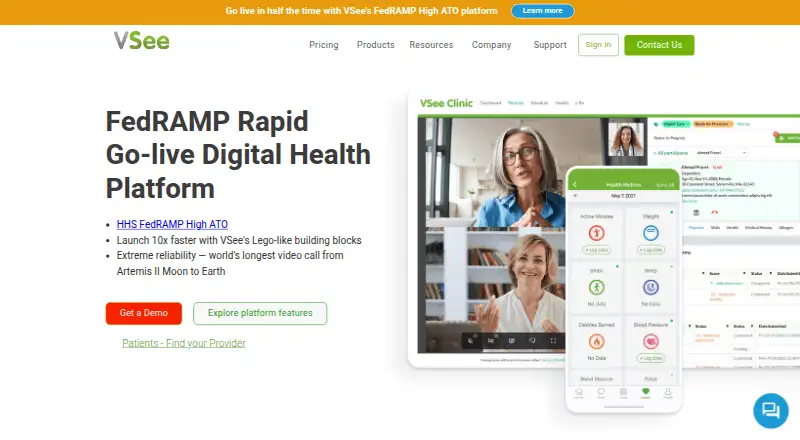
What VSee is
VSee provides configurable telehealth software and workflows for healthcare organizations and clinicians. Virtual visits can use video, phone, or chat, synchronously or asynchronously, with screen sharing, group calls, and file transfer. It supports plug-and-play medical devices including stethoscopes, otoscopes, dermascopes, ultrasound, and EKG devices. Remote patient monitoring can use Bluetooth and cellular medical devices, with customizable threshold alerts and escalation to video visits. Enterprise integrations include Epic, Oracle Health (Cerner), Athenahealth, NextGen, and PointClickCare. VSee describes EHR video launch, two-way scheduling, note exchange, and access to records through health information exchanges. APIs and SDKs offer building blocks for patient mobile and web apps. VSee describes encryption, MFA and SSO options, and SOC 2 certification. Clinic plans include a Business Associate Agreement, while Free VSee Messenger does not. Premium is $49 per month per provider plus a $200 one-time setup fee.
Good
- Supports video, phone, and chat visits.
- Works with listed plug-and-play medical devices.
- Remote monitoring supports threshold alerts.
- Enterprise integrations include several named EMRs.
- Available on web, desktop, and mobile platforms.
Watch out
- Free plan is limited to one provider.
- Free Messenger does not include a HIPAA BAA.
- Premium has a $200 one-time setup fee.
- VSee recommends no more than 30 participants per group session.
Who it suits
VSee may suit clinicians and healthcare organizations seeking virtual visits, remote exams, or patient monitoring. Organizations needing multiple providers or schedulers should note that those require Premium or Enterprise.
Verdict
VSee combines virtual visits, remote exams, and monitoring with healthcare integrations and API options. Compare plan requirements carefully, including provider limits, the BAA distinction, and Premium's setup fee.
Plans and prices
From VSee's own pricing page, checked 20 Sep 2026.
| Plan | Price | What it gives you |
|---|---|---|
| Enterprise | — | Branded mobile app · SSO and MFA · Custom workflows · Cloud recording · RPM and device integration · Eligibility, billing, and claims |
| Free Messenger | Free | 1 screen share per day · per month per provider |
| Pro Messenger | $49 a month | Group video · Phone dial-in · Text chat and picture sending · File sending · Unlimited screen sharing · HIPAA BAA · per month per provider |
| Device Streaming | $299 a month | Group video · Phone dial-in · Unlimited screen sharing · HIPAA BAA · Peripheral streaming · Remote PTZ camera control · per month per account |
| Free | Free | $0 per month per provider · solo providers · unlimited 1-1 HD video, chat and screen sharing · no group calls |
| PLUS | $29 a month | Unlimited group video · patient portal · intake and consent · credit card payments · SMS/email invites and reminders · phone dial-out · per month per provider |
| PREMIUM | $49 a month | $200 one-time setup fee · shared waiting room and scheduling · up to 50 remote care team members · standard EMR notes and reports · live chat and phone support · per month per provider |
The facts
Each one read from VSee's own pages, with the date it was checked.
What it does
- API and SDK
- VSee says its APIs and SDKs provide low-code telehealth building blocks for creating patient mobile and web apps.checked 3 Oct 2026
- Breakout rooms
- Yeschecked 20 Sep 2026
- HIPAA
- VSee says its Clinic plans include a Business Associate Agreement, while Free VSee Messenger does not.checked 3 Oct 2026
- Integrations
- Enterprise VSee integrates with Epic, Oracle Health (Cerner), Athenahealth, NextGen, PointClickCare, and other EMRs.checked 3 Oct 2026
- Interoperability
- VSee describes EHR video launch, two-way scheduling, note exchange, and HIE access to records from other systems.checked 3 Oct 2026
- Key integrations
- Epic,Oracle Health (Cerner),Athenahealth,NextGen,PointClickCare,HL7,FHIR,APIs and SDKschecked 20 Sep 2026
- Meeting recording
- Yeschecked 20 Sep 2026
- Product
- VSee offers configurable telehealth software and workflows for healthcare organizations and clinicians.checked 3 Oct 2026
- Remote exams
- VSee says it supports plug-and-play medical devices including stethoscopes, otoscopes, dermascopes, ultrasound, and EKG devices.checked 3 Oct 2026
- Remote monitoring
- Its remote patient monitoring supports Bluetooth and cellular medical devices, customizable threshold alerts, and escalation to video visits.checked 3 Oct 2026
- Screen sharing
- Yeschecked 20 Sep 2026
- Security
- VSee describes 256-bit AES or DTLS 1.2+ encryption, MFA and SSO options, and SOC 2 certification with third-party testing and audits.checked 3 Oct 2026
- Support
- The Free plan includes knowledge base and email support; Premium includes live chat and phone support.checked 3 Oct 2026
- Virtual visits
- The platform supports video, phone, chat, synchronous and asynchronous visits, screen sharing, group calls, and file transfer.checked 3 Oct 2026
- Who it serves
- VSee describes itself as a digital transformation tool for healthcare enterprises and says it serves over 1,000 clients.checked 3 Oct 2026
The company
- Company history
- VSee says it was founded in 2008 and originated in Stanford University's Human Computer Interaction and Computer Graphics labs.checked 3 Oct 2026
- Founded
- 2008checked 28 Sep 2026
Money
- Free plan
- Yeschecked 20 Sep 2026
- Plan limits
- Multiple providers and schedulers require Premium or Enterprise, and VSee recommends no more than 30 participants in a group session.checked 3 Oct 2026
Where it runs
- Supported platforms
- web,windows,macos,linux,ios,androidchecked 20 Sep 2026
The full review of VSee
VSee is configurable telehealth software for healthcare organizations and clinicians. It suits care teams that need virtual visits alongside remote exams, patient monitoring, or connections to clinical systems. Its healthcare focus is a strength, but its distinct Clinic, Messenger, and Device Streaming plans make careful plan selection essential.
Overview
VSee combines video, phone, chat, group calls, file transfer, and asynchronous visits with tools for remote exams and patient monitoring. That clinical breadth makes it a stronger fit for care workflows than a general-purpose meeting app, particularly when device support or health-system integration matters. The trade-off is a more complicated buying decision: features and HIPAA BAA coverage vary across offerings.
Founded in 2008, VSee says it began in Stanford University's Human Computer Interaction and Computer Graphics labs. It describes itself as a digital transformation tool for healthcare enterprises and says it serves over 1,000 clients.
Key features
Virtual visits, exams, and monitoring
Visits can be synchronous or asynchronous and include screen sharing, group calls, and file transfer. Remote exams can use plug-and-play stethoscopes, otoscopes, dermascopes, ultrasound, and EKG devices, giving clinicians options beyond a standard video appointment. Remote patient monitoring supports Bluetooth and cellular medical devices, customizable threshold alerts, and escalation to video visits. These capabilities are most relevant to programs built around ongoing care; a team seeking only online meetings may not need the added clinical scope. VSee recommends no more than 30 participants in a group session.
Clinical connections and security
Enterprise integrations include Epic, Oracle Health (Cerner), Athenahealth, NextGen, and PointClickCare. VSee also describes EHR video launch, two-way scheduling, note exchange, and HIE access to records from other systems, which can help organizations connect visits with existing clinical workflows. Its security features include 256-bit AES or DTLS 1.2+ encryption, optional MFA and SSO, and SOC 2 certification with third-party testing and audits. Clinic plans include a Business Associate Agreement; Free VSee Messenger does not, an important distinction for healthcare buyers.
APIs and support
APIs and SDKs offer low-code building blocks for organizations creating patient mobile or web apps. Support also depends on the plan: Free includes a knowledge base and email support, while Premium includes live chat and phone support. Multiple providers and schedulers require Premium or Enterprise, so the lower-cost options are a poor fit for teams that need several staff accounts.
Pricing
VSee is freemium, but its pricing spans several distinct products and billing bases. Clinic plan prices are per provider per month; Premium also has a one-time setup fee.
- Free: free, billed per month per provider, for 1 provider. It is a way for a single provider to start, but the Free plan's included support is limited to the knowledge base and email, and it does not provide the BAA that Clinic plans include.
- Plus: $29 a month, billed per month per provider, month-to-month, for 1 provider. This is the lowest paid Clinic tier and may suit a solo provider who wants a paid option without Premium's stated setup fee. Multiple providers and schedulers require a higher plan.
- Premium: $49 a month, billed per month per provider, month-to-month, plus a $200 one-time setup fee. It includes up to 50 remote care team members and 10 custom intake fields, as well as live chat and phone support. It is the more suitable Clinic option for a larger care team, but the setup fee raises the initial cost.
- Enterprise: custom pricing. It includes a branded mobile app, SSO and MFA, custom workflows, cloud recording, RPM and device integration, and eligibility, billing, and claims. This is the tier for organizations seeking a tailored deployment and broader operational features rather than a published per-provider price.
- Free Messenger: free, billed per month per provider, for 1 provider, with 1 screen share per day. That cap makes it a limited option for regular screen-sharing workflows, and it does not include a HIPAA BAA.
- Pro Messenger: $49 a month, billed per month per provider. It adds group video, phone dial-in, text chat and picture sending, file sending, unlimited screen sharing, and a HIPAA BAA. Choose it for those Messenger capabilities rather than assuming it is interchangeable with a Clinic plan.
- Device Streaming: $299 a month, billed per month per account. It includes group video, phone dial-in, unlimited screen sharing, a HIPAA BAA, peripheral streaming, and remote PTZ camera control. Its account-based price and device-oriented inclusions make it a specialized choice for remote peripheral workflows, not a basic solo visit plan.
Platforms
VSee supports web, Windows, macOS, Linux, iOS, and Android, with API access also listed. That broad coverage gives organizations options across desktop and mobile devices, while the API and SDK offering addresses teams building their own patient apps.
Who it's for
VSee is best suited to healthcare organizations and clinicians who need more than video visits: remote exams, device-based monitoring, integrations with clinical systems, or custom patient applications. A solo provider can start with the lower Clinic tiers, while teams needing multiple providers or schedulers should look at Premium or Enterprise. It is less compelling for people who simply need general-purpose group meetings and do not need healthcare workflows or device integrations.
Pros and cons
- Pro: Visits, remote exam devices, and monitoring sit within one healthcare-focused offering, supporting workflows that go beyond standard video appointments.
- Pro: Enterprise integrations and interoperability features can connect visits with major EMRs and other health records.
- Pro: Multiple device and desktop platforms, plus APIs and SDKs, support both off-the-shelf access and custom patient apps.
- Con: Clinic, Messenger, and Device Streaming prices and inclusions differ, so the headline $29/mo does not describe every workflow or BAA option.
- Con: Premium carries a $200 one-time setup fee, and multiple providers or schedulers require Premium or Enterprise.
- Con: Free Messenger is capped at one screen share per day and lacks a HIPAA BAA, limiting its suitability for clinical use.
Alternatives
For broader meeting software rather than telehealth workflows, compare Video Conferencing Software and Secure Video Conferencing Software.
- Microsoft Teams is a general-purpose freemium option with a free plan that allows 100 participants, 60-minute group meetings, and 5 GB cloud storage; choose it when those meeting limits and storage matter more than VSee's clinical tools.
- TeamLink has a free plan for 20 participants, 45 minutes, and 1 meeting room, making it an alternative when a small, time-limited free meeting room is the priority.
- TrueConf offers a perpetual-license free server plan and supports self-hosted deployment; consider it when those characteristics matter more than VSee's healthcare-specific workflows.
- Webex App offers free meetings for up to 100 attendees with a 40-minute limit, a fit for readers who want a time-limited general meeting option.
- Zoho Meeting has a free plan for 100 participants and 60 minutes per meeting, an alternative when those meeting limits suit the use case.
- 8x8 Meet is a free option with a stated 500-participant plan, for readers prioritizing a large meeting capacity.
- Daily offers a free allowance of the first 10,000 participant minutes each month, which may suit teams comparing usage-based video and audio calling.
- RingCentral Video has free meetings for 100 participants and 50 minutes, an alternative for general meetings with those limits.
Verdict
Choose VSee if your care team needs virtual visits alongside remote exams, monitoring, or connections to clinical systems; its healthcare-specific breadth is the main reason to select it. Look elsewhere if you need only general video meetings, or if the plan distinctions, Premium setup fee, or provider limits do not fit your team.
Getting started
- Visit https://vsee.com/.
- Choose a plan, including the free option or a paid plan from $29 per month per provider.
- Use the free trial if you want trial access before choosing a plan.
- Access VSee on web, Windows, macOS, Linux, iOS, or Android.
- For custom patient apps, use VSee's APIs and SDKs.
Limits worth knowing
The Free plan is for one provider. Multiple providers and schedulers require Premium or Enterprise, and VSee recommends no more than 30 participants in a group session. Free VSee Messenger does not include a HIPAA Business Associate Agreement.
Questions
Does VSee have a free plan or trial?
Yes. VSee offers a free plan and a free trial.
Which platforms does VSee support?
VSee supports web, Windows, macOS, Linux, iOS, and Android.
Does VSee integrate with health records systems?
Enterprise VSee integrates with Epic, Oracle Health (Cerner), Athenahealth, NextGen, and PointClickCare, among other EMRs.
Does VSee include a HIPAA agreement?
VSee says Clinic plans include a Business Associate Agreement. Free VSee Messenger does not.
What does Enterprise include?
The listed Enterprise features include a branded mobile app, SSO and MFA, custom workflows, cloud recording, RPM and device integration, and eligibility, billing, and claims.