UptimeUp
UptimeUp monitors websites, APIs, and servers continuously and alerts users when issues occur.
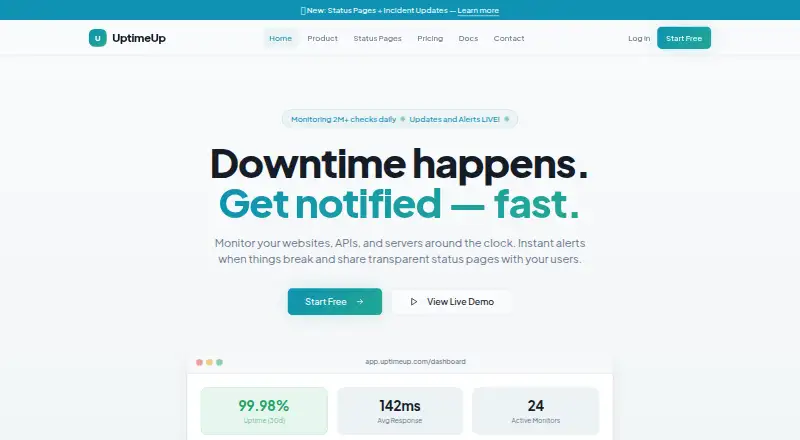
What UptimeUp is
UptimeUp monitors websites, APIs, and servers continuously and alerts users when issues occur. HTTP and HTTPS checks run from multiple global regions at configurable intervals. API checks can validate status codes, response bodies, headers, and JSON schemas, while server checks cover ping, TCP ports, and service-level checks. It also monitors SSL and domain expiry, page keywords, DNS records, latency, and page health. Users can publish public or private branded status pages, incident posts, and maintenance windows. Alert channels include email, Slack, webhooks, Telegram, SMS, and Microsoft Teams; the homepage describes SMS, Slack, and Microsoft Teams as add-ons. Reports provide uptime and SLA tracking, regional response-time charts, incident timelines, and exports. UptimeUp states that data is encrypted at rest and in transit, with Admin, Member, and Viewer roles. There are no agents to install, and it says a first monitor can be set up in under 60 seconds.
Good
- Monitors websites, APIs, and servers
- Regional HTTP and HTTPS checks
- API schema and response validation
- Branded public or private status pages
- No agents to install
Watch out
- Some alert channels are add-ons
- Free plan retains data for seven days
- Free plan allows five monitors
- Paid plans add recurring costs
Who it suits
UptimeUp suits personal projects, freelancers, agencies, and teams monitoring websites, APIs, servers, or client-facing systems. Its plans cover testing through production use cases.
Verdict
UptimeUp combines endpoint checks, server monitoring, status pages, alerts, reporting, and access controls. Its free tier supports basic monitoring, while higher monitor counts, retention, and channels require paid plans.
Plans and prices
From UptimeUp's own pricing page, checked 9 Oct 2026.
| Plan | Price | What it gives you |
|---|---|---|
| Free | Free | 5 monitors · 5-minute check interval · 1 status page · Email alerts · 7-day data retention · 1 team member · Basic uptime dashboard · No credit card required |
| Solo | $9 a month | 10 monitors · 5-minute check interval · 2 status pages · Email + Webhook alerts · 30-day data retention · 1 team member · Custom branding on status pages · Monthly |
| Pro | $19 a month | 50 monitors · 3-minute check interval · 5 status pages · Email + Webhook + Telegram · 90-day data retention · 2 team members · API access · Custom branding · Monthly |
| Business | $39 a month | 100 monitors · 1-minute check interval · 10 status pages · All alert channels · 1-year data retention · 2 team members · API access · Priority support · Custom domain for status pages · Monthly |
| Teams | $79 a month | 200 monitors · 1-minute check interval · 20 status pages · All channels + SMS + Slack · 1-year data retention · 3 team members · Monthly |
The facts
Each one read from UptimeUp's own pages, with the date it was checked.
What it does
- Add-ons
- The pricing page lists additional status pages for $2 per page per month and additional team members for $5 per member per month on paid plans.checked 9 Oct 2026
- Alerts and integrations
- Alert channels listed are Email, Slack, Webhooks, Telegram, SMS, and Microsoft Teams; SMS, Slack, and Microsoft Teams are described as add-ons on the homepage.checked 9 Oct 2026
- API checks
- API checks validate status codes, response bodies, headers, and JSON schemas.checked 9 Oct 2026
- Audience
- The pricing page describes the Free plan as for testing and personal projects, Solo for freelancers and solo builders, Pro for growing apps and agencies, and Business for production systems and client-facing apps.checked 9 Oct 2026
- Audit history
- The homepage describes incident history and change logs as audit-friendly.checked 9 Oct 2026
- Escalations
- The homepage says users can define notification order and wait times before escalating to the next responder.checked 9 Oct 2026
- Expiry and DNS
- The product monitors SSL and domain expiry, page keywords, and DNS records.checked 9 Oct 2026
- Monitoring
- UptimeUp monitors websites, APIs, and servers around the clock and provides alerts when issues occur.checked 9 Oct 2026
- Reports
- Reports include uptime percentage and SLA tracking, response-time charts across regions, and incident history timelines and exports.checked 9 Oct 2026
- Security
- The homepage states that data is encrypted at rest and in transit and that role-based access control includes Admin, Member, and Viewer roles.checked 9 Oct 2026
- Server checks
- Server monitoring includes ping, TCP port, and service-level checks.checked 9 Oct 2026
- Setup
- UptimeUp says there are no agents to install and that a first monitor can be set up in under 60 seconds.checked 9 Oct 2026
- Status pages
- Users can publish public or private branded status pages, incident posts, and maintenance windows.checked 9 Oct 2026
- Uptime checks
- It checks HTTP/HTTPS endpoints from multiple global regions at configurable intervals.checked 9 Oct 2026
Alternatives to UptimeUp
- 1

Dotcom-Monitor
Free planAndroidiOSWebAPI8.3From $13.33 a month - 2

Distill Web Monitor
Free planAndroidiOSWebAPI8.0From $15 a month - 3
OnWebChange
Free planAndroidiOSWebAPI8.0From €0.89 a month - 4
Visual Sentinel
Free planAndroidiOSWebAPI8.0From $6 a month - 5

Pingdom
AndroidiOSWebAPI7.8From $16.50 a month - 6

UptimeRobot
Free planAndroidiOS7.8From $9 a month