UpGex DNS Monitoring
- Free plan
- Yes
- Paid plans from
- $8.33/mo
- Runs on
- Web
Summary
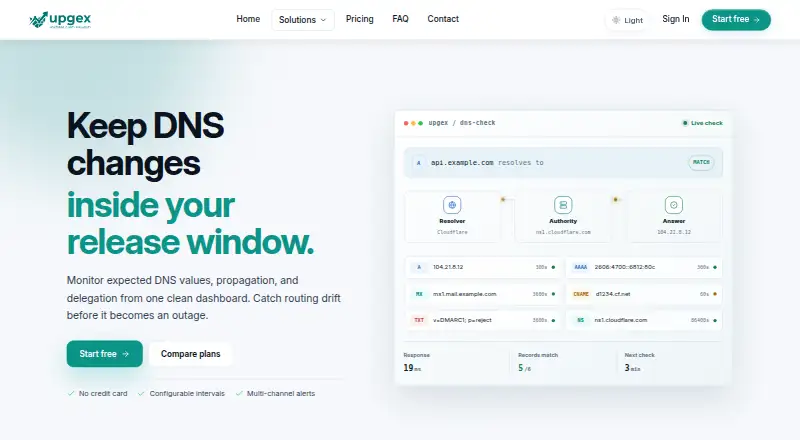
UpGex DNS Monitoring checks whether resolved DNS values match the expected values a user defines, helping identify routing drift before it becomes an outage. It supports A, AAAA, CNAME, MX, TXT, NS, SOA, PTR, SRV and other standard record types. Check intervals can be configured per monitor and plan. When checks fail, the service retries according to monitor settings and opens an incident after the configured threshold is reached. Diagnostics can compare public resolver responses, verify the authority chain, compare SOA serials and classify common DNS failures. Alert channels listed include email, Telegram, Slack, webhooks, Discord, Microsoft Teams, PagerDuty and SMS via Twilio. Paid tiers include REST API access for managing monitors and platform resources. The free tier includes real monitoring and a full dashboard without a credit card, with six monthly credits, a 900-second minimum interval and three days of history. Credits are consumed at rates based on monitor type, interval, region and add-ons. Paid plans start at $9.99 USD per month.
Who it is for
UpGex DNS Monitoring suits people managing provider moves, domain transfers, infrastructure cutovers, releases, rollbacks or ongoing DNS drift checks. It is available as a web service with a free tier and paid plans.
What is good
- Monitors a broad range of standard DNS records.
- Compares resolved values with user-defined expectations.
- Diagnostics include authority-chain and SOA checks.
- Free tier needs no credit card.
- Supports multiple alert channels.
What to know first
- Free tier has six credits per month.
- Free tier retains history for three days.
- Free tier minimum check interval is 900 seconds.
- Credit costs vary by monitor settings and add-ons.
Everything Xiaomi review
UpGex DNS Monitoring: the full review
UpGex combines DNS checks, incident diagnostics and configurable alerts in a web service. Its credit model and plan-specific intervals and history are important limits to consider.
UpGex DNS Monitoring is a web service for checking DNS answers against values you expect and diagnosing incidents when they drift. It is best suited to teams managing DNS changes or ongoing infrastructure checks; its configurable diagnostics and alerts are useful, but monthly credits and plan-based limits shape how closely it can monitor.
Overview
UpGex checks DNS values, propagation and delegation to help catch routing changes before they become outages. You define the expected answers, and monitors compare resolved values against them. That makes the service relevant both for planned work—such as provider moves, domain transfers, infrastructure cutovers, releases and rollbacks—and for detecting drift during ongoing operations.
Its incident flow goes beyond a failed check: monitors can retry according to their settings and open an incident after a configured threshold. Diagnostics can compare public resolver responses, verify the authority chain, compare SOA serials and classify common DNS failures. That combination is more useful for tracing a DNS issue than a simple alert, though the credit model means monitoring frequency and add-ons need to be budgeted.
Key features
DNS checks and incident diagnostics
UpGex supports A, AAAA, CNAME, MX, TXT, NS, SOA, PTR, SRV and other standard record types. It also supports propagation checks, nameserver health checks and record-change alerts. The breadth suits teams with varied DNS records, while configurable intervals and retry thresholds let them tune how quickly checks escalate.
When a threshold is reached, incident diagnostics can help distinguish resolver disagreement, authority-chain problems and SOA serial differences. This is a practical strength during migrations and cutovers, when a change can appear correct from one resolver but not another.
Alerts and API
Email and Slack are described as alert channels on the DNS page; the pricing page lists Telegram, email, Slack, webhooks, Discord, Teams, PagerDuty and SMS as well. Multi-channel alerts include incident context, which can help teams route an issue to the people who can act on it. Paid tiers include REST API access for managing monitors and platform resources.
Pricing
UpGex has a no-card-required free plan with real monitoring and a full dashboard. It provides 6 credits per month, a 900-second minimum check interval and 3 days of history. That is a sensible way to evaluate monitoring or cover low-urgency checks, but the small credit allowance and short retention make it a poor fit for a broad or fast-moving production estate.
Pro costs 9.99 USD per month, billed monthly, and includes 50–199 credits per month, a 60-second minimum interval and 30 days of history. It is the entry point for users who need more frequent checks or a useful incident lookback. Business costs 29.99 USD per month, billed monthly, with 180 credits per month, the same 60-second minimum interval and 90 days of history. Its longer retention favors teams reviewing incidents over a wider period, though the stated credit allotment is fixed at 180 rather than a range.
Credits are monthly, and their cost depends on monitor type, interval, region and add-ons. As a result, a faster interval or more complex monitoring can consume the allowance differently; prospective users should account for that when estimating coverage. The supplied plan terms do not establish seat counts or a trial length, so those should not be assumed.
Platforms
UpGex is available on the web. This fits teams that want a browser-based DNS monitoring dashboard, but it is not presented as a mobile app.
Who it's for
Choose UpGex if you need expected-value checks, propagation and nameserver monitoring, and incident diagnostics around DNS changes or routine drift detection. Its retries, contextual alerts and resolver comparisons are especially relevant during provider moves, domain transfers, infrastructure cutovers, releases and rollbacks. It is less compelling for teams that need generous free monitoring, long history at no cost, or predictable usage independent of monitor settings and add-ons.
Pros and cons
- Pro: Checks cover many standard DNS record types, propagation, nameserver health and record changes, supporting more than basic uptime-style checks.
- Pro: Incident diagnostics compare resolver responses and authority details, giving teams useful ways to investigate DNS failures.
- Pro: The free plan includes real monitoring and a full dashboard without requiring a credit card.
- Con: Free monitoring is capped at 6 credits per month, a 900-second minimum interval and 3 days of history, limiting its value for production coverage.
- Con: Credit consumption varies with monitor type, interval, region and add-ons, making usage less straightforward to forecast.
- Con: The web-only platform will not suit readers seeking a native mobile app.
Alternatives
Browse DNS Monitoring Software for more options. Consider DomainWarn if you want a free plan with 3 domains, 2 members and checks every 15 minutes across API, extension and web platforms. StatusDrift may fit better if a free five-monitor setup with a status page, audit logs and 90-day data retention matters more than UpGex's DNS diagnostics.
DNS Check offers a free allowance of 10 DNS records and 7 days of history, or a Professional plan at 8.00 USD per month with 100 records and 90 days of history. DriftWatch is another option for readers comparing a stated 29.00 USD-per-month Pro plan with 25 domains, unlimited DNS records, five-minute scans and 90-day change history.
ZoneWatcher is a paid alternative with per-domain plans. Visual Sentinel is another freemium option with web and mobile platforms. DNS Spy is paid and lists a Personal plan at 9.00 USD per month for up to 10 domains and one year of history. Metric Tower is a free alternative whose free tier includes 10,000 lookups per day.
Verdict
UpGex is a strong fit for teams that need DNS-specific checks, incident diagnostics and configurable alerts around changes or ongoing drift. Its clearest reason to choose is the combination of expected-value monitoring and resolver and authority diagnostics; its main drawback is a credit-based model paired with limited free intervals and history. Look elsewhere if you need a more generous free allowance, longer free retention or mobile apps.
UpGex DNS Monitoring plans and pricing
All plansCompared on DNS monitoring software
- Free plan
- Yesupgex.com
- Paid from
- $9.99/moupgex.com
- Check interval
- 1 minutesupgex.com
- Resolution checks
- Yesupgex.com
- Propagation checks
- Yesupgex.com
- Record-change alerts
- Yesupgex.com
- Nameserver health checks
- Yesupgex.com
- Alert channels
- Email, Telegram, Slack, Discord, Microsoft Teams, PagerDuty, SMS via Twilio, custom webhooksupgex.com
Facts
- Purpose
- UpGex monitors expected DNS values, propagation, and delegation to catch routing drift before it becomes an outage.upgex.com · 30 Sept 2026
- Record types
- It supports A, AAAA, CNAME, MX, TXT, NS, SOA, PTR, SRV, and other standard DNS record types.upgex.com · 30 Sept 2026
- Expected values
- Each monitor compares resolved values with the expected values the user defines.upgex.com · 30 Sept 2026
- Check intervals
- Check intervals are configurable per monitor and plan.upgex.com · 30 Sept 2026
- Retries and incidents
- UpGex retries failed checks according to monitor settings and opens an incident after the configured threshold is reached.upgex.com · 30 Sept 2026
- Diagnostics
- DNS incident diagnostics can compare public resolver responses, verify the authority chain, compare SOA serials, and classify common DNS failures.upgex.com · 30 Sept 2026
- Notifications
- The DNS page lists Slack and email as alert channels and describes multi-channel alerts with incident context.upgex.com · 30 Sept 2026
- Other alert integrations
- The pricing page lists Telegram, email, Slack, webhooks, Discord, Teams, PagerDuty, and SMS as alert channels.upgex.com · 30 Sept 2026
- API
- Paid tiers include REST API access for managing monitors and platform resources.upgex.com · 30 Sept 2026
- Free tier
- The free plan includes real monitoring, a full dashboard, and requires no credit card.upgex.com · 30 Sept 2026
- Credit limits
- UpGex uses monthly credits, and the credit cost depends on monitor type, check interval, region, and add-ons.upgex.com · 30 Sept 2026
- Who it is for
- The DNS page describes use during provider moves, domain transfers, infrastructure cutovers, releases, rollbacks, and ongoing drift detection.upgex.com · 30 Sept 2026
Best UpGex DNS Monitoring alternatives
See all 20


Where it ranks on Everything Xiaomi
- Best DNS Monitoring Software in 2026#15 of 37
Is UpGex DNS Monitoring yours?
Claim it for free: prove the domain, then correct facts, plans and screenshots. An editor reviews every change.
Sources
- upgex.com/dns-monitoring· checked 30 Sept 2026
- upgex.com/pricing· checked 30 Sept 2026