StatusDrift
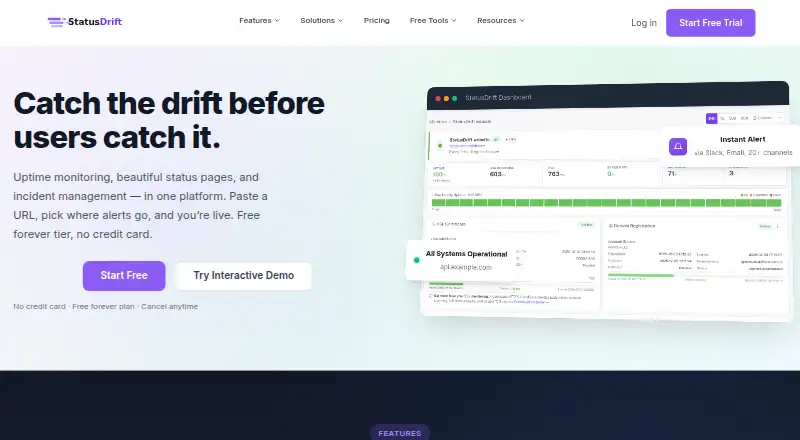
StatusDrift combines uptime monitoring, status pages, and incident management for websites, APIs, and infrastructure.
What StatusDrift is
StatusDrift combines uptime monitoring, status pages, and incident management for websites, APIs, and infrastructure. It monitors SSL certificates, DNS and domains, ping, TCP ports, and cron or heartbeat jobs, with checks available from multiple regions. Its status pages support custom branding and domains, HTTPS, component groups, incident updates, postmortems, uptime history, and password protection. Incident tools include automatic incident creation, escalation policies, on-call schedules, and publishable postmortems. The Free plan includes five monitors, five-minute checks, one status page, email, Slack, and webhook notifications, 90 days of data retention, audit logs, and community support. Paid plans list more frequent checks; Pro has a one-minute interval, while Business lists 30-second checks. The listed integrations include messaging, incident-response, monitoring, automation, and webhook services. The maker says integrations are included on paid plans, while Free includes email, Slack, and webhook alerts; StatusDrift does not send SMS or voice calls directly. A Terraform provider and REST API are available for infrastructure management. StatusDrift is available on Android, iOS, and the web, with an API.
Good
- Monitors websites, APIs, SSL, DNS, ports, and cron jobs.
- Free includes five monitors and one status page.
- Status pages support custom domains and password protection.
- Offers a Terraform provider and REST API.
Watch out
- Free checks run at five-minute intervals.
- Free integrations are limited to email, Slack, and webhooks.
- It does not send SMS or voice calls directly.
Who it suits
The maker describes Free as suited to personal projects and small sites, Pro for growing teams, Business for teams needing advanced features, and Enterprise for large organizations with custom needs. It may suit teams that need monitoring alongside status pages and incident workflows.
Verdict
StatusDrift brings monitoring, public status information, and incident response together, with a Free plan for smaller projects. Teams should check the plan limits and note that direct SMS and voice alerts are not available.
Plans and prices
From StatusDrift's own pricing page, checked 4 Oct 2026.
| Plan | Price | What it gives you |
|---|---|---|
| Free | Free | 5 monitors · 5-minute check interval · 1 status page · Email, Slack, Webhook notifications · 90-days data retention · Audit logs · Community support |
| Pro | $12,129 a month | 10 monitors shown, selectable 10/25/50/100 · 1-minute check interval · 5 status pages · Unlimited collaborators · API access · Email support · Billed as $108/year |
| Business | — | 25 monitors shown, selectable 25/50/100/250/500/1000 · 30 sec check interval · SSO / SAML · Unlimited status pages · Scheduled reports · SLA monitoring · On-call management · 2-year data retention · Priority support · Billed as $276/year |
| Enterprise | Priced on request | Unlimited monitors · Unlimited status pages · Custom data retention · Dedicated account manager · Custom integrations · SLA guarantee |
The facts
Each one read from StatusDrift's own pages, with the date it was checked.
What it does
- Audience
- The maker describes Free as suited to personal projects and small sites, Pro for growing teams, Business for teams needing advanced features, and Enterprise for large organizations with custom needs.checked 4 Oct 2026
- Checks
- Monitoring checks can run from multiple regions, with plan frequencies ranging from 5 minutes on Free to 30 seconds on Business.checked 4 Oct 2026
- Compliance
- The maker states it complies with GDPR and CCPA and offers data processing agreements on request.checked 4 Oct 2026
- Data location
- The security page says data is stored in data centers in the United States and European Union, with enterprise data residency requests available.checked 4 Oct 2026
- Incident response
- The product supports automatic incident creation, escalation policies, on-call schedules, and publishable postmortems.checked 4 Oct 2026
- Infrastructure as code
- A Terraform provider and REST API are available for managing monitors, alert contacts, schedules, policies, maintenance windows, and status pages.checked 4 Oct 2026
- Integration limits
- The maker says integrations are included on paid plans; Free includes Email, Slack, and webhook alerts, and StatusDrift does not send SMS or voice calls directly.checked 4 Oct 2026
- Integrations
- Listed integrations include Slack, Microsoft Teams, Discord, Google Chat, Mattermost, Telegram, PagerDuty, Opsgenie, Datadog, ServiceNow, Zapier, IFTTT, n8n, and webhooks.checked 4 Oct 2026
- Monitoring
- It monitors websites, APIs, SSL certificates, DNS and domains, ping, TCP ports, and cron or heartbeat jobs.checked 4 Oct 2026
- Private monitoring
- For fully private endpoints, the maker offers an internal agent that runs checks from inside the customer’s network without opening inbound ports.checked 4 Oct 2026
- Product
- StatusDrift combines uptime monitoring, status pages, and incident management in one platform.checked 4 Oct 2026
- Security
- The security page states that data in transit uses TLS 1.3 and stored data uses AES-256 encryption.checked 4 Oct 2026
- Status pages
- Status pages support custom branding and domains, HTTPS, component groups, incident updates, postmortems, uptime history, and password protection.checked 4 Oct 2026
- Support
- Pricing lists community support on Free, email support on Pro, and priority support on Business.checked 4 Oct 2026
The company
- Company history
- StatusDrift says it was founded in 2023 by a team of DevOps engineers.checked 4 Oct 2026
- Founded
- 2023checked 28 Sep 2026
The full review of StatusDrift
StatusDrift is a unified service for uptime checks, status communication, and incident coordination. It fits teams that want those duties in one operational workflow, from a small personal site to an enterprise with bespoke requirements. Its breadth is attractive, but the Free tier’s five-monitor ceiling and five-minute interval limit how far smaller deployments can grow.
Overview
Founded in 2023 by DevOps engineers, StatusDrift monitors websites, APIs, SSL certificates, DNS and domains, ping, TCP ports, and cron or heartbeat jobs. Checks can run from multiple regions, while resolution, propagation, and record-change checks add useful coverage for DNS and domain operations. This range makes it more than a basic HTTP uptime checker; teams can watch several parts of an internet-facing service from one console.
Status pages, monitoring, and incident workflows are connected in the same platform. That is a sensible fit for organizations that need to detect a fault, coordinate responders, and communicate progress without stitching together separate products. A project requiring only one narrow check may not benefit from the larger operational scope.
Key features
Status pages support custom branding and domains, HTTPS, component groups, incident updates, uptime history, password protection, and postmortems. Public pages can explain an outage to customers, while password protection suits internal or partner audiences. Incident management includes automatic incident creation, escalation policies, on-call schedules, and publishable postmortems, giving teams a path from alert to reviewable record.
Alerting can reach Email, Slack, Discord, Microsoft Teams, Google Chat, Telegram, Mattermost, PagerDuty, PagerTree, Opsgenie, VictorOps, Zenduty, Pushover, Pushbullet, and webhooks. Paid plans include integrations; Free is limited to Email, Slack, and webhook alerts. StatusDrift does not place SMS or voice calls directly, so teams that require those channels must involve another service.
Terraform and a REST API can manage monitors, alert contacts, schedules, policies, maintenance windows, and status pages. That is valuable for infrastructure-as-code practices and repeatable administration. For fully private endpoints, an internal agent runs checks inside the customer network without opening inbound ports. TLS 1.3 protects data in transit and AES-256 protects stored data; the maker states GDPR and CCPA compliance, data centers in the United States and European Union, and enterprise data-residency requests.
Pricing
StatusDrift uses a freemium model with a 14-day trial. The Free plan costs nothing and includes five monitors, five-minute checks, one status page, Email/Slack/webhook notifications, 90 days of data retention, audit logs, and community support. It is appropriate for personal projects and small sites, but the monitor and interval limits make it a poor fit for broad coverage or fast detection.
Pro costs $12,129 a month, billed as $108/year. It shows 10 monitors, with selectable allowances of 10, 25, 50, or 100, plus one-minute checks, five status pages, unlimited collaborators, API access, and email support. This is the more practical tier for a growing team that needs faster checks and shared administration; the displayed pricing and selectable monitor quantities should be confirmed before purchase.
Business costs $292,923 a month, billed as $276/year. Monitor choices run from 25 to 1,000, with 30-second checks, SSO/SAML, unlimited status pages, scheduled reports, SLA monitoring, on-call management, two-year retention, and priority support. It targets teams with formal operational and reporting requirements rather than light monitoring.
Enterprise has custom pricing and includes unlimited monitors and status pages, custom retention, a dedicated account manager, custom integrations, and an SLA guarantee. It is the route for large organizations needing contractual service terms or tailored deployment requirements.
Platforms
StatusDrift is offered on Android, iOS, web, and through an API. The API and Terraform provider make it workable in automated infrastructure workflows, while the web and mobile platforms cover routine access and alert response.
Who it's for
Free suits personal projects and small sites that can live with five-minute checks. Pro is aimed at growing teams needing more monitors, faster detection, collaborators, and API access. Business fits organizations requiring SSO, SLA monitoring, on-call management, reporting, and longer retention. Enterprise is for large organizations with custom integrations, data-retention, residency, or contractual needs.
Pros and cons
Pros
- Broad monitoring coverage: Websites, APIs, DNS, certificates, ports, and heartbeat jobs can be watched in one service.
- Connected incident workflow: Automatic incidents, escalation, on-call schedules, status pages, and postmortems support the full response cycle.
- Automation support: Terraform and REST API management suits repeatable infrastructure operations.
- Private-endpoint option: An internal agent checks systems without opening inbound ports.
Cons
- Free is tightly capped: Five monitors and five-minute checks constrain larger or latency-sensitive deployments.
- Free integrations are limited: Broader integrations require paid plans, and direct SMS or voice alerts are unavailable.
- Paid pricing needs scrutiny: The displayed Pro and Business amounts, billing terms, and selectable monitor quotas warrant confirmation before commitment.
Alternatives
Choose Paessler PRTG Network Monitor instead if you need Windows, Linux, macOS, or self-hosted coverage and a Freeware Edition supporting up to 100 sensors. Visual Sentinel is another freemium option for teams wanting Android, iOS, web, and API access. Dotcom-Monitor suits a free deployment with up to 25 targets, five-minute frequency, two locations, and email alerts. Pick Dynatrace Kubernetes Monitoring when Kubernetes-specific monitoring and hourly pod billing are the priority. Checkmate is the stronger choice for self-hosted users wanting all features, unlimited monitors, and 12 alert channels at no charge. DNSai fits domain-heavy work, with a Free allowance of 100 domains and 100 scans per day. TLDTrack is suited to a single website plus four extra monitors with uptime, domain-expiry, and SSL-expiry alerts. Nagios XI is an alternative for self-hosted monitoring with a Free tier capped at seven nodes or 100 services.
For a broader directory of domain-focused tools, see DNS Monitoring Software.
Verdict
StatusDrift is a strong choice for teams that want monitoring, customer-facing status pages, and incident response under one roof, especially when Terraform, API control, private checks, and structured on-call workflows matter. Look elsewhere if five Free monitors are insufficient, if direct SMS or voice escalation is essential, or if a narrowly focused domain or self-hosted monitor would meet the need more simply.
Alternatives to StatusDrift
- 1

Dotcom-Monitor
Free planAndroidiOSWebAPI8.3From $13.33 a month - 2

Nagios XI
Free planWebAPILinuxmacOS8.1$2,595 one-time - 3
TLDTrack
Free planAndroidiOSWebAPI8.0From $11 a month - 4
Visual Sentinel
Free planAndroidiOSWebAPI8.0From $6 a month - 5

Paessler PRTG Network Monitor
Free planAndroidiOSWebAPI7.7From $200 a month - 6
Domain Monitor
Free planAndroidWebAPI7.6From £6.39 a month