
Checkmate
Checkmate is a free, open-source, self-hosted dashboard for infrastructure monitoring, uptime, PageSpeed, and incident alerts.
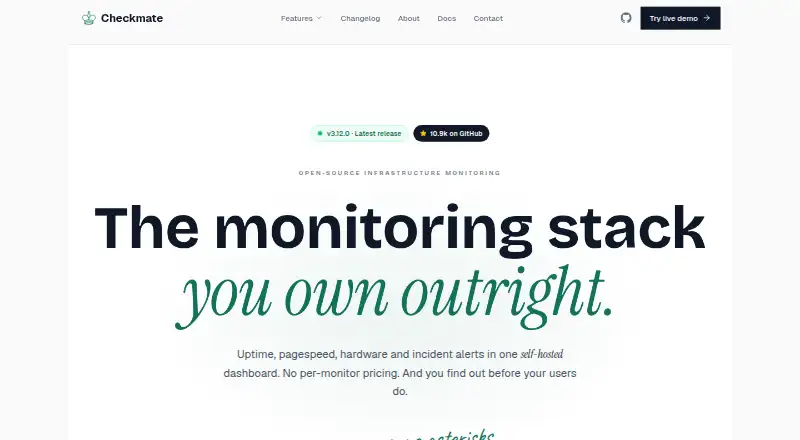
What Checkmate is
Checkmate is a free, open-source, self-hosted dashboard for infrastructure monitoring, uptime, PageSpeed, and incident alerts. It checks HTTP, ping, TCP, gRPC, WebSocket, DNS, SSL, and more than 100 game server types. Its Capture agent reports server CPU, memory, disk, temperature, and network metrics. PageSpeed monitoring tracks Lighthouse scores and Core Web Vitals over time, while public status dashboards can show per-service uptime, incident history, and custom branding. Alerts can go to email, Slack, Discord, Telegram, Twilio SMS, Pushover, ntfy, Matrix, Rocket.Chat, PagerDuty, Microsoft Teams, and webhooks. The operator's configured database stores metrics, logs, incidents, and user accounts; the maker says there is no phone-home or telemetry pipeline. Checkmate uses the AGPL-3.0 license and supports Docker Compose and Kubernetes/Helm deployment. The image runs on x86, Apple Silicon, and Raspberry Pi. The free plan includes all features, no monitor limits, self-hosting, and 12 alert channels.
Good
- Free plan has no monitor limits.
- Checks numerous service protocols and game server types.
- Tracks hardware metrics and PageSpeed scores.
- Public status dashboards support custom branding.
- No phone-home or telemetry pipeline, according to the maker.
Watch out
- Choosing Checkmate means giving up managed cloud.
- There is no one-click migration import.
- No paid support tier is offered.
Who it suits
Checkmate may suit homelab operators, SaaS founders, agencies, sysadmins, DevOps teams, e-commerce businesses, and open-source maintainers who want to host their monitoring dashboard themselves.
Verdict
Checkmate offers broad monitoring and alerting in a self-hosted package with no monitor cap on its free plan. Readers should be prepared to operate their own deployment and handle migration without a one-click import.
Plans and prices
From Checkmate's own pricing page, checked 3 Oct 2026.
| Plan | Price | What it gives you |
|---|---|---|
| Free | Free | All features · no monitor limits · self-hosted · 12 alert channels |
The facts
Each one read from Checkmate's own pages, with the date it was checked.
What it does
- API
- The maker says the API accepts JSON for bulk monitor setup and provides a REST API reference.checked 3 Oct 2026
- Audience
- The maker names homelabs, SaaS founders, agencies, sysadmins and DevOps, e-commerce, and open-source maintainers as users.checked 3 Oct 2026
- Availability checks
- It monitors HTTP, ping, TCP, gRPC, WebSocket, DNS, SSL, and more than 100 game server types.checked 3 Oct 2026
- Deployment
- The documentation describes Docker Compose installation and lists Kubernetes/Helm deployment; it says the image runs on x86, Apple Silicon, and Raspberry Pi.checked 3 Oct 2026
- Infrastructure
- The Capture agent reports CPU, memory, disk, temperature, and network metrics from servers.checked 3 Oct 2026
- Integrations
- Alert channels include email, Slack, Discord, Telegram, Twilio SMS, Pushover, ntfy, Matrix, Rocket.Chat, PagerDuty, Microsoft Teams, and webhooks.checked 3 Oct 2026
- License
- Checkmate is licensed under AGPL-3.0, and the maker says users can read, fork, and audit its source.checked 3 Oct 2026
- Limits
- The maker says there is no one-click migration import and describes managed cloud as something users give up when choosing Checkmate.checked 3 Oct 2026
- PageSpeed
- PageSpeed monitoring tracks Lighthouse scores and Core Web Vitals over time.checked 3 Oct 2026
- Product
- Checkmate is an open-source, self-hosted infrastructure monitoring dashboard for uptime, PageSpeed, hardware, Docker, and incident alerts.checked 3 Oct 2026
- Security and data
- The maker says metrics, logs, incidents, and user accounts stay in the database configured by the operator, with no phone-home or telemetry pipeline.checked 3 Oct 2026
- Status pages
- It provides public status dashboards with per-service uptime, incident history, and custom branding.checked 3 Oct 2026
- Support
- The maker identifies Discord as the fastest help channel and GitHub issues for bugs and feature requests, and says there is no paid support tier.checked 3 Oct 2026
The company
- Founded
- 2023checked 28 Sep 2026
- Maker
- Checkmate is built by Bluewave Labs with community contributors.checked 3 Oct 2026
Money
- Free plan
- Yeschecked 23 Sep 2026
The full review of Checkmate
Checkmate is an open-source infrastructure monitoring dashboard that you run on your own systems. It suits operators who want uptime, server, PageSpeed and incident monitoring under one roof; its main trade-off is taking responsibility for deployment and migration.
Overview
Checkmate brings availability checks, server metrics, PageSpeed tracking and public status dashboards into a self-hosted package. It covers a wide range of check types, from HTTP and DNS to gRPC and WebSocket, and supports more than 100 game server types. That breadth makes it useful for mixed environments, while the self-hosted model will be a poor fit for teams seeking managed cloud operations.
Operators retain control of where metrics, logs, incidents and user accounts are stored: the maker says they remain in the database configured by the operator, with no phone-home or telemetry pipeline. Checkmate uses the AGPL-3.0 license, and its source can be read, forked and audited. The corresponding cost is operational ownership: users deploy and maintain it themselves, and there is no one-click migration import.
Key features
- Availability checks: Monitor HTTP, ping, TCP, gRPC, WebSocket and DNS, alongside SSL and more than 100 game server types. That range suits services beyond standard websites.
- Server metrics: The Capture agent reports CPU, memory, disk, temperature and network metrics. Checkmate supports VM and service monitoring, as well as agentless monitoring.
- PageSpeed tracking: Track Lighthouse scores and Core Web Vitals over time, giving site owners a view of performance alongside uptime.
- Status pages: Publish dashboards with per-service uptime, incident history and custom branding. These can communicate service health without requiring users to interpret internal monitoring data.
- Alerts: Send notifications through 12 channels, including email, Slack, Discord, Telegram, Twilio SMS, PagerDuty, Microsoft Teams and webhooks. The range supports different team workflows, though operators still need to configure and run the system.
- Deployment and API: Documentation covers Docker Compose and Kubernetes/Helm; the image runs on x86, Apple Silicon and Raspberry Pi. A JSON-capable API supports bulk monitor setup, with a REST API reference for integrations.
Pricing
Checkmate has one Free plan at no cost. It includes all features, unlimited monitors, self-hosting and 12 alert channels. The absence of a monitor cap makes it suitable for users with many checks, without a paid tier to unlock the listed feature set.
There is no free trial because the product is free, and no paid support tier. Help is available through Discord, identified as the fastest channel, and GitHub issues for bugs and feature requests. The free plan does not remove the costs of operating your own deployment or the effort of migrating existing monitors.
Platforms
Checkmate is available for API, Linux, macOS, self-hosted, web and Windows environments. Its deployment options include Docker Compose and Kubernetes/Helm, and its image supports x86, Apple Silicon and Raspberry Pi. This flexibility is useful for varied infrastructure, but it does not turn Checkmate into a managed service.
Who it's for
Checkmate is a strong fit for homelabs, SaaS founders, agencies, sysadmins, DevOps teams, e-commerce operators and open-source maintainers who want broad monitoring without per-monitor limits and are willing to run the software. Its data-control model will also appeal to operators who want metrics and incident records kept in their configured database.
Look elsewhere if your priority is managed cloud monitoring or a one-click move from another product. Checkmate leaves deployment and migration work to the operator, and support is community-based rather than a paid service tier.
Pros and cons
- Pro: No monitor limits on the free plan make it practical to expand coverage without hitting a listed monitor quota.
- Pro: Availability, infrastructure, PageSpeed, status pages and 12 alert channels cover several monitoring needs in one self-hosted tool.
- Pro: Operator-configured data storage and no phone-home or telemetry pipeline give users direct control over where monitoring data stays.
- Con: Self-hosting means the operator owns deployment and ongoing operations; there is no managed cloud option.
- Con: No one-click migration import makes switching more work for teams bringing monitors from another service.
- Con: There is no paid support tier, so teams looking for contractual support should consider another option.
Alternatives
For a self-hosted uptime service with a defined small-team quota, consider SolidPing: its free plan allows 5 team members, 10 check executions per minute, 100 monitors and 1 private-location agent. Choose it when those limits are sufficient and the team-member allowance matters more than Checkmate's unlimited monitors and broader listed monitoring scope.
Uptimia may suit small websites that prefer a hosted web service: its Basic plan is $9 a month, billed annually, and includes 10 uptime checks, a 1-minute interval, 1 advanced check, 1 server and 1 status page. That is a more constrained, paid starting point than Checkmate's free self-hosted plan.
UptimeRobot is an alternative for hobby and non-profit projects: its free plan includes 50 monitors with a 5-minute monitoring interval and requires no credit card. Prefer it when that allowance and its listed mobile platforms suit the need better than operating a self-hosted service.
HetrixTools offers a free-for-life plan with 15 uptime monitors, 15 server monitors, 1-minute checks and 4 monitoring locations, subject to account activity. It is a fit when those fixed quotas and monitoring locations are a better match than Checkmate's unlimited self-hosted plan.
Hyperping is worth considering for a compact hosted setup: its free plan has 1 seat, 20 monitors, 5-minute checks, 1 server monitoring agent and 1 basic status page, with HTTP, port, ping and keyword monitoring. Choose it when that bounded scope is enough and a web-based option is preferable to self-hosting.
openstatus is another open-source, self-hosted option, but its Hobby plan is limited to 1 monitor, 1 status page, 3 components and 10-minute minimum checks. It may fit a small project that needs only that scale; Checkmate offers more room for monitor growth on its free plan.
Dotcom-Monitor offers a free plan for up to 25 targets, checks as frequent as every 5 minutes, 2 monitoring locations and email alerts. Consider it when those target and location limits suit the use case better than running Checkmate yourself.
Kuvasz Uptime is another free, open-source, self-hosted option with unlimited monitors, status pages and multiple notification channels.
For more options, browse Uptime Monitoring Software, Container Monitoring, Infrastructure Monitoring and DNS Monitoring Software.
Verdict
Choose Checkmate if you want broad infrastructure and uptime monitoring, unlimited monitors on a free plan, and control over your deployment and data. Its range of checks, server metrics, PageSpeed tracking, status pages and alert channels is compelling for technically capable operators. Look elsewhere if you want managed cloud, one-click migration or paid support: Checkmate expects you to run it yourself.
Alternatives to Checkmate
- 1

Dotcom-Monitor
Free planAndroidiOSWebAPI8.9From $13.33 a month - 2

UptimeRobot
Free planAndroidiOS8.5From $9 a month - 3

Pingdom
AndroidiOSWebAPI8.4From $16.50 a month - 4

SolidPing
Free planWebAPILinuxSelf-hosted8.2From €5 a month - 5

Uptimia
Free planWeb8.2From $9 a month - 6
HetrixTools
Free planLinuxmacOSWindows8.2From $9.95 a month