
openstatus
openstatus is an open-source platform for uptime monitoring and status pages.
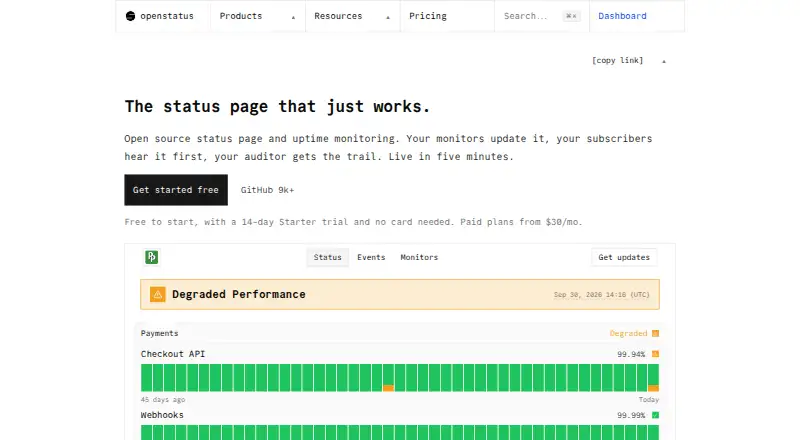
What openstatus is
openstatus is an open-source platform for uptime monitoring and status pages. It monitors websites, APIs, and services from 28 regions across multiple cloud providers. Its automation interfaces include a CLI, typed API with OpenAPI, Node SDK, MCP server, and Terraform management. Status pages can support custom domains and themes, subscribers, locale switching, and maintenance status, depending on plan. The free Hobby plan includes one monitor, one status page, three components, and checks at a minimum interval of 10 minutes. Starter costs $30 a month, billed annually at $300/year ($25/mo), and includes 20 monitors, one-minute checks, a custom domain, and subscribers. Openstatus is licensed under AGPL-3.0 and can be self-hosted with Docker. It was founded in 2023 and is built by a bootstrapped, self-funded two-person team. Alert channels include Slack, Discord, Telegram, Google Chat, Microsoft Teams, email, SMS, and others; paid plans include selected channels such as webhook, WhatsApp, and PagerDuty.
Good
- Monitors websites, APIs, and services from 28 regions
- Offers CLI, API, Node SDK, MCP, and Terraform interfaces
- Can be self-hosted with Docker
- Free plan includes one monitor and one status page
Watch out
- Free checks have a 10-minute minimum interval
- Starter costs $30 a month billed annually
- Status-page features vary by plan
Who it suits
It suits teams that need uptime checks and status pages, including those who want to self-host or manage monitoring through automation interfaces. The free Hobby plan may fit a small setup with modest monitoring needs.
Verdict
openstatus combines uptime monitoring, status pages, and infrastructure automation, with a free entry plan and self-hosting option. Check plan limits and feature availability against the monitoring and status-page setup you need.
Plans and prices
From openstatus's own pricing page, checked 28 Sep 2026.
| Plan | Price | What it gives you |
|---|---|---|
| Hobby | Free | 1 monitor · 1 status page · 3 components · 10-minute minimum checks |
| Starter | $30 a month | 20 monitors · 1-minute checks · custom domain · subscribers · Annual: $300/year ($25/mo) |
| Pro | $100 a month | 50 monitors · 30-second checks · all 28 regions · custom theme · Annual: $1,000/year ($83/mo) |
| Scale | $500 a month | 500 components · white label · email authentication · IP restriction · Annual: $5,000/year ($416/mo) |
| Enterprise | Priced on request | SOC2 reports · SAML/SSO · custom regions · higher monitor and status-page limits · dedicated SLA · Custom contract and invoicing |
The facts
Each one read from openstatus's own pages, with the date it was checked.
What it does
- Alert channels
- Slack,Discord,Telegram,Google Chat,Microsoft Teams,Email,SMS,WhatsApp,OpsGenie,PagerDuty,Grafana OnCall,Webhook,Ntfychecked 19 Sep 2026
- Auditability
- Every workspace mutation from the dashboard, API, MCP, or Slack integration is recorded in an append-only audit log.checked 28 Sep 2026
- Authentication
- Users sign in with GitHub or Google OAuth, while API keys have read and write scopes enforced before database lookup.checked 28 Sep 2026
- Automation interfaces
- The product provides a CLI, typed API with OpenAPI and a Node SDK, an MCP server, and Terraform management.checked 28 Sep 2026
- Check interval
- 1 minutechecked 19 Sep 2026
- Keyword monitoring
- Yeschecked 19 Sep 2026
- Monitoring coverage
- It monitors websites, APIs, and services from 28 regions globally across multiple cloud providers.checked 28 Sep 2026
- Monitoring locations
- 6checked 19 Sep 2026
- Monitor limit
- 20checked 19 Sep 2026
- Notifications
- Paid plans include Slack, Discord, email, webhook, WhatsApp, PagerDuty, OpsGenie, and Grafana OnCall notifications.checked 28 Sep 2026
- Paid from
- 30checked 19 Sep 2026
- Product
- Openstatus is an open-source status-page and uptime-monitoring platform.checked 28 Sep 2026
- Security transport
- Traffic to openstatus.dev and its API is served over HTTPS with modern TLS, and infrastructure providers encrypt data at rest.checked 28 Sep 2026
- Self-hosting
- Openstatus is licensed under AGPL-3.0 and can be self-hosted with Docker.checked 28 Sep 2026
- Server monitoring
- Yeschecked 19 Sep 2026
- SSL expiry alerts
- Yeschecked 19 Sep 2026
- Status pages
- Status pages can use a custom domain, custom theme, subscribers, locale switching, and maintenance status features depending on plan.checked 28 Sep 2026
- Vulnerability reporting
- Security issues can be reported to [email protected], with acknowledgement promised within three business days.checked 28 Sep 2026
- Workspace isolation
- Every database read and write is filtered by workspace ID at the service layer with no shared state between workspaces.checked 28 Sep 2026
Where it runs
- CLI platforms
- The CLI installation instructions cover macOS, Linux, and Windows.checked 28 Sep 2026
The company
- Company
- Openstatus is built by a bootstrapped, profitable, self-funded two-person team.checked 28 Sep 2026
- Founded
- 2023checked 28 Sep 2026
Money
- Free plan
- Yeschecked 19 Sep 2026
The full review of openstatus
Openstatus is an open-source platform for uptime monitoring and status pages. It is best suited to technical teams that want to automate monitoring through developer tools or run the software themselves. Its free tier makes it approachable, but monitor capacity and faster checks are gated by paid plans.
Overview
Openstatus monitors websites, APIs, and services across 28 regions and multiple cloud providers. Alongside its dashboard, it offers a CLI, a typed API with OpenAPI, a Node SDK, an MCP server, and Terraform management. That breadth makes it a stronger fit for teams incorporating monitoring into existing workflows than for buyers seeking only a simple hosted checker.
The open-source software is licensed under AGPL-3.0 and can be self-hosted with Docker. The company is a bootstrapped, profitable, self-funded two-person team, founded in 2023. Security measures include HTTPS with modern TLS, encryption at rest by infrastructure providers, scoped API keys, workspace-level data filtering, and an append-only audit log of workspace changes. Sign-in uses GitHub or Google OAuth.
Key features
Monitoring and alerts
Openstatus covers SSL expiry, keyword, and server monitoring. Checks start at 10-minute intervals on Hobby, tighten to one minute on Starter, and reach 30 seconds on Pro. Faster checks reduce the time before teams can detect a problem, but require a paid plan; Pro is the first plan with all 28 regions. The broader product coverage spans 28 regions, while the general monitoring-location figure is six, so teams should confirm which locations apply to their selected plan.
Alert channels span Slack, Discord, Telegram, Google Chat, Microsoft Teams, email, SMS, WhatsApp, OpsGenie, PagerDuty, Grafana OnCall, webhooks, and Ntfy. Paid plans include Slack, Discord, email, webhooks, WhatsApp, PagerDuty, OpsGenie, and Grafana OnCall. This supports common incident-response workflows, though teams depending on other channels should verify plan availability before committing.
Status pages and automation
Status pages can support custom domains, custom themes, subscribers, locale switching, and maintenance status, with availability varying by plan. Starter includes a custom domain and subscribers; Pro adds a custom theme. The API, CLI, SDK, MCP server, and Terraform support give engineering teams multiple ways to manage the service without relying solely on the dashboard.
Pricing
Openstatus uses a freemium model, with a free plan and paid plans from $30/mo. Annual billing lowers the effective monthly cost on the first three paid tiers, but requires the stated yearly payment.
- Hobby: free. Includes 1 monitor, 1 status page, 3 components, and minimum checks every 10 minutes. It is suitable for a small project, but the single-monitor cap and slowest interval limit broader or time-sensitive monitoring.
- Starter: $30 a month, or $300/year ($25/mo) billed annually. Includes 20 monitors, one-minute checks, a custom domain, and subscribers. This is the practical step up for a small team needing faster checks and a public page with a branded address.
- Pro: $100 a month, or $1,000/year ($83/mo) billed annually. Includes 50 monitors, 30-second checks, all 28 regions, and a custom theme. It suits teams that need broader geographic coverage and quicker detection, at a substantial increase over Starter.
- Scale: $500 a month, or $5,000/year ($416/mo) billed annually. Includes 500 components, white label, email authentication, and IP restriction. This targets larger deployments needing customization and access controls.
- Enterprise: custom pricing with custom contract and invoicing. Includes SOC2 reports, SAML/SSO, custom regions, higher monitor and status-page limits, and a dedicated SLA. It is aimed at organizations requiring contractual terms and enterprise controls.
A free trial is available. The plan limits make Hobby a useful starting point, but teams should budget for Starter or above if they need more than one monitor or checks faster than every 10 minutes.
Platforms
Openstatus supports API, Linux, macOS, self-hosted, web, and Windows. CLI installation instructions cover macOS, Linux, and Windows, while Docker provides the self-hosting route.
Who it's for
Openstatus is a sound choice for developers and operations teams that want monitoring, status pages, and infrastructure automation in one open-source product. Its self-hosting option and several automation interfaces are meaningful advantages for technically capable teams. It is less compelling for buyers who need a large free monitor allowance, or who want broad monitoring capacity without moving up from the tightly capped Hobby plan.
Pros and cons
- Pro: A CLI, typed API, Node SDK, MCP server, and Terraform management give technical teams several integration and automation paths.
- Pro: Docker self-hosting and an AGPL-3.0 license allow teams to operate the open-source software themselves.
- Pro: The paid tiers add faster checks and, at Pro, access to all 28 regions.
- Con: Hobby allows only one monitor and checks no faster than every 10 minutes, which is restrictive for multiple services or prompt incident detection.
- Con: Useful status-page options and higher limits vary by plan, with custom theming only arriving at Pro and enterprise controls reserved for custom pricing.
- Con: Starter annual billing is $300/year and Pro annual billing is $1,000/year; lower effective monthly rates require paying annually.
Alternatives
For more options, browse Uptime Monitoring Software or Status Page Software.
- Dotcom-Monitor is worth considering if its free plan's 25 targets and two monitoring locations fit your needs; it checks as slowly as every five minutes and includes email alerts.
- HetrixTools may suit users who want a free-for-life allowance of 15 uptime monitors and 15 server monitors, with one-minute checks and four locations.
- Spectate is another freemium option for readers comparing monitoring and status-page software.
- UptimeRobot offers 50 free monitors at five-minute intervals, making it a possible fit for hobby or nonprofit projects that can work with slower checks.
- Checkmate is a free alternative with all features, no monitor limits, self-hosting, and 12 alert channels.
- Better Uptime offers a free personal-project plan with 10 monitors and heartbeats, one status page, and Slack and email alerts.
- SolidPing provides 100 free monitors, 10 check executions per minute, five team members, and one private-location agent for readers prioritizing a larger free allowance.
- Uptimia is an alternative for web users seeking a paid basic plan with 10 uptime checks, one-minute testing, one advanced check, one server, and one status page for $9 a month billed annually.
Verdict
Choose Openstatus if you want an open-source monitoring and status-page platform with strong automation interfaces and the option to self-host. Its main advantage is how much developer-facing control it brings together; its main drawback is that useful monitoring scale and speed quickly require paid plans. If a generous free monitor count is the priority, compare alternatives before settling on Hobby.
Getting started
- Visit https://www.openstatus.dev/.
- Choose the hosted service or self-host with Docker.
- Sign in with GitHub or Google OAuth for the hosted service.
- Select Hobby, Starter, Pro, or Scale; Enterprise uses a custom contract and invoicing.
- Install the CLI using instructions for macOS, Linux, or Windows.
Limits worth knowing
Hobby includes one monitor, one status page, three components, and checks no more frequently than every 10 minutes. Starter costs $30 a month and includes 20 monitors, one-minute checks, a custom domain, and subscribers.
Questions
Is Openstatus free?
Yes. Its Hobby plan is free and includes one monitor, one status page, three components, and 10-minute minimum checks.
How much does Openstatus cost?
Starter costs $30 a month, or $300/year ($25/mo) when billed annually. Pro costs $100 a month, Scale costs $500 a month, and Enterprise uses custom pricing.
Which platforms does Openstatus support?
The listed platforms are API, Linux, macOS, self-hosted, web, and Windows. CLI installation instructions cover macOS, Linux, and Windows.
Can Openstatus be self-hosted?
Yes. It is licensed under AGPL-3.0 and can be self-hosted with Docker.
Which alert channels are available?
Listed channels include Slack, Discord, Telegram, Google Chat, Microsoft Teams, email, SMS, WhatsApp, OpsGenie, PagerDuty, Grafana OnCall, webhooks, and Ntfy. Paid-plan notifications include Slack, Discord, email, webhook, WhatsApp, PagerDuty, OpsGenie, and Grafana OnCall.
Who makes Openstatus?
Openstatus is made by openstatus. The project was founded in 2023 and is built by a bootstrapped, profitable, self-funded two-person team.
Alternatives to openstatus
- 1
Dotcom-Monitor
Free planAndroidiOSWebAPI8.3From $13.33 a month - 2

Pingdom
AndroidiOSWebAPI7.8From $16.50 a month - 3

UptimeRobot
Free planAndroidiOS7.8From $9 a month - 4
HetrixTools
Free planLinuxmacOSWindows7.5From $9.95 a month - 5

Montastic
Free planWebAPI7.5From $5 a month - 6
Spectate
Free planAndroidiOSWeb7.5From $12 a month