TuringDB
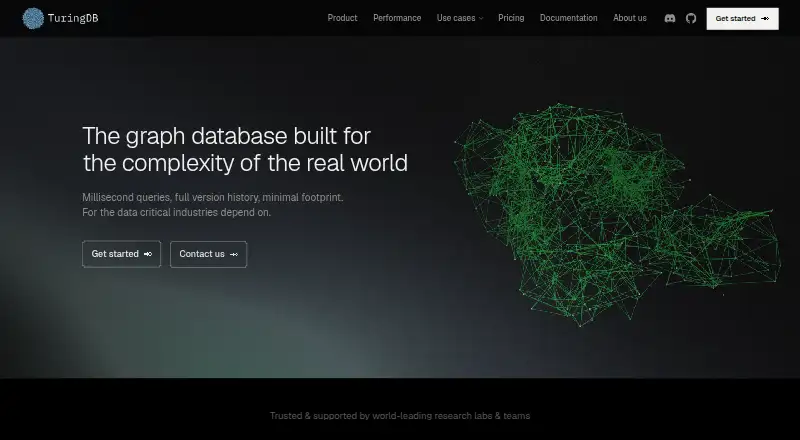
TuringDB is an in-memory, columnar graph database with Git-style versioning built into its engine.
What TuringDB is
TuringDB is an in-memory, columnar graph database with Git-style versioning built into its engine. It supports OpenCypher and multi-hop graph traversals, which its maker says return in milliseconds. Users can branch, merge, compare, roll back, and query earlier graph versions. The FAQ says one machine can hold hundreds of millions of nodes and billions of edges. Its immutable data architecture supports concurrent reads and writes with full snapshot isolation, according to the FAQ; ACID transactions and graph algorithms are also supported. Vector search is built in. Import formats include JSONL, CSV, Neo4j, GML, and Parquet, and the product includes a Python SDK. TuringDB can run as a self-hosted server, on-premise, or in an air-gapped environment, or be embedded and driven from Python. The Community plan is free and provides full source access. The maker highlights use in biopharma and life sciences, financial services, healthcare, supply chains, defense, and infrastructure.
Good
- Supports OpenCypher and multi-hop traversals
- Users can branch, merge, and query historical versions
- Includes built-in vector search
- Community plan offers full source access
- Can be deployed on-premise or air-gapped
Watch out
- Advanced security and permissions are listed for Enterprise
Who it suits
TuringDB may suit developers and organizations working with connected data, including the industries its maker highlights. Its deployment options include self-hosting, on-premise and air-gapped use, or embedding through Python.
Verdict
TuringDB combines graph querying with version history and several deployment approaches. The free Community plan and paid Enterprise option serve different needs; advanced security and dedicated support are listed with Enterprise.
Plans and prices
From TuringDB's own pricing page, checked 5 Oct 2026.
| Plan | Price | What it gives you |
|---|---|---|
| Community | Free | Self-hosted · run anywhere with pip and Docker · full source access |
| Enterprise | Priced on request | Cloud, on-prem, or hybrid · advanced security and permissions · horizontal scale and high availability · dedicated support and integrations · From $5,000 |
| Custom | Priced on request | Managed with you · bespoke graph applications, visualisation, modeling, data integration, and engineering · License & AEs |
The facts
Each one read from TuringDB's own pages, with the date it was checked.
The company
- Company
- Turing Biosystems says it founded the company to integrate multimodal data and build digital twins of biological systems, and that its graph engine became TuringDB.checked 5 Oct 2026
- Headquarters
- The maker lists Turing Biosystems Ltd. in London and Lyon.checked 5 Oct 2026
What it does
- Concurrency
- Its immutable data architecture supports concurrent reads and writes with full snapshot isolation, according to the FAQ.checked 5 Oct 2026
- Deployment
- TuringDB can be self-hosted as a server, deployed on-premise or air-gapped, or embedded and driven from Python.checked 5 Oct 2026
- Integrations
- The documentation lists JSONL, CSV, Neo4j, GML, and Parquet as data import formats, and the product includes a Python SDK.checked 5 Oct 2026
- Product
- TuringDB is an in-memory, columnar graph database with Git-style versioning built into its engine.checked 5 Oct 2026
- Querying
- It supports Cypher and offers multi-hop graph traversals that the maker says return in milliseconds.checked 5 Oct 2026
- Scale
- The FAQ says TuringDB can hold hundreds of millions of nodes and billions of edges on a single machine.checked 5 Oct 2026
- Security and audit
- The Enterprise plan includes advanced security and permissions plus data access and change logging.checked 5 Oct 2026
- Support
- The Enterprise plan includes dedicated support and integrations.checked 5 Oct 2026
- Vector search
- Vector search is built into the engine.checked 5 Oct 2026
- Version history
- Users can branch, merge, diff, roll back, and query historical graph versions.checked 5 Oct 2026
- Who it serves
- The maker highlights use in biopharma and life sciences, financial services, healthcare, supply chains, defense, and infrastructure.checked 5 Oct 2026
Alternatives to TuringDB
- 1

ArcadeDB
Free planOpen sourceWebAPILinuxmacOS8.3From $19.99 a month - 2
NebulaGraph
Free planOpen sourceWebAPILinuxmacOS8.1Free plan - 3
Eclipse RDF4J
Free planOpen sourceWebAPILinuxmacOS7.6Free plan - 4

Sparksee
Free planAndroidiOSAPILinux7.6Free plan - 5

FalkorDB
Free planWebAPILinuxSelf-hosted7.5From $73 a month - 6
LadybugDB
Free planAndroidiOSWebAPI7.4Free plan