The Org
The Org is a network of public organization charts, with tools for sales teams, recruiters and people researching companies.
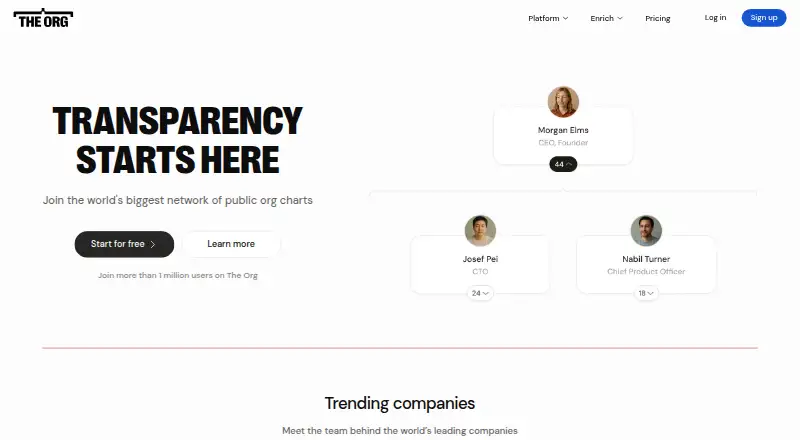
What The Org is
The Org is a network of public organization charts, with tools for sales teams, recruiters and people researching companies. It says it has more than 1 million users; its business solutions page lists 850,000 organizations, 51 million positions and 5 million changes per month. Sales teams can use its data to identify relevant buyers within organizations, while recruiters can look for emerging talent. Its browser extension for Chrome and Microsoft Edge places a LinkedIn profile within its organization chart context and provides contact details for positions shown in charts. Enrichment apps can add charts to HubSpot contact and company records and Salesforce Account and Contact records. Developer options include an API, Zapier integrations, flat-file delivery and chart embeds. The Org says its data comes from public internet pages and community contributors. People can join their company to update position pages, report inaccuracies or opt out of appearing. The free plan includes limited organization views, one seat and 10 credits per seat per month.
Good
- Free plan includes one seat and 10 monthly credits.
- Chrome and Edge extension provides chart context for LinkedIn profiles.
- Charts can appear in HubSpot and Salesforce records.
- API, Zapier, flat-file delivery and chart embeds are available.
- People can correct position pages or opt out.
Watch out
- Free plan limits organization views and includes one seat.
- Enterprise plan requires a minimum 12-month commitment.
Who it suits
It may suit sales teams identifying buyers, recruiters exploring talent within organizations and users who need organization charts alongside CRM records. Its free plan is an option for users with limited viewing needs.
Verdict
The Org combines public organization charts with browser, CRM and developer access for sales and recruiting use. Review the free-plan limits and annual paid-plan terms against your expected usage.
Plans and prices
From The Org's own pricing page, checked 14 Oct 2026.
| Plan | Price | What it gives you |
|---|---|---|
| free | Free | Limited organization views · 1 seat per account · 10 credits per seat/month · $0.05 per additional credit · $0 billed yearly |
| basic | $19.33 a month | Unlimited organization views · Unlimited contact reveals · 1 seat · 12,000 credits per seat/year · Advanced people and jobs filtering · $232 per seat billed yearly + tax |
| premium | $32.67 a month | Unlimited organization views · Unlimited contact reveals · 1–10 seats · 24,000 credits per seat/year · Contact export · Collaboration features · $392 per seat billed yearly + tax |
| enterprise | Priced on request | 10+ seats · 48,000 credits per seat/year · $0.02 per additional credit · Research requests · Account management · Minimum 12 month commitment |
The facts
Each one read from The Org's own pages, with the date it was checked.
What it does
- API credits
- Accounts receive 100 API credits monthly under the documented universal credit system, with enterprise allowances potentially customized or unlimited.checked 14 Oct 2026
- API endpoint
- The REST API is served from https://api.theorg.com/v1.1 and requires an X-Api-Key header over HTTPS.checked 14 Oct 2026
- API rate limit
- Each API key is limited to 15 requests per second, with additional sliding-window limits on credit-free routes.checked 14 Oct 2026
- Contact information
- The platform provides professional contact details for networking and outreach.checked 14 Oct 2026
- CRM integrations
- Official enrichment apps place The Org charts in HubSpot and Salesforce and allow one-click contact creation.checked 14 Oct 2026
- Data coverage
- The business solutions page lists 850,000 organizations, 51 million positions, and 5 million changes per month.checked 5 Oct 2026
- Data sources
- The Org says its data comes from company websites, news aggregation, public LinkedIn monitoring and user-generated content.checked 14 Oct 2026
- Developer access
- The developer platform documents an API, Zapier integrations, flat-file delivery, and org chart embeds.checked 5 Oct 2026
- Documentation depth
- Documentation covers getting started, authentication, rate limits, credits, data models, endpoint references and a dated changelog.checked 14 Oct 2026
- Founding
- The Org says Christian Wylonis and Andreas Jarbøl founded it in November 2017.checked 14 Oct 2026
- Funding
- The Org says it has raised more than $30 million from investors including Sequoia Capital, Founders Fund, Tiger Global and Balderton Capital.checked 14 Oct 2026
- Greenhouse integration
- Greenhouse is the only ATS integration currently offered for automatically synchronizing open jobs.checked 14 Oct 2026
- Historical scale
- A September 2021 TechCrunch report said The Org hosted about 130,000 public org charts, had more than 120,000 registered users and saw about 30,000 daily visitors.checked 14 Oct 2026
- Job discovery
- Companies can place open roles inside their org charts so candidates can see the role's team and reporting context.checked 14 Oct 2026
- Legal entity
- Crunchbase identifies the legal name as Orgio, Inc.checked 14 Oct 2026
- License terms
- The terms grant a revocable, non-transferable, non-exclusive limited license for personal noncommercial website use and prohibit copying, reverse engineering and commercial exploitation.checked 14 Oct 2026
- Limit: extension paywall
- Chrome extension reviewers complain that the extension immediately requires a paid account and offers no useful preview before upgrading.checked 14 Oct 2026
- Limit: G2 exports and hierarchy
- G2 reviewers report difficulty downloading or printing charts and say displayed seniority can be misleading when roles share a reporting level.checked 14 Oct 2026
- Limit: Trustpilot privacy complaints
- Trustpilot reviewers repeatedly complain that profiles were created from public or LinkedIn data without consent, contained inaccuracies and were difficult to remove.checked 14 Oct 2026
Where it runs
- Browser extension
- The Org's browser extension displays a LinkedIn profile's role and organization context and supports saved contact lists.checked 14 Oct 2026
The company
- Company pages
- Company pages show organizational membership, reporting lines and decision-makers.checked 14 Oct 2026
- Company size and headquarters
- LinkedIn lists The Org as a privately held software company with 11–50 employees headquartered in New York, New York.checked 14 Oct 2026
- Founded
- The Org says Christian Wylonis and Andreas Jarbøl founded it in November 2017.checked 5 Oct 2026
- Headquarters
- New York, United Stateschecked 28 Sep 2026
The full review of The Org
The Org is a public organization-chart network with tools for sales and recruiting workflows. It suits teams that need role and reporting context alongside prospect data, particularly in LinkedIn, HubSpot, or Salesforce. The main trade-off is that useful team access and higher data allowances require paid seats.
Overview
The Org reports more than 1 million users and covers 850,000 organizations, 51 million positions, and 5 million changes per month. That scale makes it a substantial source for mapping decision-makers and following organizational movement. Its data comes from public internet pages and community contributors, including company team pages, news announcements, public LinkedIn profiles, and user-generated content, so it is best treated as prospecting context rather than an authoritative employee record.
The service was founded in 2017 and is headquartered in New York. Privacy controls let people join their company to edit position pages, report inaccurate information, or opt out of appearing. The Trust Center says security work is progressing toward ISO 27001/2 alignment and SOC 2 certification. Support is handled through The Org Support Center.
Key features
Charts for sales and recruiting
The Chrome and Microsoft Edge extension places a LinkedIn profile inside its organization chart and supplies contact information for chart positions. Sales teams can use that surrounding structure to identify relevant buyers, while recruiters can look for promising people who may be ready for another opportunity. The benefit is relationship and role context instead of an isolated contact; the limitation is that completeness and accuracy depend on public and community-contributed data.
CRM and browser workflows
Enrichment apps put organization charts directly into HubSpot contact and company records and Salesforce Account and Contact records. That is a practical fit for teams that already work in those systems and want company structure visible during account research. Teams using another CRM do not receive the same documented integration advantage.
Developer access
The developer platform documents an API, Zapier integrations, flat-file delivery, and embeddable organization charts. These options support automated enrichment, no-code workflows, data-file processes, or chart experiences inside another product. API access is available, but the plan and credit allowance still determine how much data a team can use.
Pricing
The free plan costs nothing, billed $0 billed yearly. It permits limited organization views, one seat per account, and 10 credits per seat/month; additional credits cost $0.05 each. This is suitable for an individual evaluating the directory or handling occasional lookups, not for sustained prospecting.
Basic costs $19.33 per user per month, billed $232 per seat billed yearly plus tax. It adds unlimited organization views, one seat, 12,000 credits per seat/year, $0.04 additional credits, and advanced people and jobs filtering. It is the economical choice for one heavy user, but the single-seat limit rules it out for shared team workflows.
Premium costs $32.67 per user per month, billed $392 per seat billed yearly plus tax. Accounts can have 1–10 seats, with 24,000 credits per seat/year and $0.03 additional credits. Advanced people and jobs filtering remain, while CSV and CRM contact export plus collaboration features make this the more credible plan for a small sales or recruiting team.
Enterprise uses custom pricing with a minimum 12-month commitment and supports 10 or more seats. Each seat receives 48,000 credits per year, additional credits cost $0.02, and the package adds research requests and account management. It fits larger programs that need volume and service support, but the annual commitment warrants a clear usage forecast. A 7-day trial is offered for paid evaluation.
Platforms
The Org is available on the web, through its API, and as a browser extension. The extension supports Google Chrome and Microsoft Edge. This combination covers normal browser research, CRM or automation work, and developer-led integration.
Who it's for
Choose The Org when sales development depends on identifying buyers within complex organizations, or when recruiting teams need to understand where promising people sit in a company. Premium is the practical starting point for small groups needing exports, collaboration, and multiple seats; Basic suits a single researcher. The free plan is mainly an introductory option because its one-seat, limited-view, and low credit allowance constrain regular use.
Pros and cons
Pros
- Large stated coverage of organizations, positions, and monthly changes supports broad account mapping.
- Charts connect LinkedIn profiles with surrounding roles and contact information, giving prospecting useful organizational context.
- HubSpot, Salesforce, API, Zapier, flat-file, and embed options fit established sales and developer workflows.
- Premium adds exports and collaboration, while Enterprise adds research requests and account management.
Cons
- The free account is limited to one seat, limited organization views, and 10 credits per seat/month.
- Basic remains one seat, so team adoption begins at Premium pricing.
- Credit overages cost extra on every plan, making high-volume usage harder to budget.
- Public and community-sourced data can require correction and should not be assumed complete.
- Enterprise requires a minimum 12-month commitment and custom pricing.
Alternatives
Org Chart Software is the broader category guide for comparing chart products. Pick Org Chart Studio for simple web charts with a free 250-person, watermarked PNG plan or a $1 one-day clean export. orgchart.live is better when you want unlimited people and charts, spreadsheet/CSV/Excel import, and live editing at no subscription cost. Choose OrgChartBuilder for self-hosted deployment and a forever-free 200-employee plan. OrgNice suits teams wanting Google Sheets connection, sharing, and embedding on its annually billed Standard plan at $20.00 per month. Maptio is the alternative for open-source, self-hosted software. Organimi fits a small internal chart starting with 25 employees, one admin, and one chart free. Our Org Chart is a simpler choice for CSV/PNG export, Google Workspace, and available AI assistance. SharePoint Smart Org Chart & Directory is the fit for a free, MIT-licensed SharePoint Online web part without per-user licensing.
Verdict
The Org is a strong choice for sales and recruiting teams that need public organization structure tied to people discovery, CRM records, or developer workflows. Its scale, chart-based context, and Premium integrations justify the cost for active prospecting programs. Look elsewhere if you need a low-cost multi-user chart maker, guaranteed authoritative personnel data, or an open-ended free plan.
Alternatives to The Org
- 1

Maptio
Open sourceWebSelf-hosted7.8From $10 a month - 2

Sift
AndroidiOSWebAPI7.8From $150 a month - 3

OrgNice
Free planWebExtension7.3From $30 a month - 4

Our Org Chart
Free planWebExtensionSelf-hosted7.2From $5 a month - 5

OrgChart
WebAPI6.9From $105 a month - 6

TeamOrgChart
Web6.9From $200 a year