Real-ESRGAN
Real-ESRGAN is an open-source project developing algorithms for image and video restoration.
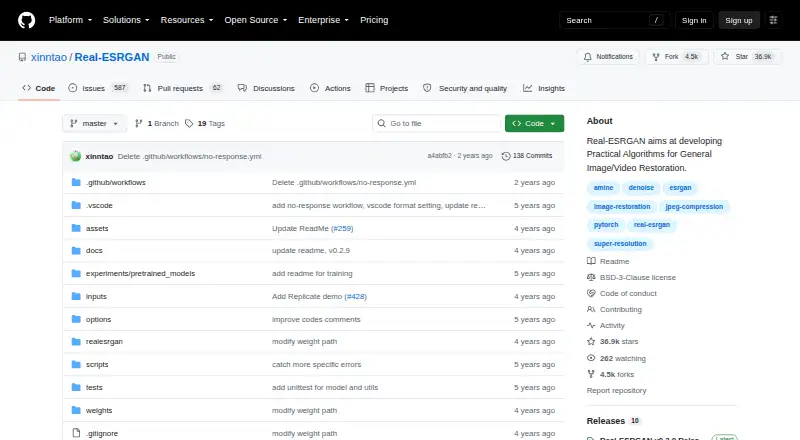
What Real-ESRGAN is
Real-ESRGAN is an open-source project developing algorithms for image and video restoration. It provides pretrained models for general images, anime images, and animation video, with image inputs including JPG, PNG, and WEBP. Portable inference supports 2×, 3×, or 4× scaling, while the Python implementation allows arbitrary output scaling. Supported image types include alpha-channel, grayscale, and 16-bit images, and GFPGAN is integrated for face enhancement. Portable NCNN executables are available for Windows, Linux, and macOS, with required binaries and models included; they do not require a CUDA or PyTorch environment. These portable builds do not include every function in the Python inference script, including its outscale option. Python use requires Python 3.7 or newer and PyTorch 1.7 or newer. Online inference is available through a Tencent ARC demo and Colab demos. The project uses pure synthetic training data, and its training code supports fine-tuning on a user’s own data or paired data. Real-ESRGAN is released under the BSD 3-Clause license.
Good
- Open-source under the BSD 3-Clause license.
- Portable inference supports 2×, 3×, or 4× scaling.
- Portable builds include required binaries and models.
- Supports alpha-channel, grayscale, and 16-bit images.
- Training code supports fine-tuning on user data.
Watch out
- Portable executables omit some Python features, including outscale.
- Python implementation requires Python 3.7 or newer.
- Python implementation requires PyTorch 1.7 or newer.
Who it suits
Real-ESRGAN may suit developers and users seeking image or video restoration models, including tools for general images and anime. Its portable executables offer a route that does not require CUDA or PyTorch, while Python users can access arbitrary output scaling and training customization.
Verdict
Real-ESRGAN offers pretrained restoration models and portable executables, with additional scaling and customization options in Python. Choose the implementation based on whether its portable feature limits or Python requirements fit your workflow.
The facts
Each one read from Real-ESRGAN's own pages, with the date it was checked.
What it does
- Batch processing
- Yeschecked 20 Sep 2026
- Custom training
- The project supports finetuning on users' own data or paired data.checked 27 Sep 2026
- Dependencies
- The Python installation instructions specify Python 3.7 or later and PyTorch 1.7 or later.checked 2 Oct 2026
- Face enhancement
- Its inference code can use GFPGAN to enhance faces.checked 2 Oct 2026
- Image enhancement
- The project provides pretrained models for general images and anime images, including a smaller anime model.checked 2 Oct 2026
- Image options
- The inference code supports tiling, alpha-channel images, grayscale images, and 16-bit images.checked 2 Oct 2026
- Image support
- The inference code supports tile options, alpha-channel images, grayscale images, and 16-bit images.checked 1 Oct 2026
- Input formats
- The executable accepts JPG, PNG, and WebP images.checked 27 Sep 2026
- Integrations
- The README says Real-ESRGAN was integrated into Hugging Face Spaces with Gradio and links to a web demo.checked 2 Oct 2026
- License
- The repository includes a BSD 3-Clause license that permits redistribution and use in source and binary forms subject to its conditions.checked 2 Oct 2026
- Licensing
- The repository is distributed under the BSD 3-Clause License, which permits redistribution and use in source and binary forms with conditions.checked 1 Oct 2026
- Limitations
- The README says the portable NCNN executable lacks some Python-script features, such as arbitrary outscale, and tile processing can cause block inconsistencies.checked 2 Oct 2026
- Maximum scale
- customchecked 20 Sep 2026
- Model options
- Provided models include general, anime-image, anime-video, and Real-ESRNet variants.checked 27 Sep 2026
- Models
- The project provides models for general images, anime images, and animation video.checked 1 Oct 2026
- Online inference
- Online inference is available through an ARC Demo and Colab demos.checked 27 Sep 2026
- Open-source license
- Released under the BSD-3-Clause license.checked 27 Sep 2026
- Operating systems
- The project lists portable executable files for Windows, Linux, and macOS.checked 2 Oct 2026
- Output formats
- The executable can output JPG, PNG, and WebP images.checked 27 Sep 2026
- Output scaling
- The Python script supports arbitrary output scaling with the --outscale option and resizes after model inference.checked 2 Oct 2026
- Portable dependencies
- The portable executable includes required binaries and models and does not need CUDA or a PyTorch environment.checked 1 Oct 2026
Where it runs
- Desktop app
- Yeschecked 20 Sep 2026
- Online demos
- Online inference is available through the Tencent ARC Demo and two Colab demos.checked 1 Oct 2026
Money
- Free plan
- Yeschecked 20 Sep 2026
The full review of Real-ESRGAN
Overview
Real-ESRGAN is an open-source project for AI-based image and video restoration, with pretrained models for general imagery, anime, and animation. It suits users who want control over the restoration workflow and are comfortable choosing between a portable executable and a Python setup. Its breadth is a strength, but the portable version omits some Python features.
Released under the BSD-3-Clause license, the project permits use and redistribution in source and binary forms subject to the license conditions. Its repository has 36.9k stars and 4.5k forks, a sign of substantial developer interest rather than a guarantee of support or results. Browse Image Upscaling Software, Video Upscaling Software, AI Image Upscalers, and AI Video Upscalers to compare categories.
Key features
Model selection and restoration
Models cover general images, anime images, and anime video, with Real-ESRNet variants, a smaller anime-image model, and AnimeVideo-v3 alongside small anime-video models. GFPGAN integration adds face enhancement. That range makes the project useful for mixed image workflows and animation, rather than only one narrow image style.
Training uses synthetic data, and the released training code supports finetuning on a user's own or paired data. That is valuable for users prepared to customize a model; it is a technical option, not a turnkey benefit for someone seeking a simple hosted service.
Scaling and formats
The portable executable supports 2x, 3x, and 4x scaling, with 4x as the default. Python inference adds arbitrary output scaling through --outscale and includes the RealESRGAN_x2plus model. Because portable inference does not support all Python functions, users needing precise output sizing should favor the Python route.
Inference handles alpha-channel, grayscale, and 16-bit images, as well as JPG, PNG, and WEBP inputs. The executable can save JPG, PNG, or WebP, and batch processing is supported. These capabilities make it more flexible than a single-file, single-format upscaler, though the portable format and scale constraints still matter.
Ways to run it
Portable NCNN executables are available for Windows, Linux, and MacOS for Intel, AMD, and Nvidia GPUs. They bundle required binaries and models and do not require CUDA or a PyTorch environment, reducing setup demands for users who can work within their limits. The Python implementation requires Python 3.7 or newer and PyTorch 1.7 or newer, a better fit for users who need its fuller feature set and can manage those dependencies.
Online inference is available through the Tencent ARC Demo and two Colab demos. Hugging Face Spaces integration uses Gradio; related projects include NCNN-Android and VapourSynth. These routes expand how the models can be accessed, but do not replace the flexibility of running the Python implementation.
Pricing
Real-ESRGAN is free and open source under BSD-3-Clause. There is no paid plan to compare: the choice is between using the supplied portable executables, setting up Python and PyTorch, or trying the online demos. The repository also provides a pricing page URL, but that page returns Page not found.
Platforms
The project supports Linux, macOS, Windows, self-hosted use, and web-based access through online inference. Portable downloads target Windows, Linux, and MacOS across Intel, AMD, and Nvidia GPUs. The Python implementation is the option for users who need features unavailable in the portable executable.
Who it's for
Real-ESRGAN is a strong fit for technically capable users who want free restoration models, batch processing, multiple image types, and choices for general or anime content. It is also worth considering for users who want to finetune on their own data or process animation video.
It is less suitable for someone who wants a single polished application with no setup decisions, or who needs Python-only scaling features without installing Python and PyTorch. Users looking for a bounded hosted allowance or a more straightforward service may prefer an alternative.
Pros and cons
- Pro: General, anime, and anime-video models, plus GFPGAN face enhancement, serve several restoration needs in one project.
- Pro: Portable executables bundle their dependencies and models, avoiding CUDA and PyTorch setup.
- Pro: Batch processing and support for alpha, grayscale, and 16-bit images offer practical flexibility.
- Con: Portable inference lacks some Python functions, including arbitrary output scaling.
- Con: The Python route requires Python 3.7+ and PyTorch 1.7+, which adds setup for users seeking the fullest control.
Alternatives
NextGenUp is another free, open-source option, with a completely free plan and no trial limit or subscription; consider it if those stated terms are your priority.
Bigjpg suits readers who prefer a freemium service across web, desktop, and mobile platforms; its free plan caps use at 20 pictures per month, 5MB uploads, and 4x enlargement, with slow speed and a shared server.
LetsEnhance is a freemium API option whose free plan provides 10 credits, 24-megapixel input, 50MB input size, and 8-megapixel output. Choose it when those stated API limits match the job.
PixelPanda Image Upscaler offers API, extension, and web access, with one-time purchases of 10 credits for $1.99 a month or 50 credits for $10 a month; it may suit readers who prefer credit packs to a subscription.
Upscayl offers a 10-credit free trial and a Pro plan at $24.99 a month; consider it if a trial-based paid plan fits better than using Real-ESRGAN directly.
PicWish Image Upscaler is a freemium API alternative with limited non-HD daily downloads on its free plan and daily HD downloads for most online features on Pro.
SupaRes is a freemium API option whose free plan provides 10 processing credits, 64 megapixels, and one user; consider it when those bounded limits suit your workload.
Upscale.media provides a free plan with three credits and three downloads each month, making it an option for occasional API use within that monthly allowance.
Verdict
Choose Real-ESRGAN if you want a free, open-source restoration project with broad model coverage, batch support, and a portable route that avoids CUDA and PyTorch. Its main trade-off is the split between portability and control: users who need arbitrary scaling or other Python-only features must accept the Python and PyTorch requirements, while users wanting a more managed workflow should look elsewhere.
Alternatives to Real-ESRGAN
- 1
Cutout.Pro
Free planAndroidiOSWebAPI8.5From $5 a month - 2

Krea Enhancer
Free planiOSWebAPISelf-hosted8.4Free plan - 3

Bigjpg
Free planAndroidiOSWebAPI8.4$6 one-time - 4
Phot.AI
Free planAndroidiOSWebAPI8.4From $9 a month - 5

Pixelcut
Free planAndroidiOSWebAPI8.4From $8 a month - 6
Upscal
Free planiOSmacOSWindows8.3Free plan