
QuestDB
QuestDB is a time-series database for environments where low latency matters.
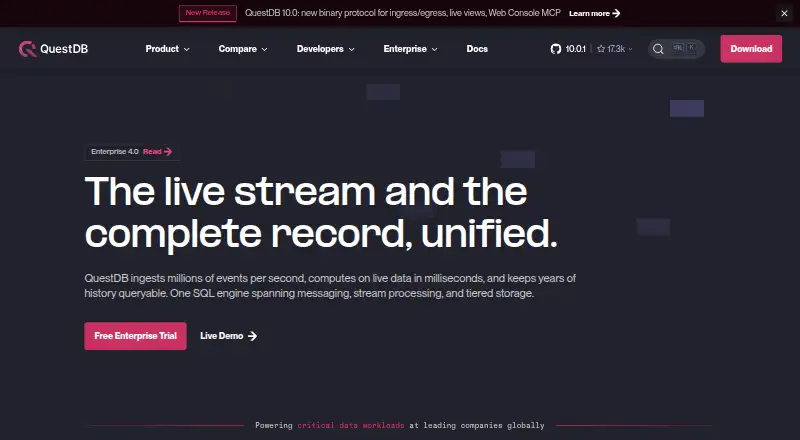
What QuestDB is
QuestDB is a time-series database for environments where low latency matters. It provides standard SQL, a vectorized execution engine, and time-series extensions such as SAMPLE BY, ASOF, and HORIZON JOIN. QuestDB advertises ingestion speeds of 8M+ rows per second. Its Open Source edition is self-managed and available as binaries, containers, and source code. It supports Parquet storage and PostgreSQL Wire Protocol compatibility, with ingestion options that include QuestDB Wire Protocol, InfluxDB Line Protocol, REST API, client libraries, SQL INSERT, Kafka connector, and CSV import. Listed integrations include Grafana, Power BI, Apache Kafka, Telegraf, Redpanda, Apache Flink, Pandas, and Apache Spark. Open Source is free, single-instance, and community-supported. Enterprise adds TLS, role-based access controls, audit logs, OAuth 2.0/OIDC single sign-on, replication, automatic failover, and dedicated engineering support with response-time SLAs. It also offers hot storage and Parquet or Iceberg tables on object storage. Open Source basic authentication uses unencrypted transmission. The site states QuestDB is SOC 2 Type 2 compliant and offers a free Enterprise trial, without stating its duration.
Good
- Open Source edition is free and self-managed.
- Supports standard SQL and time-series extensions.
- Offers Parquet storage and PostgreSQL Wire Protocol compatibility.
- Lists integrations including Grafana and Apache Kafka.
- Enterprise includes replication and automatic failover.
Watch out
- Open Source is limited to a single instance.
- Open Source authentication uses unencrypted transmission.
- Open Source support is community-based.
Who it suits
QuestDB is suited to teams managing time-series data in low-latency environments. Its stated users include capital-markets firms, digital-asset businesses, energy operators, aerospace companies, and robotics firms.
Verdict
QuestDB offers a free self-managed edition alongside an Enterprise option with added security, availability, storage, and support features. The unencrypted transmission noted for Open Source is important to consider when evaluating deployment needs.
Plans and prices
From QuestDB's own pricing page, checked 30 Sep 2026.
| Plan | Price | What it gives you |
|---|---|---|
| QuestDB Open Source | Free | Apache 2.0 core · self-managed · single instance · community support |
| QuestDB Enterprise | Priced on request | Production deployments · replication and failover · RBAC, TLS and SSO · tiered storage · dedicated support with SLAs |
The facts
Each one read from QuestDB's own pages, with the date it was checked.
What it does
- Audience
- QuestDB says its users include capital-markets firms, digital-asset businesses, energy operators, aerospace companies, and robotics firms.checked 30 Sep 2026
- Availability
- QuestDB Enterprise advertises replication, automatic failover, and a 99.9% uptime guarantee.checked 30 Sep 2026
- Compliance
- QuestDB's site states that it is SOC 2 Type 2 compliant.checked 30 Sep 2026
- Data formats
- QuestDB supports Parquet storage and PostgreSQL Wire Protocol compatibility with existing tools and drivers.checked 30 Sep 2026
- Deployment
- QuestDB Open Source is self-managed and is available as binaries, containers, and source code.checked 30 Sep 2026
- Enterprise security
- QuestDB Enterprise offers TLS encryption, role-based access control, audit logs, and single sign-on through OAuth 2.0/OIDC.checked 30 Sep 2026
- Ingestion
- QuestDB advertises ingestion speeds of 8M+ rows per second.checked 30 Sep 2026
- Integrations
- QuestDB lists Grafana, Power BI, Apache Kafka, Telegraf, Redpanda, Apache Flink, Pandas, and Apache Spark among its integrations.checked 30 Sep 2026
- Open source security limit
- The Enterprise comparison says Open Source provides basic authentication over unencrypted transmission.checked 30 Sep 2026
- Product
- QuestDB is a time-series database for mission-critical environments where low latency matters.checked 30 Sep 2026
- Querying
- QuestDB provides a vectorized execution engine, standard SQL, and time-series extensions including SAMPLE BY, ASOF, and HORIZON JOIN.checked 30 Sep 2026
- SQL support
- Yeschecked 22 Sep 2026
- Storage
- Enterprise supports hot storage plus Parquet and Iceberg tables on object storage, including Amazon S3, Azure Blob, and GCS.checked 30 Sep 2026
- Support
- Enterprise includes dedicated access to QuestDB engineers and guaranteed response-time SLAs; Open Source has community support.checked 30 Sep 2026
The company
- Founded
- 2019checked 23 Sep 2026
- Headquarters
- London and New Yorkchecked 23 Sep 2026
Money
- Free plan
- Yeschecked 22 Sep 2026
- Trial
- QuestDB offers a free Enterprise trial, but the page does not state its duration.checked 30 Sep 2026
The full review of QuestDB
Overview
QuestDB is a time-series database for teams handling fast-moving data where low-latency queries matter. Its SQL support, ingestion options, and self-managed edition make it a strong fit for technical teams that want control over deployment. Choose Enterprise when security, failover, or guaranteed support are essential; Open Source’s unencrypted transmission is a meaningful production constraint.
Key features
High-throughput ingestion and SQL
QuestDB advertises ingestion speeds of 8M+ rows per second, a compelling target for demanding streams, though real-world throughput depends on workload. Data can arrive through QuestDB Wire Protocol, InfluxDB Line Protocol, REST API, native client libraries, SQL INSERT, a Kafka connector, or CSV import. That range suits teams integrating varied pipelines without giving up SQL access.
A vectorized execution engine supports standard SQL alongside time-series extensions such as SAMPLE BY, ASOF, and HORIZON JOIN. These tools are aimed at time-oriented analysis; PostgreSQL Wire Protocol compatibility can also ease use with existing tools and drivers. Retention policies and horizontal scaling round out the database capabilities.
Formats and integrations
QuestDB supports Parquet storage and lists Grafana, Power BI, Apache Kafka, Telegraf, Redpanda, Apache Flink, Pandas, and Apache Spark integrations. That breadth gives data teams several routes into analytics and downstream processing. The query interfaces include QuestDB SQL, PostgreSQL Wire Protocol, REST API, and Apache Parquet.
Enterprise controls
Enterprise adds TLS encryption, role-based access control, audit logs, and OAuth 2.0/OIDC single sign-on. It also advertises replication, automatic failover, and a 99.9% uptime guarantee. Hot storage can be paired with Parquet and Iceberg tables on Amazon S3, Azure Blob, or GCS. Dedicated access to QuestDB engineers and guaranteed response-time SLAs make this the more appropriate option for organizations with operational commitments.
Open Source instead provides basic authentication over unencrypted transmission, single-instance deployment, and community support. That may be acceptable for self-managed projects whose security and availability needs are modest, but it is a poor fit when encrypted transport or failover is a requirement. QuestDB states that it is SOC 2 Type 2 compliant.
Pricing
QuestDB Open Source
At free, the Apache 2.0 core is self-managed, limited to a single instance, and supported by the community. It is the straightforward choice for teams that want a free deployment and can operate without Enterprise security, replication, or dedicated support.
QuestDB Enterprise
Enterprise has custom pricing for production deployments. It includes replication and failover, RBAC, TLS and SSO, tiered storage, and dedicated support with SLAs. This plan is better suited to production environments where availability and security justify a paid arrangement.
Platforms
QuestDB supports API, Linux, macOS, self-hosted, web, and Windows environments. Open Source is available as binaries, containers, and source code, giving operators deployment control across supported settings.
Who it's for
QuestDB is aimed at teams with time-series workloads and low-latency requirements. Its maker names capital-markets firms, digital-asset businesses, energy operators, aerospace companies, and robotics firms among its users. SQL familiarity and broad ingestion methods can suit data engineering teams; organizations that need encrypted connections, controlled access, or high availability should consider Enterprise rather than the single-instance Open Source edition.
Pros and cons
- Pros: Ingestion options span protocols, APIs, clients, SQL, Kafka, and CSV, which can accommodate varied data pipelines.
- Pros: Standard SQL, PostgreSQL Wire Protocol compatibility, and time-series extensions bring familiar querying alongside purpose-built operations.
- Pros: Enterprise combines encryption, access controls, failover, tiered storage, and SLA-backed support for production needs.
- Cons: Open Source is single-instance and sends traffic over unencrypted transmission, limiting its suitability for deployments with strict security or availability requirements.
- Cons: Enterprise pricing is custom, so buyers must obtain a quote to assess cost.
Alternatives
Exasol is worth considering for buyers seeking a freemium database with pay-as-you-go compute plans, including XS at $3.30 a month and S at $6.60 a month.
CrateDB offers a free shared tier capped at 2 vCPUs, 2 GiB RAM, and 8 GiB storage, a defined entry point for teams comparing resource-bounded hosted use with QuestDB’s self-managed free edition.
Apache Druid is another free, open-source analytics database available for self-hosting.
DuckDB UI is a free local browser-based DuckDB interface with a SQL notebook and optional MotherDuck connection, a different choice for local querying.
Teradata VantageCloud is a freemium option with a free trial for teams evaluating that platform.
Apache Kylin is a free open-source OLAP engine distributed as source and binary packages under Apache License v2.
MonetDB is a free, open-source database under the Mozilla Public License 2.0.
Oracle Autonomous AI Lakehouse provides an always-free usage tier for an unlimited time, subject to capacity limits, and may suit readers comparing cloud lakehouse options.
Browse Time-Series Databases, OLAP Databases, Columnar Databases, OLAP Software, and Database Software.
Verdict
QuestDB is a strong choice for engineering teams that need a self-managed time-series database with SQL, flexible ingestion, and a free Apache 2.0 core. Its central trade-off is clear: Open Source’s single-instance model and unencrypted transmission keep it from meeting every production requirement, while Enterprise addresses those gaps at custom pricing. Choose QuestDB when time-series performance and deployment control lead; look elsewhere if the free edition’s security and availability limits are deal-breakers or Enterprise costs do not fit.
Alternatives to QuestDB
- 1

TDengine
Free planOpen sourceWebAPILinuxmacOS8.3Free plan - 2

Amazon Timestream
Free planWebAPILinuxmacOS7.9Free plan - 3

Apache IoTDB
Free planOpen sourceWebAPILinuxmacOS7.7Free plan - 4

InfluxDB
Free planWebAPILinuxmacOS7.4$0.01 usage-based - 5

VictoriaMetrics
Free planWebAPILinuxmacOS7.4From $200 a month - 6

LinDB
Free planWebAPILinuxmacOS6.9Free plan