
LinDB
LinDB is a free, open-source distributed time-series database for IoT and IT operations monitoring.
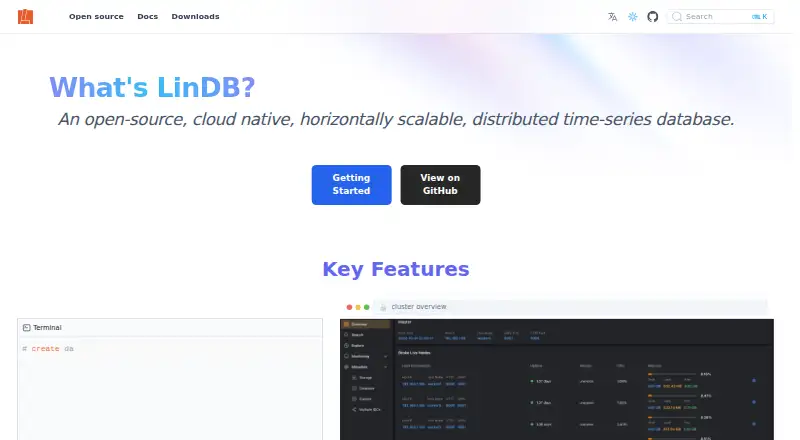
What LinDB is
LinDB is a free, open-source distributed time-series database for IoT and IT operations monitoring. It stores and analyzes metrics from IaaS, PaaS, SaaS, and application layers using a schema-free model of metrics, tags, and fields. LinQL offers SQL-like queries, and users can insert and query data through client libraries or an HTTP REST API. Ingestion supports FlatBuffers, Protocol Buffers, and InfluxDB Line Protocol. The system separates computation from storage, uses ETCD as its only external dependency, and can run in standalone or cluster mode. It supports replicas, horizontal scaling, and operation across multiple IDCs, with automatic minute, hour, and day rollups. Its documentation describes a single server supporting more than one million write transactions per second. Deployment guides cover Linux, Windows, and macOS, with a Docker guide for Linux. LinDB is designed for numeric time-series data with accuracy up to the second; it is not suited to text records or finer time precision.
Good
- Free and open source under Apache 2.0.
- Supports replicas, horizontal scaling, and multiple IDCs.
- Automatically creates minute, hour, and day rollups.
- Provides SQL-like LinQL queries and an HTTP REST API.
Watch out
- Does not support text-based records.
- Time accuracy is limited to the second.
- ETCD is required as an external dependency.
Who it suits
LinDB suits teams monitoring numeric metrics across infrastructure, services, applications, or IoT deployments. It may also fit organizations that need horizontal scaling, replicas, and multi-IDC operation.
Verdict
LinDB brings scaling, replication, and automatic rollups to numeric time-series monitoring. Its second-level time accuracy and lack of support for text records limit the kinds of data it can handle.
Plans and prices
From LinDB's own pricing page, checked 3 Oct 2026.
| Plan | Price | What it gives you |
|---|---|---|
| LinDB | Free | open source · Apache 2.0 |
The facts
Each one read from LinDB's own pages, with the date it was checked.
What it does
- API
- LinDB provides a version 1 HTTP REST API under /api/v1/* for insert, query, and state operations.checked 3 Oct 2026
- Architecture and dependency
- LinDB separates computation and storage, and its documentation identifies ETCD as its only external dependency.checked 2 Oct 2026
- Automatic rollups
- LinDB automatically supports rollups at minute, hour, and day intervals after database creation.checked 2 Oct 2026
- Availability
- LinDB supports multiple replicas and is described as able to keep working with only one replica alive.checked 3 Oct 2026
- Availability and scale
- LinDB supports multiple replicas, horizontal scaling, and operation across multiple IDCs.checked 2 Oct 2026
- Client libraries
- The maker lists Go and Java client libraries and invites contributions for other languages.checked 3 Oct 2026
- Connections
- LinDB provides an admin console, client connections, and an HTTP REST API for inserting and querying data.checked 2 Oct 2026
- Data and time limits
- LinDB currently supports numeric time-series data with time accuracy up to the second; the documentation says it is unsuitable for text records or finer time accuracy.checked 2 Oct 2026
- Data model
- LinDB uses a schema-free multidimensional data model with metrics, tags, and fields.checked 2 Oct 2026
- Deployment
- The documentation describes standalone and cluster modes, and deployment as a binary with ETCD as its external dependency.checked 3 Oct 2026
- Integrations
- The documentation says data ingestion currently supports FlatBuffers, Protocol Buffers, and InfluxDB protocols.checked 3 Oct 2026
- Integrations and protocols
- The documentation describes client libraries including Go and Java, and an HTTP write endpoint that accepts InfluxDB Line Protocol.checked 2 Oct 2026
- Intended use
- The maker describes use for IT operations monitoring and IoT, including monitoring metrics across IaaS, PaaS, SaaS, and application layers.checked 3 Oct 2026
- Limit
- LinDB currently records numeric time-series data with time accuracy up to the second; the documentation says it is not suitable for higher time accuracy or text-based records.checked 3 Oct 2026
- Multi-region
- LinDB supports multiple IDCs, with writes in either IDC and queries and aggregation across IDCs.checked 3 Oct 2026
- Performance
- The maker says a single server could support more than one million write TPS.checked 3 Oct 2026
- Product
- LinDB is an open-source, cloud-native, horizontally scalable distributed time-series database.checked 3 Oct 2026
- Query language
- LinQL provides SQL-like syntax for querying data and performing cluster or database operations.checked 3 Oct 2026
- Rollups
- LinDB automatically supports rollups at minute, hour, and day intervals after database creation.checked 3 Oct 2026
- Security
- The introduction lists self-governance and defensive capability against malicious users as features.checked 3 Oct 2026
- Storage model
- LinDB uses a schema-free multidimensional data model with metrics, tags, and fields.checked 3 Oct 2026
- Support
- The product page links to GitHub channels for feature requests, bug reports, and questions.checked 3 Oct 2026
- Use cases
- The documentation describes LinDB for IoT and IT operations monitoring, including metric storage and analysis for IaaS, PaaS, SaaS, and application layers.checked 2 Oct 2026
Where it runs
- Deployment platforms
- The package guide documents installation on Linux, Windows, and macOS; the product also provides a Docker deployment guide for Linux.checked 2 Oct 2026
The full review of LinDB
LinDB is an open-source time-series database for numeric monitoring data, aimed at teams running IoT or IT operations systems of their own. It is most compelling when horizontal scale and multi-data-center operation matter more than sub-second precision or support for text records.
Overview
LinDB is designed for metrics from infrastructure, platforms, software services, applications, and IoT deployments. Its schema-free model organizes data as metrics, tags, and fields, which suits multidimensional monitoring without requiring a fixed schema in advance.
The maker says a single server could support more than one million write transactions per second. Treat that as a stated capability, not a universal workload guarantee. Computation and storage are separated, and ETCD is the sole external dependency, so deployment has a focused dependency footprint but still requires operators to manage ETCD.
Key features
- Scaling and resilience: Horizontal scaling, multiple replicas, and operation across multiple IDCs support deployments that need to grow or span data centers. LinDB is described as able to keep working with one replica alive, helping preserve service when other replicas are unavailable.
- Cross-IDC data: Writes can go to either IDC, with queries and aggregation across IDCs. This suits distributed monitoring setups that need a broader view than one data center provides.
- Automatic rollups: Minute-, hour-, and day-level rollups are supported after database creation. These built-in intervals can simplify access to coarser summaries, though they do not change the underlying time-accuracy limit.
- Ingestion and access: LinDB offers client connections, an HTTP REST API for inserts and queries, and an admin console. Documented ingestion protocols include FlatBuffers, Protocol Buffers, and InfluxDB Line Protocol; Go and Java client libraries are available, with other languages left to community contributions.
- Query and operations: LinQL uses SQL-like syntax for querying and for cluster or database operations. A version 1 REST API under /api/v1/* also covers insert, query, and state operations.
- Deployment: Standalone and cluster modes are documented, with binary deployment and ETCD as the external dependency. Installation guidance covers Linux, Windows, and macOS, and a Docker guide covers Linux.
The central constraint is data scope: LinDB handles numeric time-series data only, with time accuracy up to the second. It is a poor fit for text-based records or workloads that require finer timestamp precision. The introduction also cites self-governance and defenses against malicious users, but those claims do not remove the need to assess an operator-managed deployment.
Pricing
LinDB is free and open source under Apache 2.0. Its LinDB plan costs nothing, with no separate free trial. There are no paid tiers or seat and usage caps described for this plan; the tradeoff is that teams operate the software themselves rather than selecting a priced hosted plan.
Platforms
LinDB is documented for Linux, Windows, and macOS installation, with Docker deployment guidance for Linux. It also provides a web admin console, client connections, and an HTTP API. Self-hosted operation is central to its deployment model; the API and client interfaces let applications connect programmatically.
Who it's for
LinDB fits engineering teams building self-managed monitoring or IoT systems that collect numeric metrics across infrastructure and application layers. It is especially relevant where horizontal growth, replication, cross-IDC writes and queries, and automatic rollups are useful. Teams needing text records, sub-second timestamps, or a managed service should look elsewhere.
Pros and cons
- Pros: Horizontal scaling and replicas suit growing deployments, and the stated ability to operate with one replica alive adds resilience.
- Pros: Multi-IDC writes and queries let teams combine monitoring data across data centers.
- Pros: Automatic minute, hour, and day rollups provide standard summary intervals without requiring teams to add those rollups manually.
- Pros: Free Apache 2.0 software avoids a license charge and permits self-managed deployment.
- Cons: Numeric records only and second-level accuracy exclude text-heavy and finer-grained time-series use cases.
- Cons: ETCD remains an operational dependency, and the documented binary and cluster deployment model calls for infrastructure ownership.
- Cons: Go and Java are the documented client libraries; teams using other languages may need to contribute a client or use the HTTP interface.
Alternatives
For a broader comparison, browse Time-Series Databases.
- InfluxDB is a freemium option with a free plan and a pay-for-what-you-use Cloud Serverless data-in plan; consider it when that pricing model is a better fit.
- TDengine offers an open-source edition with clustering under the AGPL license, making it an alternative when that license and edition suit your deployment.
- QuestDB has a free Apache 2.0 open-source, self-managed single-instance plan with community support; choose it when that single-instance model fits.
- VictoriaMetrics offers open-source single-node and cluster versions; consider it when you want those versions as the basis of a deployment.
- Prometheus is a free Apache 2.0 monitoring and alerting toolkit; choose it when a toolkit rather than LinDB's database is the better match.
- Apache IoTDB is a free open-source time-series database with downloadable binaries and source.
- DolphinDB offers a perpetual-license Community Edition capped at two nodes, with two CPU cores and 8 GB RAM per node; that defined node limit may suit smaller deployments.
- Grafana k6 is a Linux-only freemium option whose free plan is limited to 500 virtual user hours per month; consider it when that allowance fits your needs.
Verdict
Choose LinDB for self-hosted numeric monitoring when horizontal scale, replication, rollups, and multi-IDC operation are priorities and second-level timestamps are sufficient. Its free Apache 2.0 license is a clear advantage, but teams handling text records or needing finer time accuracy should choose a different tool.
Getting started
- Visit https://www.lindb.io/oss/lindb.
- Choose standalone or cluster deployment.
- Deploy the binary with ETCD as the external dependency.
- Install on Linux, Windows, or macOS, or follow the Docker deployment guide for Linux.
- Connect through a client library or the HTTP REST API and send supported time-series data.
Limits worth knowing
LinDB records numeric time-series data with accuracy up to the second. Its documentation says it is not suitable for text-based records or finer time accuracy.
Questions
Does LinDB cost anything?
LinDB is free and open source under Apache 2.0.
What data is LinDB designed to handle?
It is designed for numeric time-series data, including monitoring metrics for IoT and IT operations across IaaS, PaaS, SaaS, and application layers.
Which platforms can I deploy it on?
The package guide covers Linux, Windows, and macOS. A Docker deployment guide is available for Linux.
How can I ingest and query data?
LinDB provides an HTTP REST API and client libraries, including Go and Java. Its documented ingestion protocols include FlatBuffers, Protocol Buffers, and InfluxDB protocols, and LinQL offers SQL-like syntax.
Can LinDB scale across regions?
LinDB supports horizontal scaling and multiple IDCs. It supports writes in either IDC and queries and aggregation across IDCs.
What are LinDB's time-series data limits?
It stores numeric time-series data with accuracy up to the second. The documentation says it is not suitable for text records or finer time precision.
Alternatives to LinDB
- 1

TDengine
Free planOpen sourceWebAPILinuxmacOS8.3Free plan - 2

Amazon Timestream
Free planWebAPILinuxmacOS7.9Free plan - 3

Apache IoTDB
Free planOpen sourceWebAPILinuxmacOS7.7Free plan - 4

InfluxDB
Free planWebAPILinuxmacOS7.4$0.01 usage-based - 5

VictoriaMetrics
Free planWebAPILinuxmacOS7.4From $200 a month - 6

QuestDB
Free planWebAPILinuxmacOS6.9Free plan