
TDengine
TDengine is an industrial data platform that combines ingestion, storage, analytics, modeling, visualization, and AI applications.
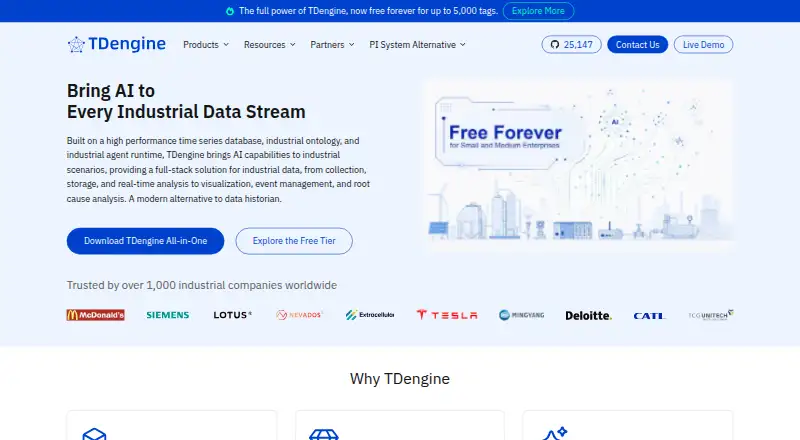
What TDengine is
TDengine is an industrial data platform that combines ingestion, storage, analytics, modeling, visualization, and AI applications. Its core components are TDengine TSDB and TDengine IDMP. TSDB is a distributed time-series database with caching, stream processing, and data subscription. The platform connects to sources such as OPC, MQTT, and Kafka, and includes ETL for cleaning and transforming data. Access methods include a REST API, JDBC, ODBC, Kafka, MQTT, iframe embedding, and an Excel Add-In; listed integrations span monitoring, analytics, visualization, and industrial tools. Self-hosted deployments can run at the edge, in containers or virtual machines, on local servers, or in public, private, and hybrid clouds. Managed TDengine Cloud is offered on AWS, Azure, and Google Cloud. The TSDB-OSS edition is open source under AGPL and includes clustering. The self-hosted free tier covers up to 5,000 tags; Starter is listed at $970 a month.
Good
- TSDB includes caching, stream processing, and data subscription.
- Connects to industrial sources including OPC, MQTT, and Kafka.
- Self-hosted deployments support edge and cloud environments.
- Open-source TSDB-OSS includes clustering.
- Free self-hosted tier covers up to 5,000 tags.
Watch out
- Starter costs $970 a month.
- Free tier is self-hosted and limited to 5,000 tags.
- Optional annual support for free-tier deployments costs $3,375 a year.
- Premium Support for Severity 1 incidents costs extra.
Who it suits
TDengine is designed for industrial enterprises and organizations running traditional data historians or legacy industrial IoT platforms, especially those needing time-series ingestion and analysis.
Verdict
TDengine combines a time-series database with industrial data connectivity, analytics, and deployment choices. The free self-hosted tier provides a bounded starting point, while managed cloud and larger self-hosted licenses have listed costs.
Plans and prices
From TDengine's own pricing page, checked 30 Sep 2026.
| Plan | Price | What it gives you |
|---|---|---|
| Free Tier | Free | up to 5,000 tags · self-hosted |
| Self-hosted Free Tier | Free | up to 5,000 tags · optional support $3,375/year · HA +30% |
| TDengine Cloud Starter | $970 a month | 5,000 tags · managed AWS, Azure or Google Cloud service · monthly |
| Starter | $970 a month | 5,000 tags · fully managed cloud · monthly |
| TDengine Cloud Small | $1,740 a month | 10,000 tags · managed cloud infrastructure · monthly |
| TDengine Cloud Medium | $2,570 a month | 20,000 tags · managed cloud infrastructure · monthly |
| Optional Annual Support | $3,375 a year | free-tier deployments up to 5,000 tags · annual support |
| Starter | $11,640 a year | 5,000 tags · fully managed cloud · annually |
| 7,500-tag Annual License | $12,500 a year | 7,500 tags · self-hosted · annual license |
| Self-hosted 7,500-tag annual license | $12,500 a year | 7,500 tags · standard support included · HA +30% · annual |
| Self-hosted 10,000-tag annual license | $15,500 a year | 10,000 tags · standard support included · HA +30% · annual |
| 7,500-tag Perpetual License | $31,250, paid once | 7,500 tags · self-hosted · perpetual license |
The facts
Each one read from TDengine's own pages, with the date it was checked.
What it does
- Analytics and AI
- Included capabilities include forecasting, anomaly detection, data imputation, natural-language data exploration and AI-generated root-cause analysis.checked 14 Oct 2026
- API and SDKs
- Documentation covers a REST API and language connectors with sample code, while the repository exposes client libraries and Rust bindings.checked 14 Oct 2026
- Asset modeling
- TDengine IDMP provides tree-structured industrial entity definitions, semantic contextualization and reusable templates for equipment and processes.checked 14 Oct 2026
- Cloud providers
- TDengine Cloud is offered as a managed service on Amazon Web Services, Microsoft Azure, and Google Cloud Platform.checked 30 Sep 2026
- Compliance claims
- TDengine states that its policies align with SOC 2 and ISO 27001/27017 and offers reports or certificates on request.checked 14 Oct 2026
- Core components
- The platform consists of TDengine TSDB and TDengine IDMP.checked 30 Sep 2026
- Core database features
- TDengine TSDB includes built-in caching, stream processing and data subscription to reduce the need for separate infrastructure components.checked 14 Oct 2026
- Data model
- TDengine uses one-table-per-data-collection-point, super-table and virtual-table models designed for time-series storage efficiency.checked 14 Oct 2026
- Deployment
- Self-hosted deployments can run at the edge, in containers or virtual machines, on local servers, or in public, private, or hybrid clouds.checked 30 Sep 2026
- Deployment options
- TDengine can run self-hosted at the edge, in containers or VMs, on local servers, in public/private/hybrid clouds, or as managed TDengine Cloud.checked 14 Oct 2026
- Developer access
- TDengine provides a REST API described by OpenAPI and supports JDBC, ODBC, Kafka, MQTT, iframe embedding, and an Excel Add-In.checked 30 Sep 2026
- Documentation depth
- Official documentation spans installation, SQL, data modeling, ingestion, querying, subscriptions, stream processing, security, operations, integrations and kernel design.checked 14 Oct 2026
- Edge-cloud synchronization
- Enterprise editions provide automated replication between edge and cloud deployments for cross-site consolidation.checked 14 Oct 2026
- Enterprise limitations
- Compared with OSS, Enterprise adds tiered storage, incremental backup, views, replication, data sharing, PI/MQTT/OPC integrations, privilege controls, encryption, auditing and IP whitelisting.checked 14 Oct 2026
- Installation
- Official packages support Linux and Windows, and documentation also provides Docker and Kubernetes deployment paths.checked 14 Oct 2026
- Integrations
- The documented ecosystem includes Grafana integration, Kafka integration, MQTT, OPC, PI System and Excel connectivity.checked 14 Oct 2026
- License
- The TDengine TSDB open-source repository is licensed under GNU Affero General Public License version 3.0.checked 14 Oct 2026
- Limit: ecosystem
- Several G2 reviewers say the community, third-party tutorials, plugins and broader ecosystem are smaller than those around InfluxDB or TimescaleDB.checked 14 Oct 2026
- Limit: general-purpose flexibility
- Reviewers note that TDengine is specialized for time-series workloads and is less suitable for non-time-series data or some complex queries.checked 14 Oct 2026
The company
- Company profile
- LinkedIn identifies TDengine as a privately held software-development company founded in 2017 with 51–200 employees and headquarters in Los Gatos, California.checked 14 Oct 2026
- Company scale
- TDengine's About page reports more than one million global installations and over 25,000 GitHub stars.checked 14 Oct 2026
- Headquarters
- San Jose, California, United Stateschecked 28 Sep 2026
Money
- Industrial connectors
- The platform advertises zero-code connectors for MQTT, Kafka, OPC, PI System and other industrial or enterprise sources.checked 14 Oct 2026
- Industrial data sources
- TDengine connects to OPC, MQTT, Kafka, and other industrial data sources, with built-in ETL for cleaning and transformation.checked 30 Sep 2026
The full review of TDengine
TDengine is a time-series database and industrial data platform for organizations collecting operational data across equipment and legacy systems. It suits industrial teams that need broad connectivity and deployment flexibility. Its free self-hosted tier is a useful bounded entry point, but paid cloud and larger self-hosted plans carry substantial costs.
Overview
TDengine combines TSDB, a distributed time-series database, with IDMP for industrial data ingestion, storage, analytics, modeling, visualization, and AI applications. TSDB adds caching, stream processing, and data subscriptions. Built-in ETL cleans and transforms data from sources including OPC, MQTT, and Kafka, making the platform relevant when data arrives directly from industrial systems rather than as prepared metrics.
SQL, retention policies, and horizontal scaling cover core database needs. Ingestion also supports InfluxDB Line Protocol, OpenTSDB protocols, CSV, PI System, and data from MySQL, PostgreSQL, Oracle, and MongoDB. TDengine claims more than 10 times the write and query performance of general-purpose databases and storage costs reduced to one tenth; those are the company's claims, not a guarantee for every workload.
Key features
Industrial connectivity and integrations
Official integrations include monitoring and data tools such as Prometheus, Telegraf, Kafka, Flink, and Grafana, alongside Power BI, Tableau, Spark, Pandas, DBeaver, Node-RED, and Ignition. This breadth can help teams connect collection, analysis, and visualization workflows without treating the database as an isolated store. Developer access includes a REST API described by OpenAPI, JDBC, ODBC, Kafka, MQTT, iframe embedding, and an Excel Add-In.
Deployment and security
Self-hosted installations can run at the edge, in containers or virtual machines, on local servers, or in public, private, and hybrid clouds. TDengine Cloud is managed on AWS, Azure, and Google Cloud Platform. Cloud security controls include encryption in transit and at rest, role-based access, IP whitelisting, scheduled backups, and cross-cloud or cross-region replication. TDengine states support for 21 CFR Part 11 technical controls and compliance with SOC 2 and ISO 27001/27017 standards.
TSDB-OSS is fully open source under AGPL and includes clustering. That offers a capable self-managed route, but organizations should ensure the license fits their intended use. Standard Support comes with annual plans; Premium Support, including 24×7 coverage for Severity 1 incidents, costs extra.
Pricing
The free tier is self-hosted and capped at 5,000 tags, making it the lowest-risk way to evaluate a bounded deployment. Teams wanting managed hosting can choose Starter at $970 a month, billed monthly, for 5,000 tags. The same tag ceiling makes it easier to compare against the free tier, but the paid plan's managed-cloud deployment is its clear distinction.
- Free Tier: free; self-hosted, up to 5,000 tags.
- Starter: $970 a month, billed monthly; fully managed cloud, 5,000 tags.
- Optional Annual Support: $3,375 a year, billed annual support; for free-tier deployments up to 5,000 tags.
- 7,500-tag Annual License: $12,500 a year, billed annual license; self-hosted, 7,500 tags.
- 7,500-tag Perpetual License: $31,250, paid once, billed perpetual license; self-hosted, 7,500 tags.
The larger self-hosted licenses raise capacity to 7,500 tags but represent a major step up in cost from the free tier. Annual support is a separate option for free-tier deployments, while Premium Support adds further cost. The pricing model is freemium, but these paid options make it most appropriate for organizations with industrial workloads substantial enough to justify a dedicated platform.
Platforms
TDengine supports API access, Linux, macOS, Windows, web access, and self-hosted deployment. Its edge, server, virtualized, and cloud deployment choices suit varied infrastructure, although the Starter plan is specifically fully managed cloud.
Who it's for
TDengine is designed for industrial enterprises and organizations running traditional data historians or legacy industrial IoT platforms. It is a strong fit for teams consolidating operational data from varied equipment and systems, especially when industrial protocols, transformation, analytics, and deployment control matter together. It is less compelling for a small deployment that can live within the 5,000-tag free cap but cannot justify paid cloud or license costs.
Pros and cons
- Pro: Broad industrial ingestion, including OPC UA, OPC DA, MQTT, Kafka, and PI System, reduces the need to normalize every source before it reaches the platform.
- Pro: Edge, self-hosted, and managed-cloud deployment options let organizations match placement to their infrastructure needs.
- Pro: TSDB-OSS includes clustering and is open source, providing a self-managed route for teams comfortable with AGPL.
- Con: The free tier stops at 5,000 tags, while the listed 7,500-tag self-hosted licenses cost $12,500 a year or $31,250, paid once.
- Con: Starter costs $970 a month for managed cloud at 5,000 tags, so teams seeking a low-cost managed entry point may find it difficult to justify.
- Con: Premium 24×7 Severity 1 support costs extra, adding to the commitment for organizations that need that coverage.
Alternatives
Consider InfluxDB if a freemium time-series database with a free usage-based cloud data-in option better fits the deployment; its Cloud Serverless - Data In plan is free, pay for what you use. LinDB is a free Apache 2.0 open-source option for teams prioritizing a no-cost license. QuestDB may fit readers seeking a free Apache 2.0 core with self-managed single-instance deployment and community support.
VictoriaMetrics is another freemium option with open-source single-node and cluster versions. Prometheus is a free Apache 2.0 monitoring and alerting toolkit, a better fit when that focused role is the priority. Apache IoTDB is a free open-source time-series database with downloadable binaries and source.
DolphinDB offers a free Community Edition limited to two nodes, with 2 CPU cores and 8 GB RAM per node. TimeBase is a free Community Edition with unlimited data storage, an Apache 2.0 license, and technical support via GitHub.
Browse more options in Time-Series Databases, OLAP Software, and IoT Analytics Software.
Verdict
TDengine is best for industrial organizations that need to bring diverse equipment and legacy-system data into a platform with database, analytics, and deployment choices in one stack. Its industrial connectivity and flexible deployment are the strongest reasons to choose it; the 5,000-tag free cap and costly paid plans are the clearest reasons to look elsewhere if the workload is small or budget-sensitive.
Getting started
- Visit the TDengine website
- Choose self-hosted TSDB-OSS, a self-hosted license or TDengine Cloud
- Deploy on supported edge, server, container, virtual machine or cloud infrastructure
- Connect industrial sources through a listed ingestion method
- Use SQL, APIs or supported connectors to access data
- Add visualisation, analytics or industrial integrations
Limits worth knowing
The Free Tier supports up to 5,000 tags in a self-hosted deployment. The Starter plan provides 5,000 tags on fully managed cloud, while listed annual and perpetual licenses cover 7,500 tags.
Questions
Is TDengine available for free?
Yes. The Free Tier costs nothing and supports up to 5,000 tags self-hosted.
What does the Starter plan cost?
Starter costs $970 a month, billed monthly, for 5,000 tags on fully managed cloud.
Is TDengine open source?
TDengine TSDB-OSS is fully open source, includes clustering and is released under the AGPL license.
Which deployment options are available?
Self-hosted deployments can run at the edge, in containers or virtual machines, on local servers, or in public, private and hybrid clouds. TDengine Cloud is managed on AWS, Azure and Google Cloud.
Which integrations and interfaces are supported?
TDengine provides REST, JDBC, ODBC, Kafka, MQTT, iframe and Excel Add-In access, with integrations including Grafana, Power BI, Tableau, Prometheus and Node-RED.
Alternatives to TDengine
- 1

Amazon Timestream
Free planWebAPILinuxmacOS7.9Free plan - 2

Apache IoTDB
Free planOpen sourceWebAPILinuxmacOS7.7Free plan - 3

InfluxDB
Free planWebAPILinuxmacOS7.4$0.01 usage-based - 4

VictoriaMetrics
Free planWebAPILinuxmacOS7.4From $200 a month - 5

LinDB
Free planWebAPILinuxmacOS6.9Free plan - 6

QuestDB
Free planWebAPILinuxmacOS6.9Free plan