
Exasol
Exasol is a database for organizations running analytics and high-concurrency AI workloads.
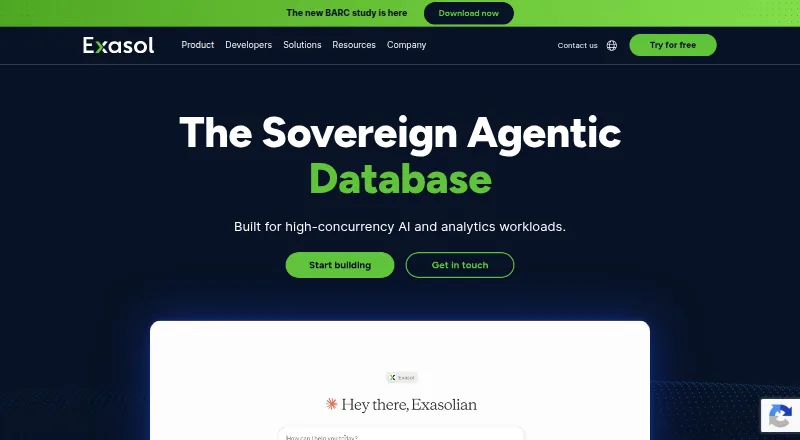
What Exasol is
Exasol is a database for organizations running analytics and high-concurrency AI workloads. It offers cloud, on-premises, hybrid, fully managed SaaS, and air-gapped deployment options. Exasol says teams can analyze billions of rows in seconds, and that automatic self-indexing helps tune performance. Its SaaS offering includes five databases, multi-cluster support, basic UDF support, advanced in-database analytics, and data virtualization. Teams can scale vertically or add clusters with dedicated compute for tasks such as data ingest or machine learning. Compute is billed pay-as-you-go, with XS at $3.30 a month and S at $6.60 a month; storage is listed separately at $25 a month. The SaaS trial provides $200 of usage for 30 days and requires no credit card. Exasol lists integrations including Airbyte, Alation, Amazon QuickSight, Apache Airflow, and Apache Superset. Its documentation describes several authentication methods and TLS encryption for database connections; encryption at rest must be configured on the supplied file systems and devices.
Good
- Offers cloud, on-premises, hybrid, and air-gapped deployment options.
- SaaS supports dedicated compute clusters for workloads.
- Includes data virtualization and advanced in-database analytics.
- 30-day SaaS trial includes $200 usage and needs no card.
Watch out
- Community Edition is limited to 200GB of data.
- Personal license is for one user and two data sources.
- Storage is priced separately at $25 a month.
Who it suits
Exasol SaaS is suited to organizations with multi-department analytics needs, in-database machine learning or AI workloads, or complex data integration and virtualization requirements. Its deployment options also suit teams that need on-premises or air-gapped environments.
Verdict
Exasol combines analytics, database scaling, and multiple deployment choices for teams with substantial or varied data workloads. Check the free editions’ limits and separate storage cost against your needs.
Plans and prices
From Exasol's own pricing page, checked 20 Sep 2026.
| Plan | Price | What it gives you |
|---|---|---|
| XS | $3.30 a month | 8 vCPUs · 64 GB memory · Pay-as-you-go |
| S | $6.60 a month | 16 vCPUs · 128 GB memory · Pay-as-you-go |
| M | $13.20 a month | 32 vCPUs · 256 GB memory · Pay-as-you-go |
| L | $26.40 a month | 64 vCPUs · 512 GB memory · Pay-as-you-go |
| XL | $52.80 a month | 128 vCPUs · 1024 GB memory · Pay-as-you-go |
| 2XL | $105.60 a month | 256 vCPUs · 2048 GB memory · Pay-as-you-go |
| 3XL | $158.40 a month | 384 vCPUs · 3072 GB memory · Pay-as-you-go |
| Storage | $25 a month | Separate storage pricing · Additional cost |
| Exasol Personal | Free | Personal use · Cloud or local deployment · Feature availability varies by deployment · Free |
| Exasol Community Edition | Free | Up to 200GB of data · preconfigured sample data and scripts · Free on-premises edition |
| Exasol SaaS XS | $3.30 a month | 8 vCPUs · 64GB memory · $3.3/hr |
| Exasol SaaS S | $6.60 a month | 16 vCPUs · 128GB memory · $6.6/hr |
| Exasol SaaS M | $13.20 a month | 32 vCPUs · 256GB memory · $13.2/hr |
| Exasol SaaS L | $26.40 a month | 64 vCPUs · 512GB memory · $26.4/hr |
| Exasol SaaS XL | $52.80 a month | 128 vCPUs · 1024GB memory · $52.8/hr |
| Exasol SaaS 2XL | $105.60 a month | 256 vCPUs · 2048GB memory · $105.6/hr |
| Exasol SaaS 3XL | $158.40 a month | 384 vCPUs · 3072GB memory · $158.4/hr |
The facts
Each one read from Exasol's own pages, with the date it was checked.
What it does
- Analytics
- Exasol says teams can analyze billions of rows in seconds and use the database in cloud, on-premises, or hybrid environments.checked 28 Sep 2026
- Authentication
- Documented database authentication methods include passwords, LDAP/Active Directory, Kerberos single sign-on and OpenID.checked 14 Oct 2026
- Automatic tuning
- Exasol automatically gathers optimizer statistics, maintains join indexes, reorganizes tables and can reuse query-cache results.checked 14 Oct 2026
- Core licence
- The Exasol database is distributed under Exasol commercial EULAs and raw-data or pay-as-you-go licensing rather than as an open-source database.checked 14 Oct 2026
- Database security
- The documentation describes password, LDAP/AD, Kerberos SSO, and OpenID authentication, along with MFA support where the authentication provider supports it.checked 28 Sep 2026
- Deployment
- Exasol lists on-premises, hybrid, and fully managed SaaS deployment options; on-premises environments can include air-gapped setups.checked 28 Sep 2026
- Deployment choices
- The vendor documents SaaS, on-premises, hybrid and air-gapped deployment models.checked 14 Oct 2026
- Documentation
- The official documentation covers SaaS and self-managed deployment, SQL, administration, security, integrations, drivers, UDFs and troubleshooting.checked 14 Oct 2026
- Drivers and clients
- Exasol supports JDBC, ODBC and other drivers, with documented connections from DBeaver, DataGrip, DbVisualizer, EXAplus CLI and VS Code.checked 14 Oct 2026
- Encryption
- The documentation says Exasol uses TLS encryption for JDBC, ODBC, ADO.NET, CLI, and WebSockets, while encryption at rest must be configured on the supplied file systems and devices.checked 28 Sep 2026
- In-memory MPP engine
- The database uses in-memory processing, column storage, compression and massively parallel processing to accelerate analytical queries.checked 14 Oct 2026
- Integrations
- Official ecosystem documentation lists BI integrations including Power BI, Tableau, Looker, Qlik Sense, SAS, Superset, Yellowfin and Amazon QuickSight.checked 14 Oct 2026
- Intended users
- Exasol SaaS is described as suited to organizations needing multi-departmental analytics, in-database machine learning or AI, and complex data integration or virtualization.checked 28 Sep 2026
- IPO
- Exasol completed a Frankfurt Stock Exchange IPO in May 2020 and reported gross proceeds of EUR 48.5 million.checked 14 Oct 2026
- ISO certification
- Exasol AG holds an ISO/IEC 27001:2022 certificate valid from 17 June 2024 through 16 June 2027 for database development and associated services.checked 14 Oct 2026
- Lakehouse access
- Lakehouse Turbo connects to a catalog and incrementally replicates selected lakehouse tables into Exasol for faster queries.checked 14 Oct 2026
- Legal name
- Crunchbase identifies the legal name as Exasol AG and lists Nuremberg, Bavaria, Germany as headquarters.checked 14 Oct 2026
- Limit: documentation
- G2’s review summary says some users find documentation, especially scripting guidance, in need of improvement.checked 14 Oct 2026
The company
- Company facts
- LinkedIn lists Exasol as a public software company founded in 2000 with headquarters in Nürnberg and 201–500 employees.checked 14 Oct 2026
- Company origin
- Exasol began as a research and student project at Friedrich-Alexander University and formally became Exasol AG in 2000.checked 14 Oct 2026
- Founded
- 2000checked 28 Sep 2026
- Headquarters
- Nuremberg, Germanychecked 28 Sep 2026
Money
- Free plan
- Yeschecked 20 Sep 2026
- Limit: cost
- Reviewers say high-performance virtual machines and the service price can become expensive for large datasets.checked 14 Oct 2026
The full review of Exasol
Overview
Exasol is an analytics database for organizations running concurrent analytics, AI and data-integration workloads. It is strongest for teams that need deployment flexibility and database-scale analysis; it is a poor fit for an individual looking for an unrestricted shared workspace.
Exasol says it can analyze billions of rows in seconds and uses automatic self-indexing to tune performance. Buyers can choose managed SaaS, on-premises or hybrid deployment, including air-gapped on-premises environments. That range suits organizations with differing infrastructure needs, but makes it important to match the edition and operating model to the workload.
Key features
- Analytics and AI: Exasol targets high-concurrency analytics and supports advanced in-database analytics and machine learning. That can keep analytical work within the database, a useful fit for organizations with multiple departments or complex workloads.
- Scaling: SaaS supports vertical scaling and additional clusters with dedicated compute for jobs such as ingest or machine learning. Separating compute for those jobs can help teams serve varied workloads, though additional compute and storage affect cost.
- Data connectivity: Data lake support, streaming ingestion and data virtualization broaden the kinds of data workflows it can serve. Its integrations directory includes Airbyte, Alation, Amazon QuickSight, Apache Airflow and Apache Superset.
- Security and operations: Exasol states it is ISO/IEC 27001 certified. Authentication options include passwords, LDAP/AD, Kerberos SSO and OpenID, with MFA where the authentication provider supports it. TLS covers JDBC, ODBC, ADO.NET, CLI and WebSockets; encryption at rest must be configured on the supplied file systems and devices. Support includes 24/7 incident troubleshooting and monitoring, plus performance analysis, maintenance and planning assistance.
Pricing
Exasol combines free editions with pay-as-you-go SaaS compute. SaaS compute is billed hourly; the listed monthly figures are $3.30 a month for XS (8 vCPUs and 64 GB memory), $6.60 a month for S (16 vCPUs and 128 GB), $13.20 a month for M (32 vCPUs and 256 GB), $26.40 a month for L (64 vCPUs and 512 GB), $52.80 a month for XL (128 vCPUs and 1024 GB), $105.60 a month for 2XL (256 vCPUs and 2048 GB), and $158.40 a month for 3XL (384 vCPUs and 3072 GB). These tiers scale compute and memory together, so larger workloads can move up without changing the pay-as-you-go model.
Storage is separate at $25 a month. This is a material cost distinction: the compute figure alone does not represent the full bill when storage is needed. SaaS XS and S include five databases; the broader SaaS feature set includes multi-cluster support, basic UDF support, advanced in-database analytics and data virtualization.
Exasol Personal is free for personal use, with unlimited data and clusters, but its single-user license and two connected data sources make it unsuitable for a shared team deployment. Exasol Community Edition is free on-premises and includes sample data and scripts, but its 200GB cap limits its use for larger datasets. The SaaS trial provides $200 of usage for 30 days and requires no credit card, making it a practical way to assess the service before committing.
Platforms
Exasol supports API, Linux, macOS, self-hosted and web access. Its deployment choices span fully managed SaaS, on-premises and hybrid environments, including air-gapped on-premises setups. That flexibility is valuable to organizations with infrastructure constraints; teams seeking only a simple cloud workspace may not need the range.
Who it's for
Exasol SaaS is suited to organizations coordinating analytics across departments, running in-database machine learning or AI, or handling complex integration and virtualization. Its dedicated-cluster scaling and deployment options make it particularly relevant where workloads or infrastructure requirements vary. Solo users can try Personal, while teams should account for its single-user restriction and consider SaaS or an appropriate on-premises deployment instead.
Pros and cons
- Pro: Managed, hybrid and on-premises deployment, including air-gapped setups, gives organizations room to meet differing infrastructure requirements.
- Pro: Dedicated compute clusters can separate ingest or machine-learning workloads from other work.
- Pro: The no-card, $200, 30-day SaaS trial gives teams a defined evaluation window.
- Con: Storage is charged separately from compute, so the entry compute price is not the whole cost.
- Con: The free Community Edition stops at 200GB, while Personal is limited to one user and two sources; neither is an unrestricted team tier.
- Con: Encryption at rest depends on configuration of the supplied file systems and devices, so it requires deployment attention.
Alternatives
Databend is a reasonable alternative for teams specifically seeking a free self-hosted community edition. Oracle Autonomous AI Lakehouse may suit readers who want an always-free offering subject to capacity limits. Teradata VantageCloud is another freemium option for readers comparing analytics platforms.
Databricks Notebooks may be preferable when a free web-based notebook workspace is the priority, though its free edition has limited compute size and usage. Firebolt offers a free self-hosted Core edition with no usage limits, but it cannot be used to build a hosted SaaS competing with Firebolt's managed service. Snowflake CoCo is a paid option with a free trial.
BigQuery Data Clean Rooms is a free option for publishing data to or subscribing to and querying clean rooms. Cloudera Data Lake Service is a paid alternative with custom pricing. For broader comparisons, see Data Warehouse Software, OLAP Software, Columnar Databases, OLAP Databases and Database Software.
Verdict
Choose Exasol when your organization needs a flexible analytics database for substantial, concurrent workloads and values the choice between SaaS, hybrid and on-premises deployment. Its scalable compute and broad analytical capabilities are the case for it; separate storage charges and restrictive free-edition limits are the reasons to compare costs and team needs before settling on a plan.
Getting started
- Visit the Exasol website.
- Choose a deployment approach: managed SaaS, on-premises, or hybrid.
- For SaaS, start the 30-day trial, which includes $200 of usage and needs no credit card.
- Select a pay-as-you-go compute plan; XS is $3.30 a month and S is $6.60 a month.
- Choose a free edition if appropriate: Personal or Community Edition.
Limits worth knowing
The free Community Edition supports up to 200GB of data. Exasol Personal is licensed for one user and allows up to two connected data sources. The SaaS trial lasts 30 days and includes $200 of free usage.
Questions
Is Exasol free?
Yes. Exasol Personal and Community Edition are free. Personal is for one user and allows up to two connected data sources; Community Edition is limited to 200GB of data.
How much does Exasol SaaS cost?
Pay-as-you-go compute is billed hourly. XS costs $3.30 a month and S costs $6.60 a month; storage is separately priced at $25 a month.
Does Exasol offer a free trial?
The SaaS trial lasts 30 days and includes $200 of free usage. It does not require a credit card.
Where can Exasol be deployed?
Exasol lists fully managed SaaS, on-premises, and hybrid deployments. On-premises environments can include air-gapped setups.
What integrations does Exasol list?
Examples include Airbyte, Alation, Amazon QuickSight, Apache Airflow, and Apache Superset.
What security controls does Exasol describe?
Exasol states it is ISO/IEC 27001 certified. Its documentation describes password, LDAP/AD, Kerberos SSO, and OpenID authentication, MFA where supported by the authentication provider, and TLS encryption for several connection methods.
Alternatives to Exasol
- 1

TDengine
Free planOpen sourceWebAPILinuxmacOS8.3Free plan - 2

ClickHouse Cloud
Open sourceWebAPILinuxmacOS7.9From $25.30 a month - 3
icCube
WebAPILinuxmacOS7.5From $1,950 a month - 4

IBM Db2
Free planWebAPILinuxSelf-hosted7.4From $630 a month - 5

InfluxDB
Free planWebAPILinuxmacOS7.4$0.01 usage-based - 6
Teradata VantageCloud
Free planWebAPILinuxSelf-hosted7.3$1.50 one-time