
Polars
Polars is an open-source DataFrame library for data manipulation, designed for fast processing on a single machine with a typed API.
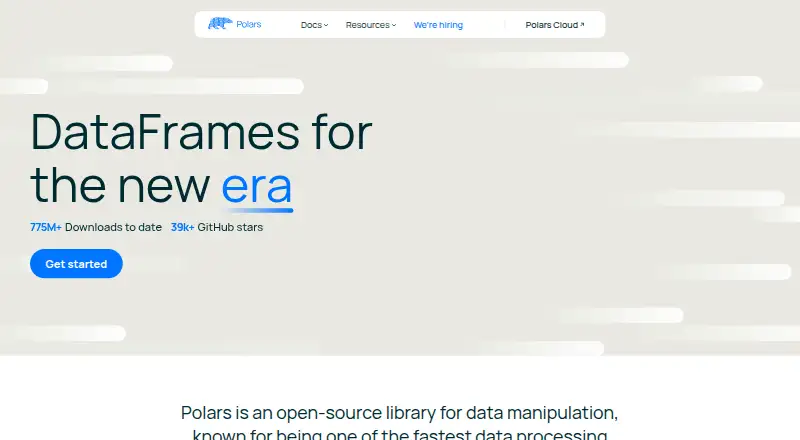
What Polars is
Polars is an open-source DataFrame library for data manipulation, designed for fast processing on a single machine with a typed API. Its multithreaded query engine is written in Rust and uses vectorized, columnar processing; a query optimizer selects an execution plan. The streaming API can handle datasets larger than memory without retaining all results in memory. Installation examples cover Python, Rust, and JavaScript. Polars supports formats such as CSV, JSON, Parquet, Delta Lake, Avro, Excel, Feather, and Arrow, along with databases and cloud storage. It can read and write data in AWS S3, Azure Blob Storage, and Google Cloud Storage. For distributed queries, Polars Cloud uses the Polars API to scale work from local execution to a cluster and is available on AWS. Its compute runs in the customer's cloud environment, where customer data stays. Polars Cloud offers a 30-day trial that starts when an organization connects its first workspace to AWS. Polars On-Prem supports Kubernetes distributions and bare-metal servers, including air-gapped Enterprise deployments. Its On-Prem Self-Serve plan is limited to one concurrent cluster, 1,024 cores per cluster, and 64 nodes. The open-source library is free under the MIT license.
Good
- Free open-source library under the MIT license.
- Streaming API handles datasets larger than memory.
- Reads and writes to major cloud storage services.
- Cloud scales queries from local execution to a cluster.
- On-Prem supports air-gapped Enterprise deployments.
Watch out
- On-Prem Self-Serve allows one concurrent cluster.
- On-Prem Self-Serve caps clusters at 1,024 cores and 64 nodes.
- Polars Cloud is available on AWS.
Who it suits
Polars suits developers and data teams manipulating data through code in Python, Rust, or JavaScript. Its Cloud and On-Prem offerings also address distributed workloads and deployments requiring customer-cloud or air-gapped environments.
Verdict
Polars provides an open-source, code-oriented option for data manipulation, with Cloud and On-Prem paths for larger or controlled deployments. Review the Self-Serve limits and Cloud availability when choosing a deployment.
Plans and prices
From Polars's own pricing page, checked 7 Oct 2026.
| Plan | Price | What it gives you |
|---|---|---|
| Polars (open source) | Free | Open source data manipulation library · Free to use under the MIT license. |
The facts
Each one read from Polars's own pages, with the date it was checked.
What it does
- Cloud availability
- The Polars Cloud user guide says Polars Cloud is available on AWS.checked 7 Oct 2026
- Cloud service
- Polars Cloud runs distributed queries using the Polars API and can scale workloads from local execution to a cluster.checked 7 Oct 2026
- Cloud storage
- The user guide says Polars can read and write data in AWS S3, Azure Blob Storage, and Google Cloud Storage.checked 7 Oct 2026
- Engine
- Its multithreaded query engine is written in Rust and uses vectorized, columnar processing for parallel execution.checked 7 Oct 2026
- Integrations
- The homepage lists support for CSV, JSON, Parquet, Delta Lake, AVRO, Excel, Feather, Arrow, several databases, and cloud storage.checked 7 Oct 2026
- Languages
- The site provides installation examples for Python, Rust, and JavaScript.checked 7 Oct 2026
- Limits
- The On-Prem Self-Serve plan is limited to one concurrent cluster, 1,024 cores per cluster, and 64 nodes.checked 7 Oct 2026
- On-prem deployment
- Polars On-Prem supports Kubernetes distributions and bare-metal servers, including air-gapped Enterprise deployments.checked 7 Oct 2026
- Product
- Polars is an open-source DataFrame library for data manipulation, described as a fast single-machine data processing solution with a typed, expressive API.checked 7 Oct 2026
- Query optimization
- Polars uses a query optimizer to determine an efficient execution plan for queries.checked 7 Oct 2026
- Security
- Polars says Polars Cloud compute runs in the customer's cloud environment and that customer data does not leave that environment.checked 7 Oct 2026
- Streaming
- The streaming API can process datasets larger than memory without keeping all results in memory.checked 7 Oct 2026
- Support
- Polars Cloud offers team support for technical questions, implementation guidance, and product feedback.checked 7 Oct 2026
The company
- Founded
- 2023checked 28 Sep 2026
- Headquarters
- Amsterdam, Netherlandschecked 28 Sep 2026
Money
- Trial
- Polars Cloud offers a 30-day trial that begins when an organization connects its first workspace to AWS.checked 7 Oct 2026
The full review of Polars
Polars is an open-source library for transforming data through code, best suited to developers and data teams who want a typed API and fast single-machine processing. Its free core is compelling for local work; distributed execution and controlled deployments require a move to Polars Cloud or On-Prem.
Overview
Polars centers on a DataFrame library with a Rust-based, multithreaded query engine. Its vectorized, columnar execution and query optimizer are designed to make efficient use of a single machine. This is a code-first tool, not a visual transformation interface, so it favors users comfortable building data workflows in Python, Rust, or JavaScript.
The open-source library is available under the MIT license, and its hybrid deployment options extend the same API to cloud clusters or customer-controlled infrastructure. The trade-off is that local Polars alone is not a distributed service.
Key features
Parallel queries and streaming
Polars processes columnar data across multiple threads, with an optimizer choosing an execution plan for queries. The streaming API can handle datasets larger than memory without retaining every result in memory, a useful distinction for constrained machines. These capabilities strengthen local data processing, but do not by themselves provide cluster execution.
Formats and storage
Supported formats include CSV, JSON, Parquet, Delta Lake, Avro, Excel, Feather, and Arrow IPC. Polars can also read and write data in AWS S3, Azure Blob Storage, and Google Cloud Storage, alongside support for several databases. That breadth makes it practical for mixed-format pipelines without narrowing the workflow to one file type.
Cloud and controlled deployment
Polars Cloud runs distributed queries through the Polars API and can scale work from local execution to a cluster. Its compute runs in the customer's cloud environment, with customer data remaining there. Cloud is available on AWS and includes team support for technical questions, implementation guidance, and product feedback.
Polars On-Prem supports Kubernetes distributions and bare-metal servers, including air-gapped Enterprise deployments. The Self-Serve plan has material ceilings: one concurrent cluster, 1,024 cores per cluster, and 64 nodes. Those limits suit bounded deployments, but teams needing more capacity or concurrent clusters should assess Enterprise options.
Pricing
The pricing model is freemium, with the open-source library at no cost under the MIT license. That is the clear starting point for individuals and teams able to run and maintain their own workflows; it does not include distributed Cloud execution or On-Prem deployment.
Polars Cloud offers a 30-day trial, beginning when an organization connects its first workspace to AWS. The pricing note gives paid service from $0.05, but does not establish the billing unit or term, so compare the service's applicable charges before committing. On-Prem Enterprise has custom pricing. The cheaper open-source option gives up managed distributed workloads and team support, while the On-Prem Self-Serve capacity limits matter for teams with larger or parallel deployments.
Platforms
Polars supports API-based use and runs across Linux, macOS, and Windows, with web and self-hosted deployment paths. Python, Rust, and JavaScript installation examples support its code-oriented approach; Cloud is AWS-based, while On-Prem targets Kubernetes and bare-metal environments.
Who it's for
Choose Polars for code-led data transformation when local, parallel processing, streaming beyond memory, or broad format support are priorities. It is also a fit for organizations that want to extend that workflow to AWS-hosted distributed queries or keep compute on their own infrastructure. Look elsewhere if your main requirement is a graphical workflow, or if you need distributed processing without adopting Cloud or On-Prem.
Pros and cons
- Pro: The free MIT-licensed library pairs multithreaded execution with query optimization, making it a capable starting point for local processing.
- Pro: Streaming can process datasets larger than memory, and support for common file formats and major cloud storage services broadens pipeline options.
- Pro: Cloud and On-Prem provide distinct paths to distributed or controlled deployments while retaining the Polars API.
- Con: The core is code-oriented, so it is not the right fit for users seeking a visual transformation interface.
- Con: Distributed queries require Polars Cloud, which is available on AWS; On-Prem Self-Serve is capped at one concurrent cluster, 1,024 cores, and 64 nodes.
- Con: Cloud's trial starts only after the first workspace connects to AWS, which may not suit teams that cannot use that environment.
Alternatives
Browse Data Transformation Tools for more options. Choose jq for a free, MIT-licensed command-line option with standalone binaries for Linux, macOS, and Windows. Apache Beam is another free open-source programming model; execution costs depend on the runner and infrastructure selected.
Bruin for Customer Success offers a free tier with $100 in credits, 50 AI tasks, and no credit card requirement. Choose csvkit for a free MIT-licensed command-line toolkit focused on CSV files. KNIME Analytics Platform is free and open source, with its plan price not established here.
OpenRefine is free, open-source software with a desktop installation. dbplyr is a free, MIT-licensed R package, while pandas is a free open-source Python library distributed through conda-forge, PyPI, or source code.
Verdict
Polars is a strong choice for developers and data teams who want a free, code-first library for parallel single-machine transformation, with credible routes to distributed or controlled deployment as needs grow. Its main reason to choose is the combination of streaming, query optimization, and broad data access in one API. Look elsewhere if you need visual workflows, or if AWS availability and Self-Serve On-Prem limits make its expansion paths a poor fit.
Getting started
- Visit https://pola.rs/
- Install Polars using the Python, Rust, or JavaScript examples
- Connect data from supported files, databases, or cloud storage
- Use the DataFrame API for local processing and queries
- Start Polars Cloud by connecting an organization workspace to AWS
- Deploy Polars On-Prem on Kubernetes or bare-metal infrastructure
Limits worth knowing
The On-Prem Self-Serve plan permits one concurrent cluster, with 1,024 cores and 64 nodes per cluster. Polars Cloud's 30-day trial starts when an organization connects its first workspace to AWS.
Questions
Is Polars free?
The open-source Polars library is free under the MIT license. Polars Cloud has a listed paid starting price of $0.05 and a 30-day trial.
Which languages can I use?
Installation examples are provided for Python, Rust, and JavaScript.
Which data formats and storage systems are supported?
Polars supports CSV, JSON, Parquet, Delta Lake, AVRO, Excel, Feather, Arrow, databases, AWS S3, Azure Blob Storage, and Google Cloud Storage.
Where does Polars Cloud run?
Polars Cloud is available on AWS, and its compute runs in the customer's cloud environment so data stays there.
Can Polars run on-premises?
Yes. Polars On-Prem supports Kubernetes distributions and bare-metal servers, including air-gapped Enterprise deployments.
Alternatives to Polars
- 1

Bruin for Customer Success
Free planOpen sourceWebAPIExtensionLinux8.2$0.01 usage-based - 2

Cube
Free planOpen sourceWebAPILinuxSelf-hosted7.9From $40 a month - 3

Apache Beam
Free planOpen sourceWebAPILinuxmacOS7.7Free plan - 4

Apache Hop
Free planOpen sourceWebAPILinuxmacOS7.7Free plan - 5

Coalesce Catalog
Free planWebAPIExtension7.5From $150 a month - 6

dbt Semantic Layer
Free planWebAPIExtension7.5From $100 a month