Pinakes
Pinakes is a self-hosted integrated library system for schools, municipalities, and private collections.
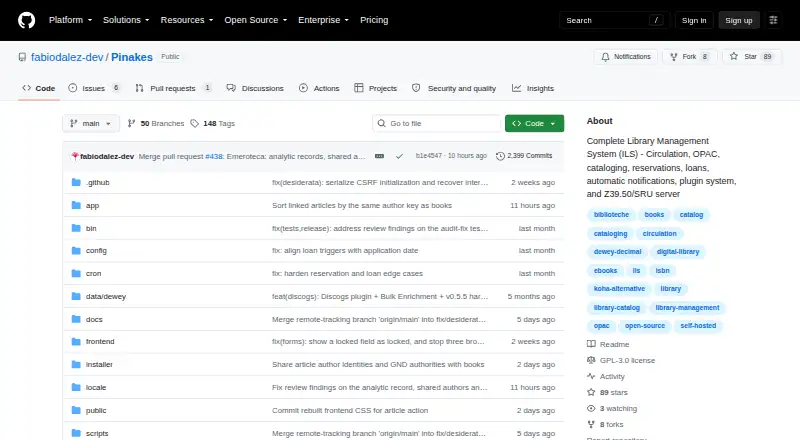
What Pinakes is
Pinakes is a self-hosted integrated library system for schools, municipalities, and private collections. It combines cataloging, circulation, a public self-service catalog, and REST APIs. Catalog records can import ISBN/EAN metadata, retrieve covers, track multiple copies, and accept bulk CSV imports. Circulation tools cover requests, approvals, checkouts, renewals, returns, due dates, and FIFO reservation queues. The Digital Library plugin supports PDF and ePub ebooks, audiobook streaming, and access controls for individual items. Metadata connections include Open Library, Google Books, and catalogs reached through Z39.50/SRU tools; its SRU 1.2 endpoint exports MARCXML, Dublin Core, and MODS. A guided installer is available, and the project documents shared-hosting deployment without production build tools. Hosting requires PHP 8.2 or later, MySQL 5.7+ or MariaDB 10.3+, and Apache or nginx. A free Android companion app can browse, borrow, reserve, and manage loans when the Mobile API plugin is enabled. Pinakes is GPL-3 licensed, with no recurring fees.
Good
- Cataloging includes ISBN/EAN imports and bulk CSV.
- Circulation supports renewals, returns, and reservations.
- Digital Library supports ebooks and audiobook streaming.
- SRU endpoint exports MARCXML, Dublin Core, and MODS.
- GPL-3 licensed with no recurring fees.
Watch out
- Self-hosting requires PHP 8.2 or later.
- Requires MySQL or MariaDB and Apache or nginx.
- Email notifications need email configuration.
Who it suits
Pinakes suits schools, municipalities, and private collections that want to host library cataloging and circulation software. It may also fit libraries that need an Android companion app or digital collection features.
Verdict
Pinakes brings cataloging, circulation, digital collections, and interoperability features into a self-hosted library system. Plan for its server requirements and configure email if you need automatic notifications.
Plans and prices
From Pinakes's own pricing page, checked 8 Oct 2001.
| Plan | Price | What it gives you |
|---|---|---|
| Pinakes | Free | GPL-3.0 open-source software · self-hosted · no recurring fees |
The facts
Each one read from Pinakes's own pages, with the date it was checked.
What it does
- Calendar
- An ICS export can sync loans and reservations with Google Calendar, Apple Calendar, and Outlook.checked 8 Oct 2001
- Cataloging
- Cataloging includes multi-copy records, physical books and digital titles, Dewey classification, CSV and LibraryThing TSV imports, and barcode generation.checked 8 Oct 2001
- Circulation
- The loan workflow supports requests, approvals, checkout, renewals, returns, configurable due dates, and FIFO reservation queues.checked 8 Oct 2001
- Core functions
- It provides cataloging, circulation, a self-service public catalog, and REST APIs.checked 8 Oct 2001
- Deployment
- Pinakes offers a guided installer and states it works on shared hosting without production build tools.checked 8 Oct 2001
- Deployment requirements
- Self-hosting requires PHP 8.2 or higher, MySQL 5.7+ or MariaDB 10.3+, and Apache or nginx; it is documented to work on shared hosting.checked 8 Oct 2001
- Digital collection
- The Digital Library plugin supports PDF and ePub ebooks, MP3/M4A/OGG audiobook streaming, and per-item access controls.checked 8 Oct 2001
- Hosting requirements
- A deployment requires PHP 8.2 or later, MySQL 5.7+ or MariaDB 10.3+, and Apache or nginx.checked 8 Oct 2001
- Integrations
- Metadata sources include Google Books, Open Library, the Italian SBN catalog, and Z39.50/SRU servers including Library of Congress, OCLC, K10plus, and SUDOC.checked 8 Oct 2001
- Interoperability
- The system exposes an SRU 1.2 endpoint with MARCXML, Dublin Core, and MODS export formats.checked 8 Oct 2001
- License
- Pinakes is released under the GNU General Public License version 3.0.checked 8 Oct 2001
- License and fees
- Pinakes is GPL-3 licensed and the repository says it has no recurring fees.checked 8 Oct 2001
- Notable limit
- Email notifications require email configuration through PHP mail() or SMTP, and cron jobs are documented for automated notifications and maintenance.checked 8 Oct 2001
- Notifications
- Automatic email notifications cover registrations, loan confirmations, approaching due dates, overdue items, and available reservations; email can use PHP mail() or SMTP.checked 8 Oct 2001
- Purpose
- Pinakes is a self-hosted integrated library system for schools, municipalities, and private collections.checked 8 Oct 2001
- Security
- The README lists CSRF protections, security headers, and an updater that backs up the database, protects paths such as uploads, and can roll back on error.checked 8 Oct 2001
- Support
- The project lists [email protected], GitHub Issues, and GitHub Discussions for support and contact.checked 8 Oct 2001
Where it runs
- Mobile app
- A free companion Android app can browse the catalog, check availability, borrow and reserve items, and manage loans when the Mobile API plugin is enabled.checked 8 Oct 2001
The full review of Pinakes
Overview
Pinakes is a self-hosted library system for schools, municipalities, and private collections that need more than a basic checkout list. Its broad cataloging and interoperability toolkit is compelling at no recurring software cost, but the organization must operate the server and configure its notifications.
Key features
Cataloging combines ISBN/EAN metadata import, automatic cover retrieval, multi-copy records, and CSV bulk import. That is useful for building or refreshing a collection without creating every record from scratch. Circulation handles requests, approvals, checkout, renewals, returns, due dates, and FIFO reservation queues; acquisitions, borrower access, and MARC records round out the staff workflow.
A public self-service catalog and REST APIs provide routes for patrons and other systems to interact with the library. The Digital Library plugin supports PDF and ePub books and streaming for MP3, M4A, and OGG audiobooks, with access controls for individual items. The free Android companion app can browse holdings, check availability, borrow and reserve items, and manage loans, but requires the Mobile API plugin.
Metadata sources include Open Library and Google Books. Z39.50/SRU tools connect to catalogs including the Library of Congress, OCLC, and SBN Italia; Pinakes also exposes an SRU 1.2 endpoint with MARCXML, Dublin Core, and MODS export. This breadth makes it a stronger fit for libraries that exchange or reuse records than for organizations seeking only a simple lending tracker. ICS export can sync loans and reservations with Google Calendar, Apple Calendar, and Outlook.
Automatic email notices cover registrations, loan confirmations, upcoming due dates, overdue items, and available reservations. They depend on configuring PHP mail() or SMTP, while cron jobs support automated notifications and maintenance. The updater documents CSRF validation, admin-only access, path traversal and Zip Slip protections, backups, and rollback after update errors; those safeguards help, but do not remove the operational responsibility of self-hosting.
Pricing
Pinakes costs nothing under the GPL-3.0 open-source license, with no recurring fees. There is no paid tier or trial to weigh against the free plan. The trade-off is that hosting is yours: deployment requires PHP 8.2 or later, MySQL 5.7+ or MariaDB 10.3+, and Apache or nginx. A guided installer and support for shared hosting lower the deployment barrier, but do not make server upkeep optional.
Platforms
Pinakes is self-hosted and accessible on the web, with API support and a companion Android app. Its documented server stack is PHP and MySQL or MariaDB behind Apache or nginx. It is not a hosted subscription service, so organizations without a suitable server or someone to maintain it should look elsewhere.
Who it's for
Pinakes suits schools, municipalities, and private collections that want cataloging, circulation, digital lending, and record exchange in one system and can manage a web deployment. It is less suitable for a library seeking a vendor-managed service or automatic email without configuring mail delivery and scheduled jobs.
Pros and cons
- Pros: Cataloging covers metadata import, covers, multiple copies, and bulk CSV updates, reducing manual record work.
- Pros: SRU, Z39.50, and multiple export formats support libraries with interoperability needs.
- Pros: Digital lending, borrower functions, and a free Android app extend the system beyond staff cataloging.
- Cons: The library must meet the PHP, database, and web-server requirements and handle its own deployment and maintenance.
- Cons: Email notifications require mail configuration, and automated tasks depend on cron jobs.
- Cons: The Android app's borrowing and loan-management features depend on enabling the Mobile API plugin.
Alternatives
School Library Management Software is the category overview for comparing library tools. Choose Librarika if a web-based freemium service with a stated 2,000-record Basic plan and unlimited patrons, staff, and check-outs is a better fit than operating Pinakes yourself. SLiMS is another free, self-hosted library system for organizations comparing open-source options. ABCD is a free option for libraries and documentation centres. Koha is a free GPL library system; choose it if its Linux-server installation requirements, including root access and command-line work, suit your technical setup. OpenLibry is another free, locally installable open-source school library option. ResourceMate is a paid alternative with a free trial for readers who prefer a commercial product. LibraryWorld offers a 30-day trial plan with all modules and up to 50,000 catalog records per library. Orell Library Management Software is an alternative with custom pricing.
Verdict
Choose Pinakes if your school, municipality, or private collection wants a capable open-source library system with digital collections and record interoperability, and has someone to manage hosting. Its strongest reason to choose is the range of library workflows and exchange tools at no recurring software fee; the clearest reason to look elsewhere is the responsibility for server setup, maintenance, and email configuration.
Alternatives to Pinakes
- 1
Librarika
Free planAndroidiOSWebAPI7.4From $11.58 a month - 2
ReadByte
Web6.9From £8.25 a month - 3
ResourceMate
WebLinuxmacOSWindows6.8From $18.33 a month - 4
LibraryWorld
AndroidiOSWeb6.7From $45.83 a month - 5
SLiMS
Free planWebLinuxmacOSSelf-hosted6.4Free plan - 6
LibStack
AndroidiOSWeb6.3