Pijul
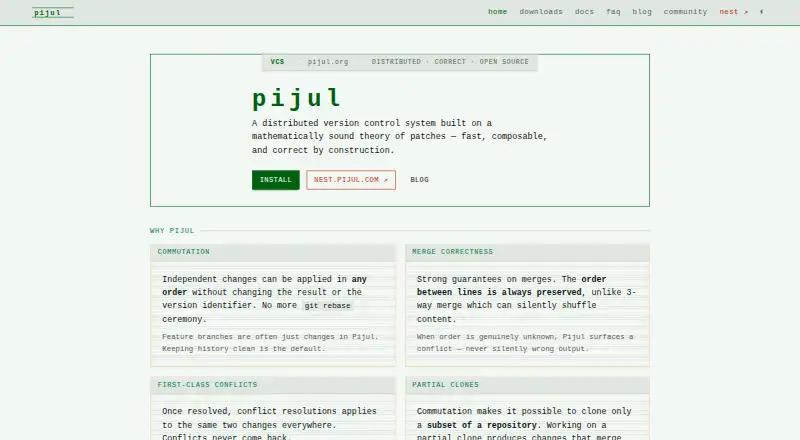
The facts below are what the maker publishes about Pijul, checked and dated. Our editors have not written about it yet.
The facts
Each one read from Pijul's own pages, with the date it was checked.
What it does
- Collaboration
- Collaboration works by sending and receiving patches and applying them to repositories.checked 11 Oct 2026
- Commutation
- Independent changes can be applied in any order without changing the result or version identifier.checked 11 Oct 2026
- Conflict resolution
- A conflict resolution applies to the same two changes everywhere and does not recur.checked 11 Oct 2026
- Hosted repositories
- Pijul Nest is described as Pijul’s repository hosting platform, with free hosting linked from the homepage.checked 11 Oct 2026
- Installation
- The recommended installation method is from source using Cargo and the Rust toolchain.checked 11 Oct 2026
- Integrations
- The Nest account manual says users can sign in with GitHub, Google, or Twitter.checked 11 Oct 2026
- Large files
- Pijul handles large files, but the FAQ says it does not currently have a good diff algorithm for them.checked 11 Oct 2026
- License
- Pijul is GPL version 2 or later and may be used for commercial projects.checked 11 Oct 2026
- Maintainers
- The site credits Pierre-Étienne Meunier and Florent Becker.checked 11 Oct 2026
- Merge behavior
- Pijul says it preserves line order in merges and surfaces conflicts when the order is unknown.checked 11 Oct 2026
- Merging
- Pijul preserves line order in merges and surfaces conflicts when the order is unknown.checked 11 Oct 2026
- Nest privacy
- The Nest privacy policy says content uploaded to Nest accounts is stored on its servers while the account is active.checked 11 Oct 2026
- Nest security
- The Nest privacy policy says data is encrypted in transit and database backups are encrypted; most data is not encrypted while in the database.checked 11 Oct 2026
- Partial clones
- Pijul can clone a subset of a repository, and changes made in a partial clone can merge into the full repository.checked 11 Oct 2026
- Purpose
- Pijul is a distributed version control system built on a patch-based theory.checked 11 Oct 2026
- Support
- The Pijul community page lists Zulip for questions and Discourse for longer discussions.checked 11 Oct 2026
- Version identifiers
- The FAQ says Pijul uses elliptic curve cryptography primitives to communicate a specific version number.checked 11 Oct 2026
The company
- Company
- The Nest terms identify the company as Pijul OÜ, an Estonian company.checked 11 Oct 2026
Where it runs
- Monorepos
- The FAQ says Pijul can retrieve a subset of patches and handle their dependencies for files consistent with a large remote repository.checked 11 Oct 2026
- Platforms
- The download page recommends installation from source using Cargo and lists community-maintained Windows binaries.checked 11 Oct 2026
- Windows support
- The downloads page links to community-maintained Windows binaries.checked 11 Oct 2026
Alternatives to Pijul
- 1

Unity
Free planAndroidiOSWebAPI8.4Free plan - 2

Unity Version Control
Free planWebAPILinuxmacOS8.1Free plan - 3

Perforce P4 (Helix Core)
Free planWebAPILinuxmacOS7.9From $39 a month - 4

Diversion
Free planWebAPILinuxmacOS7.8From $25 a month - 5

GitHub CodeQL
Free planWebExtensionLinuxmacOS7.5From $30 a month - 6
GitUI
Free planOpen sourceAndroidLinuxmacOSSelf-hosted7.5Free plan