
PictoBlox
PictoBlox is educational software for learning graphical block-based coding and Python through projects such as games, animations, IoT, robotics, AI, and mac…
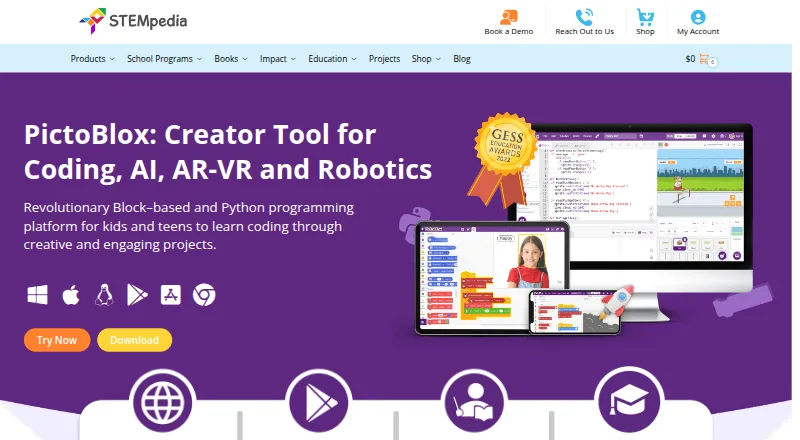
What PictoBlox is
PictoBlox is educational software for learning graphical block-based coding and Python through projects such as games, animations, IoT, robotics, AI, and machine learning. Its AI tools include face detection and recognition, computer vision, natural language processing, object and pose detection, speech recognition, QR scanning, and machine learning. Learners can build classification or regression models for image, object, hand-pose, pose, audio, text, and number data. The Python editor includes a code visualizer, debugger, autocomplete, interactive REPL, and package manager. In 3D and XR Studio, users can create models and interactive AR or VR projects with blocks or Python, then export to Google Cardboard VR, Pico VR, or Meta Quest. PictoBlox programs compatible hardware over USB or Bluetooth, including Arduino, Quarky, evive, LEGO, and micro:bit devices. Junior Blocks offers coding, AI, and robotics activities for children ages 4–7. It is available on desktop, mobile, Chromebook, and web platforms. The free plan is for individual, non-commercial use; commercial use requires contacting the maker. PictoBlox is proprietary and not open source.
Good
- Supports block-based coding and Python
- Python editor includes a debugger and code visualizer
- Projects can be exported to named VR platforms
- Programs compatible hardware over USB or Bluetooth
- Free plan available for individual, non-commercial use
Watch out
- PictoBlox is proprietary, not open source
- Free plan excludes commercial use
- Commercial use requires contacting the maker
Who it suits
PictoBlox suits learners exploring coding, robotics, AI, or machine learning through projects, including children ages 4–7 using Junior Blocks. Educators can use its classroom tools and curriculum library.
Verdict
PictoBlox spans beginner coding projects, Python tools, hardware programming, and AR or VR creation. Its free plan is limited to individual, non-commercial use.
Plans and prices
From PictoBlox's own pricing page, checked 29 Sep 2001.
| Plan | Price | What it gives you |
|---|---|---|
| Free (individual and non-commercial use) | Free | Individuals · non-commercial purposes; contact maker for commercial use |
The facts
Each one read from PictoBlox's own pages, with the date it was checked.
What it does
- 3D and XR
- 3D and XR Studio supports creating 3D models and interactive AR and VR projects with blocks or Python, with project export to Google Cardboard VR, Pico VR, and Meta Quest.checked 29 Sep 2001
- AI and ML
- Its AI features include face detection and recognition, computer vision, natural language processing, object detection, human pose detection, speech recognition, QR scanning, and machine learning.checked 29 Sep 2001
- Commercial use
- The maker asks users interested in commercial use to contact it to discuss collaboration.checked 29 Sep 2001
- For younger learners
- Junior Blocks offers play-based coding, AI, and robotics activities for children ages 4–7.checked 29 Sep 2001
- Hardware
- PictoBlox can control and program hardware over USB or Bluetooth and lists compatibility with Arduino, Quarky, evive, LEGO, and micro:bit devices.checked 29 Sep 2001
- License
- PictoBlox is proprietary and is not open source.checked 29 Sep 2001
- ML models
- The machine-learning environment supports image, object, hand-pose, pose, audio, text, and number classification or regression models.checked 29 Sep 2001
- Privacy
- The product FAQ says PictoBlox does not store users’ pictures or videos and that camera or video data is used locally or through secured servers with automated processing.checked 29 Sep 2001
- Privacy policy
- STEMpedia’s privacy policy says it does not knowingly collect information from children under 13 on its website, Dabble, and PictoBlox software, and says it will not sell personal information.checked 29 Sep 2001
- Purpose
- PictoBlox is educational software for learning graphical block-based coding and Python through projects such as games, animations, IoT, robotics, AI, and machine learning.checked 29 Sep 2001
- Python tools
- The Python editor includes a code visualizer, debugger, autocomplete, interactive REPL, and inbuilt PIP package manager.checked 29 Sep 2001
- Support and learning
- The maker points users to in-app tutorials, free online tutorials and projects, educator-led courses, and email support.checked 29 Sep 2001
The company
- Company
- STEMpedia identifies Agilo Research Pvt. Ltd. as the company responsible for its services and lists Ahmedabad, India as its headquarters.checked 29 Sep 2001
- Founded
- 2017checked 23 Sep 2001
- Headquarters
- Ahmedabad, Gujarat, Indiachecked 23 Sep 2001
The full review of PictoBlox
Overview
PictoBlox is an educational coding environment for learners moving between visual programming and Python. It suits classrooms and individual learners who want to connect coding lessons to robotics, AI or creative projects. Its breadth is a strength, though the free license limits use to individuals and non-commercial purposes.
Key features
PictoBlox offers more than one route into programming, which makes it useful across a mixed-ability group but also gives users a wide set of project areas to navigate.
- Blocks and Python: Learners can build with graphical blocks or write Python. The Python editor’s visualizer, debugger, autocomplete, interactive REPL and built-in PIP package manager make it more capable than a blocks-only introduction, particularly for learners ready to inspect and refine code.
- AI and machine learning: Projects can use face detection and recognition, computer vision, natural language processing, object and pose detection, speech recognition and QR scanning. The ML environment supports classification or regression models for images, objects, hand poses, poses, audio, text and numbers. This range supports varied experiments, but is a lot of scope for someone seeking only a basic coding tool.
- 3D and XR: 3D and XR Studio supports 3D models and interactive AR or VR projects using blocks or Python, with export to Google Cardboard VR, Pico VR and Meta Quest. That makes it a distinctive option for learners interested in immersive projects rather than only screen-based coding.
- Hardware and robotics: Programs can control hardware over USB or Bluetooth. Compatibility includes Quarky, evive, Arduino, LEGO and micro:bit devices, and PictoBlox also provides a robot simulator. The hardware range is valuable for robotics teaching, though physical-device projects depend on having compatible equipment.
- Early learning and teaching: Junior Blocks offers play-based coding, AI and robotics activities for ages 4–7. Classroom tools, a curriculum library, in-app tutorials, free online tutorials and projects, educator-led courses and email support make PictoBlox relevant to guided learning as well as independent exploration.
PictoBlox is proprietary, not open source. Its FAQ says pictures and videos are not stored and that camera or video data is handled locally or through secured servers with automated processing. STEMpedia’s privacy policy says it does not knowingly collect information from children under 13 on its website, Dabble or PictoBlox software, and will not sell personal information.
Pricing
Free (individual and non-commercial use): free. The free plan is for individuals using PictoBlox for non-commercial purposes. It is a sensible starting point for personal learning, but not a license for commercial work. For commercial use, the maker asks interested users to contact it to discuss collaboration.
Platforms
PictoBlox supports Windows, macOS, Linux, Chromebook, Android, iOS and web browsers. That range gives learners options across desktop, mobile and browser-based use.
Who it's for
PictoBlox is best suited to learners and educators who want one environment spanning block coding, Python, robotics and AI or machine-learning projects. Younger children have a dedicated Junior Blocks option, while the Python tools and XR Studio provide further directions for more ambitious work. It is less suitable for commercial users seeking a straightforward free license, or for users who want open-source software.
Pros and cons
- Pro: Blocks and Python share an environment, with debugging, visualization, autocomplete and REPL tools supporting progression beyond visual coding.
- Pro: Robotics, AI and ML, and 3D or XR projects offer several practical directions for applying coding concepts.
- Pro: Classroom tools, a curriculum library, tutorials, courses and email support serve both teaching and self-guided learning.
- Con: The free plan is limited to individual, non-commercial use, so commercial users need to contact the maker.
- Con: Hardware programming depends on compatible devices for physical projects, even though a robot simulator is also available.
- Con: The software is proprietary, which rules it out for users who require open-source tools.
Alternatives
For a robotics-learning shortlist, see Robotics Education Software.
- mBlock is a good alternative for readers seeking a free coding platform with block-based and Python coding plus AI and IoT features.
- VEXcode suits readers looking for a VR-specific free option with blocks, 15 playgrounds with basic graphics, curriculum and activities, and online resources.
- Ozobot Classroom is worth considering for educators who want a free teacher-focused portal with 700 lessons.
- Sphero Edu is an option for learners who already have a compatible Sphero robot; robot programming requires one.
- True Robotics Playground is a free web-based block-coding option for owners of True Robotics robot kits, connecting over Bluetooth or USB.
- Wonder Workshop Blockly may fit classrooms seeking a free tier for up to 35 students, one teacher and one classroom, with Blockly puzzle tracking; it requires a physical Dash robot.
- Trackio is another alternative.
- Open Roberta Lab is a free browser-based option that requires no installation.
Verdict
Choose PictoBlox if you want a single learning environment that can grow from block-based projects into Python, robotics, AI or XR work. Its strongest case is that range, backed by classroom resources and a dedicated path for young children. Look elsewhere if your use is commercial, you need open-source software, or your project depends on hardware PictoBlox does not list as compatible.
Getting started
- Open the PictoBlox product website
- Choose the Windows, macOS, Linux, Chromebook, Android, iOS, or web version
- Start with the Free plan for individual, non-commercial use
- Select block-based coding or the Python editor
- Follow in-app tutorials, online projects, or educator-led courses
- Connect compatible hardware over USB or Bluetooth when needed
Limits worth knowing
The free plan costs 0.00 USD and is for individuals using PictoBlox for non-commercial purposes. Commercial use requires contacting the maker to discuss collaboration.
Questions
Is PictoBlox free?
Yes. The Free plan costs 0.00 USD for individual, non-commercial use.
Which platforms does it support?
PictoBlox supports Windows, macOS, Linux, Chromebook, Android, iOS, and web browsers.
Is PictoBlox open source?
No. PictoBlox is proprietary software.
Can it program robots and boards?
Yes. It controls compatible hardware over USB or Bluetooth, including Arduino, Quarky, evive, LEGO, micro:bit, and Wizbot.
Does PictoBlox include Python tools?
Yes. Its Python editor has a code visualizer, debugger, autocomplete, interactive REPL, and built-in PIP package manager.
What support and learning resources are available?
STEMpedia provides in-app tutorials, free online tutorials and projects, educator-led courses, and email support.
Alternatives to PictoBlox
- 1
mBlock
Free planOpen sourceAndroidiOSWebLinux7.8Free plan - 2

Ozobot Classroom
Free planAndroidiOSWebmacOS7.4Free plan - 3
EdScratch
Free planAndroidiOSWebmacOS7.3Free plan - 4
VEXcode
Free planAndroidiOSWebExtension7.3From $16.58 a month - 5
Wonder Workshop Blockly
Free planAndroidiOSWeb7.3From $10.42 a month - 6
ROBO Pro Coding
Free planAndroidiOSLinuxmacOS7.1Free plan