EdScratch
EdScratch is a free, browser-based visual programming environment for Edison robots.
What EdScratch is
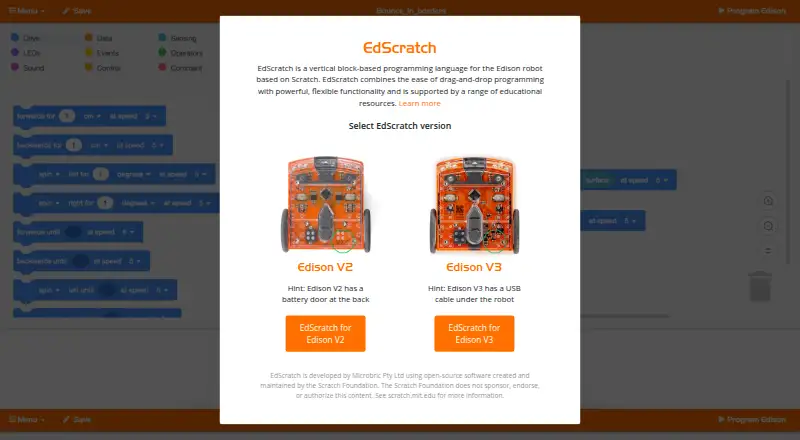
EdScratch is a free, browser-based visual programming environment for Edison robots. Its vertical drag-and-drop blocks are based on Scratch and are described as suitable for students aged 10 and up, including beginners. Versions are available for Edison V2 and V3, with blocks for drive, LEDs, sound, data, events, control, sensing, operators and comments. Programs can control robot inputs, manipulate data and use variables. A built-in bug box checks programs and displays warnings to help learners find errors. Users can save programs to a computer and load saved files back into the online app. Edison V3 can receive a program over USB from a computer or through optical flashing from an iPad; V1 and V2 use the EdComm cable. Microbric offers a free lesson set with 98 activity options across six units and a teacher’s guide. EdScratch works online on web, Windows, macOS, iPadOS and Android, but requires an internet connection. The interface is in English, while lesson resources are available in multiple languages.
Good
- Free browser-based programming for Edison robots.
- Built-in bug box displays program warnings.
- Includes 98 student activity options across six units.
- Programs can be saved and reloaded.
- Supports Edison V2 and V3.
Watch out
- Requires an internet connection.
- Interface is currently available only in English.
- V3 USB programming uses WebUSB supported by Chrome and Edge, not Firefox or Safari.
Who it suits
EdScratch suits students aged 10 and up who are learning to program Edison robots, including those without prior coding experience. Teachers can use its lesson activities and teacher’s guide.
Verdict
EdScratch provides a visual starting point for programming Edison robots, with error warnings and teaching materials. Its internet requirement and browser limits for V3 USB programming are worth checking before use.
Plans and prices
From EdScratch's own pricing page, checked 8 Oct 2001.
| Plan | Price | What it gives you |
|---|---|---|
| EdScratch | Free | Free to use with an Edison robot · browser access; no additional software required |
The facts
Each one read from EdScratch's own pages, with the date it was checked.
Where it runs
- Browser support
- The maker lists Chrome, Edge and Opera for Edison V3 computers, and Chrome, Firefox, Safari, Edge and Opera for V3 iPad and Edison V1/V2.checked 8 Oct 2001
- Platforms
- EdScratch is accessed online, and the maker says it can be used through the online app on devices running iOS or Android.checked 8 Oct 2001
What it does
- Compatibility limit
- Edison V3 USB programming uses WebUSB, which the maker says is supported by Chrome and Edge but not Firefox or Safari.checked 8 Oct 2001
- Connectivity
- Edison V3 can be programmed from a computer over USB or from an iPad by optically flashing the program to the robot.checked 8 Oct 2001
- Debugging
- A built-in bug box automatically checks programs and displays warning messages to help users find errors.checked 8 Oct 2001
- Developer
- EdScratch is developed by Microbric Pty Ltd using open-source software created and maintained by the Scratch Foundation; the Foundation does not sponsor or endorse it.checked 8 Oct 2001
- Developer and open source
- EdScratch is developed by Microbric Pty Ltd using open-source software created and maintained by the Scratch Foundation, which the maker says does not sponsor or endorse EdScratch.checked 8 Oct 2001
- Education
- The maker describes EdScratch as suitable for students aged 10 and up and provides lesson plans, student activities, and a teacher’s guide.checked 8 Oct 2001
- Error checking
- A built-in “bug box” checks programs for errors and displays red or yellow warnings.checked 8 Oct 2001
- Features
- It supports controlling robot inputs, manipulating data, and creating and using variables.checked 8 Oct 2001
- Integrations
- The maker describes EdScratch projects and programming challenges used with the EdCreate Edison robot creator’s kit.checked 8 Oct 2001
- Internet requirement
- EdScratch requires an internet connection, and the maker says no offline or downloadable version is in development.checked 8 Oct 2001
- Language limit
- The application interface currently displays only English, although lesson resources are available in multiple languages.checked 8 Oct 2001
- Limits
- EdScratch variable names may contain English letters, numbers, and underscores, and may not start with a number.checked 8 Oct 2001
- Mobile access
- EdScratch is usable through its online app on iOS and Android devices; dedicated mobile apps are not currently in development.checked 8 Oct 2001
- Programming features
- Its nine block categories include drive, LEDs, sound, data, events, control, sensing, operators and comments.checked 8 Oct 2001
- Program saving
- Users can save a program to their computer and load a saved EdScratch file back into the online app.checked 8 Oct 2001
- Purpose
- EdScratch is a Scratch-based, vertical drag-and-drop visual programming language for Edison robots.checked 8 Oct 2001
- Robot compatibility
- The maker describes programming instructions for Edison V1, V2, and V3 robots.checked 8 Oct 2001
- Robot connection
- Programs can be sent to Edison V3 from a computer over USB or from an iPad by flashing the program optically; V1/V2 use the EdComm cable.checked 8 Oct 2001
- Robot versions
- The EdScratch site offers versions for Edison V2 and Edison V3.checked 8 Oct 2001
The company
- Founded
- 2018checked 28 Sep 2001
- Headquarters
- Grange, South Australia, Australiachecked 28 Sep 2001
- Maker headquarters
- The maker says its head office is in Adelaide, South Australia.checked 8 Oct 2001
The full review of EdScratch
EdScratch is a visual coding environment for students programming Edison robots, with a low barrier for learners who have not coded before. Its focused robot blocks and substantial free teaching materials make it a strong classroom starting point; the need to work online and the constraints around V3 USB connection may not suit every setup.
Overview
EdScratch uses vertical, drag-and-drop blocks to program Edison V1, V2 and V3 robots. Learners can control robot inputs, manipulate data and use variables without needing to write conventional code. Variable names are restricted to English letters, numbers and underscores, and cannot begin with a number—a small but real constraint as students move toward more flexible programming conventions.
The nine block categories cover drive, LEDs, sound, data, events, control, sensing, operators and comments. This is a useful range for connecting code to robot behavior and introducing program structure, but the environment is purpose-built for Edison rather than a broad coding workspace.
A built-in bug box checks programs and displays red or yellow warnings. It gives beginners a prompt to inspect possible errors, although warnings should be treated as guidance rather than automatic debugging. Programs can be saved to a computer and loaded back into the online app, which helps preserve work but does not remove the need for an internet connection.
Key features
EdScratch is based on Scratch and keeps programming visual through blocks. The nine categories span movement, lights, sound, sensing and control, giving students ways to build programs around the robot’s inputs and outputs while also working with data and variables.
The maker’s free lesson set includes 98 student activity options across six units, alongside a teacher’s guide. That gives educators a substantial path for structured classroom use rather than leaving them to invent every exercise. Lesson resources are available in multiple languages, but the application interface itself currently displays only English.
EdScratch supports projects and programming challenges used with the EdCreate Edison robot creator’s kit. Support materials include tutorials, troubleshooting FAQs, a warning-message guide and contact options.
Pricing
EdScratch is free to use with an Edison robot. Its Free plan costs nothing and provides browser access without requiring additional software; there is no free trial because the software is free. The plan is a natural fit for schools and families that already have compatible Edison hardware, but it does not include the robot itself.
There are no paid tiers or seat-based charges to weigh. The practical limits are access-related: EdScratch requires an internet connection, and the maker says it has no offline or downloadable version in development. Users can save and reload program files locally, but the coding environment remains online.
Platforms
EdScratch runs in a web browser and is usable on Windows, macOS, iPadOS and Android devices. Dedicated mobile apps are not currently in development. Browser support depends on the robot and connection method: for Edison V3 computers, the maker lists Chrome, Edge and Opera; for V3 iPad use and Edison V1/V2, it lists Chrome, Firefox, Safari, Edge and Opera.
Programming a V3 from a computer over USB uses WebUSB, which the maker says is supported by Chrome and Edge but not Firefox or Safari. V3 programs can also be flashed optically from an iPad, while V1 and V2 use the EdComm cable. Check the browser and connection combination before planning a classroom around USB programming.
Who it's for
EdScratch is aimed at students aged 10 and up, including those without prior coding experience, and is best suited to educators using Edison robots for introductory programming. Its activity set and teacher’s guide support lesson-based use, while the visual blocks give beginners an approachable way to connect code with physical robot behavior.
It is less suitable for learners who need offline access, a non-English interface, or a coding tool that extends beyond Edison hardware. The open-source software it uses is maintained by the Scratch Foundation, which does not sponsor or endorse EdScratch; the product is developed by Microbric Pty Ltd.
Pros and cons
Pros
- Free access with an Edison robot: Browser use requires no additional software, keeping the entry cost to the compatible hardware.
- Useful classroom support: The 98 activity options across six units and accompanying teacher’s guide give educators a substantial teaching resource.
- Beginner-oriented error prompts: The bug box flags potential problems in red or yellow, helping learners know when to review a program.
- Multiple robot connection options: V3 supports computer USB programming or optical flashing from an iPad, while V1/V2 use the EdComm cable.
Cons
- Internet required: Saving files locally does not make the editor usable offline, which limits use where connectivity is unreliable.
- Browser restrictions for V3 USB: WebUSB support is limited to Chrome and Edge, so Firefox and Safari users cannot use that computer connection method.
- English-only interface: Multilingual lesson resources do not change the language available in the application itself.
- Narrow hardware focus: The blocks and programming workflow are designed for Edison robots, not as a general-purpose coding environment.
Alternatives
Choose mBlock if you want a free platform that combines block-based and Python coding with AI and IoT features, rather than an environment focused on Edison robots.
PictoBlox is worth considering for individuals seeking a free plan for non-commercial use; commercial users need to contact its maker.
Choose FinchBlox if you are comparing another free robotics-coding option; it is available across web, desktop and mobile platforms.
Ozobot Classroom may suit educators who want a teacher-focused portal with 700 lessons rather than EdScratch’s Edison-specific activity set.
Rocksi is another free robotics software option to consider.
Choose Sphero Edu if you have a compatible Sphero robot and want free app or web access for robot programming.
Thymio Suite is a free desktop download for users programming a Thymio robot.
True Robotics Playground is a free web-based block-coding option that connects to True Robotics kits over Bluetooth or USB.
Explore more options in Robotics Education Software.
Verdict
Choose EdScratch if you teach or support students aged 10 and up who are learning to program Edison robots: its visual blocks, warning prompts and extensive free lesson materials make a coherent introductory package. Look elsewhere if offline use, a non-English interface or broader robot compatibility matters more than Edison-focused instruction.
Getting started
- Open the EdScratch online app at edscratchapp.com.
- Choose the version for Edison V2 or Edison V3.
- Create a program with the drag-and-drop blocks.
- Connect the robot using the method for its version: USB or optical flashing for V3, or EdComm cable for V1 and V2.
- Save a program to the computer if you want to load it into the app later.
Limits worth knowing
EdScratch requires internet access and has an English-only application interface. Variable names can use English letters, numbers, and underscores, but cannot begin with a number.
Questions
Is EdScratch free?
Yes. EdScratch is free to use with an Edison robot, with browser access and no additional software required.
Which platforms does EdScratch support?
It runs through a web browser and is usable on Windows, macOS, iPadOS, and Android. There are no dedicated mobile apps currently in development.
Which Edison robots can it program?
The site offers versions for Edison V2 and V3, and the maker describes programming instructions for V1, V2, and V3.
How do I send a program to an Edison robot?
Edison V3 can be programmed from a computer over USB or from an iPad by optical flashing. V1 and V2 use the EdComm cable.
Does EdScratch include teaching materials?
Yes. The free lesson set has 98 student activity options organized into six units, plus a teacher’s guide. Lesson resources are available in multiple languages.
Who develops EdScratch, and is it open source?
Microbric Pty Ltd develops EdScratch using open-source software created and maintained by the Scratch Foundation. The Foundation does not sponsor or endorse EdScratch.
Alternatives to EdScratch
- 1
mBlock
Free planOpen sourceAndroidiOSWebLinux7.8Free plan - 2

Ozobot Classroom
Free planAndroidiOSWebmacOS7.4Free plan - 3
VEXcode
Free planAndroidiOSWebExtension7.3From $16.58 a month - 4
Wonder Workshop Blockly
Free planAndroidiOSWeb7.3From $10.42 a month - 5
ROBO Pro Coding
Free planAndroidiOSLinuxmacOS7.1Free plan - 6

BugBotLab
Free planWeb6.7From £12.42 a month