
PgDog
PgDog is a PostgreSQL connection pooler, load balancer, and database sharder built to scale databases without requiring application changes.
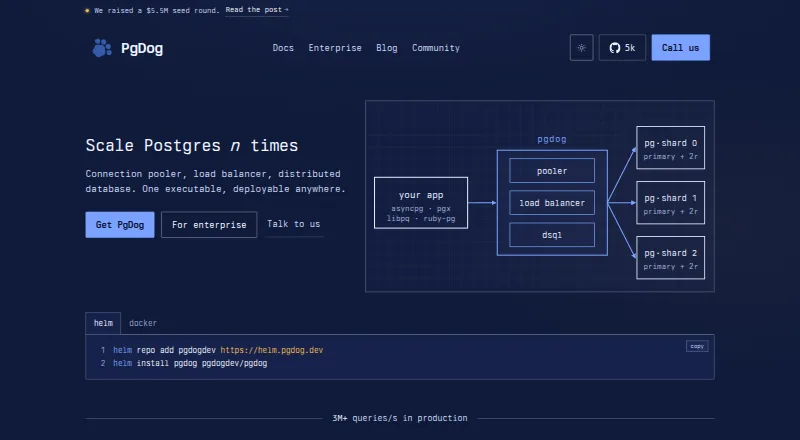
What PgDog is
PgDog is a PostgreSQL connection pooler, load balancer, and database sharder built to scale databases without requiring application changes. It multiplexes thousands of application connections over a smaller number of PostgreSQL server connections while supporting SET, LISTEN/NOTIFY, and advisory locks. Read queries can be distributed across replicas, while writes go to the primary; health checks and failover detection support that routing. Sharding keys direct queries to the appropriate database, and queries without a key can execute across databases in parallel. Cross-shard transactions use PostgreSQL prepared transactions and two-phase commit, with automatic rollback when errors occur. For online resharding, PgDog copies data and streams row changes to another database while query traffic continues. Deployment options include Kubernetes Helm, Docker, AWS ECS Terraform, pre-built binaries, and source builds. Releases cover Linux arm64 and amd64, Apple Silicon Mac, and Debian packages; the macOS binary is unsigned. PgDog is free, open-source AGPL-3.0 software, and its documentation says internal use does not require sharing source code. Enterprise support adds a production control plane, insights, dedicated Slack support, architecture reviews, and a 15-minute response SLA.
Good
- Pools thousands of connections over fewer PostgreSQL connections
- Routes reads to replicas and writes to primary
- Supports sharding-key and parallel cross-database queries
- Cross-shard transactions roll back automatically on errors
- Online data copying keeps query traffic running
- Free AGPL-3.0 open-source project
Watch out
- The macOS binary is unsigned
- Enterprise support uses a separate enterprise offering
- Supports PostgreSQL as the database system
Who it suits
PgDog suits teams running PostgreSQL that need pooling, replica-aware routing, failover detection, sharding, or online resharding without changing their applications. It is also suited to organizations comfortable deploying open-source infrastructure through containers, Kubernetes, binaries, or source.
Verdict
Pick PgDog when PostgreSQL scaling requires pooling, load balancing, sharding, and failover behavior without application rewrites. Its open-source distribution supports several deployment paths and includes online resharding. Look elsewhere if you require a signed macOS binary or a database platform other than PostgreSQL.
Plans and prices
From PgDog's own pricing page, checked 29 Sep 2026.
| Plan | Price | What it gives you |
|---|---|---|
| Open source | Free | Free and open source software · AGPL-3.0 |
| Enterprise | Priced on request | Production control plane · insights · dedicated Slack support · SLA-backed support |
The facts
Each one read from PgDog's own pages, with the date it was checked.
The company
- Company
- The site identifies the company as PgDog, Inc.; the pages reviewed do not state its headquarters or founding year.checked 29 Sep 2026
- Headquarters
- San Francisco, California, United Stateschecked 28 Sep 2026
What it does
- Connection pooling
- It multiplexes thousands of application connections over a small number of PostgreSQL server connections and supports SET, LISTEN/NOTIFY, and advisory locks.checked 29 Sep 2026
- Deployment
- PgDog can be deployed with Kubernetes Helm, Docker, AWS ECS Terraform, pre-built binaries, or from source.checked 29 Sep 2026
- Enterprise support
- Enterprise support includes a dedicated Slack channel, architecture reviews, and an SLA promising a response within 15 minutes.checked 29 Sep 2026
- Integrations
- The enterprise insights page lists Prometheus and OTEL exporters, plus Incident.io integration for alerts.checked 29 Sep 2026
- License
- The project is free and open source under AGPL-3.0, and the documentation says internal use does not require sharing source code.checked 29 Sep 2026
- Load balancing
- It distributes read queries across replicas and routes writes to the primary, with health checks and failover detection.checked 29 Sep 2026
- Resharding
- PgDog can copy data and stream row changes to another database online without pausing query traffic.checked 29 Sep 2026
- Security
- The enterprise control plane page describes SSO for access protection, while installation documentation says user credentials can be encrypted at rest in supported environments such as Kubernetes or AWS Secrets Manager.checked 29 Sep 2026
- Sharding
- PgDog routes queries using sharding keys and can execute queries without a key across databases in parallel.checked 29 Sep 2026
- Supported binaries
- Pre-built releases are available for Linux arm64 and amd64, Apple Silicon Mac, and Debian packages; the macOS binary is unsigned.checked 29 Sep 2026
- Transactions
- The product page says cross-shard transactions use PostgreSQL prepared transactions and two-phase commit, with automatic rollback on errors.checked 29 Sep 2026
- What it does
- PgDog is a PostgreSQL connection pooler, load balancer, and database sharder designed to scale databases without application changes.checked 29 Sep 2026
The full review of PgDog
PgDog is a PostgreSQL proxy that combines connection pooling, read/write load balancing, sharding, and failover-aware routing. It suits teams operating PostgreSQL at scale that want these controls without changing application code. The main appeal is unusually broad functionality in a free, open-source package; the main cautions are its PostgreSQL-only scope, AGPL-3.0 license, and unsigned macOS binary.
Overview
PgDog sits between applications and PostgreSQL servers, multiplexing client connections and deciding where queries should run. Its free Open source plan costs nothing and is released under AGPL-3.0. Documentation states that internal use does not require sharing source code, making it practical for many in-house deployments, while organizations distributing modified software should review the license carefully.
The project is available as self-hosted software and can be deployed through several infrastructure patterns. That flexibility favors engineering teams comfortable owning database proxy operations rather than buyers seeking a managed, database-agnostic service.
For a wider category view, see Database Proxy Software.
Key features
Pooling and session behavior
PgDog multiplexes thousands of application connections over a smaller number of PostgreSQL server connections. This can reduce connection pressure for busy services without discarding important PostgreSQL session features: SET, LISTEN/NOTIFY, and advisory locks are supported. It is a stronger fit than a narrowly focused pooler when applications depend on those behaviors.
Load balancing and failover
Read queries can be distributed across replicas while writes go to the primary. Health checks and failover detection inform that routing, giving teams a way to keep traffic aligned with changing database availability. The benefit is most relevant to read-heavy or highly available PostgreSQL installations; it does not broaden support beyond PostgreSQL.
Sharding and transactions
Queries containing a sharding key are routed to the appropriate database. Queries without a key can execute across databases in parallel, which helps reporting and other cross-shard work but may require careful workload design. Cross-shard transactions use PostgreSQL prepared transactions and two-phase commit, with automatic rollback when errors occur. That provides a consistency mechanism for distributed writes, alongside the operational complexity inherent in two-phase commit.
Online resharding
PgDog can copy data to another database and stream row changes while query traffic continues. Online movement avoids a planned pause during resharding and is valuable when changing shard placement on a live system. It still leaves the team responsible for planning and operating the migration.
Observability and security
Enterprise insights include Prometheus and OTEL exporters, with Incident.io integration for alerts. The enterprise control plane describes SSO for access protection, and installation guidance supports encrypting credentials at rest in environments such as Kubernetes or AWS Secrets Manager. These controls are aimed at production operations and are tied to the enterprise offering rather than the free core plan.
Pricing
| Plan | Price | Includes |
|---|---|---|
| Open source | free | Free and open source software under AGPL-3.0 |
| Enterprise | Custom pricing | Production control plane, insights, dedicated Slack support, and SLA-backed support |
The free plan is the logical choice for teams able to run PgDog themselves and accept community-led operations. Enterprise is for production users who need a control plane, integrated insights, a dedicated Slack channel, architecture reviews, and an SLA promising a response within 15 minutes. No seat, usage, or trial limits are stated, so buyers should obtain commercial terms before budgeting.
Platforms
PgDog runs on Linux, macOS, Windows, and self-hosted environments. Deployment options include Kubernetes Helm, Docker, AWS ECS Terraform, pre-built binaries, and source installation. Releases cover Linux arm64 and amd64, Apple Silicon Mac, and Debian packages. The macOS binary is unsigned, which can add trust and installation friction for Mac administrators.
Who it's for
Choose PgDog when PostgreSQL scaling requires pooling plus replica routing, sharding, cross-shard transaction handling, or online resharding in one layer. It is especially suitable for infrastructure teams that can operate Kubernetes, containers, cloud infrastructure, or source builds and want to avoid application rewrites.
Look elsewhere if you need a managed experience, a signed macOS application, or support for another database engine. The AGPL license also warrants review before embedding or redistributing modified software.
Pros and cons
- Pro: Combines pooling, load balancing, sharding, failover detection, and online resharding instead of limiting the deployment to one proxy function.
- Pro: Preserves SET, LISTEN/NOTIFY, and advisory locks while multiplexing large client populations.
- Pro: Supports multiple deployment paths, from Helm and Docker to ECS Terraform, binaries, and source.
- Con: PostgreSQL is the only supported database, so mixed-engine environments need another product.
- Con: The macOS binary is unsigned, creating an administrative hurdle on Mac systems.
- Con: Enterprise-only control-plane, insights, SSO, and rapid-response support are not part of the free core plan.
Alternatives
PgBouncer is the simpler choice when you need a free, self-hosted PostgreSQL connection pooler without PgDog’s broader sharding and routing scope. Choose pgagroal for a BSD-3-Clause self-hosted PostgreSQL pooler. PgDoorman fits buyers seeking a free pooler with no paid plans or usage limits stated.
ShardingSphere-Proxy is an alternative open-source proxy with Docker and Helm deployment. OceanBase Database suits teams wanting a distributed database with full kernel capabilities rather than a PostgreSQL proxy. MySQL is the relevant switch when the target engine is MySQL. ProxySQL offers an open-source community edition with its core features for supported platforms. TurbineProxy is a free Apache-2.0 option with no per-query fees.
Verdict
PgDog is a strong pick for PostgreSQL teams that want one open-source layer for pooling, replica routing, sharding, failover behavior, and online resharding without application rewrites. Its deployment flexibility and free core make it accessible to self-hosting engineers, while enterprise support adds a production path. Choose another product if you need a different database engine, a managed-first service, or a signed macOS binary.
Getting started
- Visit https://pgdog.dev/
- Choose a deployment route such as Kubernetes Helm, Docker, AWS ECS Terraform, a pre-built binary, or source
- Select the release matching Linux, Apple Silicon Mac, or Debian packaging where applicable
- Deploy PgDog alongside your PostgreSQL environment
- Configure pooling, routing, or sharding for your PostgreSQL workloads
Limits worth knowing
The open-source plan is free under AGPL-3.0. Enterprise capabilities are provided through a separate Enterprise plan with a production control plane, insights, dedicated Slack support, and SLA-backed support.
Questions
Is PgDog free and open source?
Yes. PgDog is free and open source under the AGPL-3.0 license. Documentation says internal use does not require sharing source code.
Which platforms can run PgDog?
PgDog supports Linux, macOS, Windows, and self-hosted deployment. Pre-built releases include Linux arm64 and amd64, Apple Silicon Mac, and Debian packages.
How can PgDog be deployed?
Deployment options include Kubernetes Helm, Docker, AWS ECS Terraform, pre-built binaries, and building from source.
What database does PgDog support?
PgDog is designed for PostgreSQL and provides pooling, query routing, load balancing, and sharding for PostgreSQL databases.
What does enterprise support include?
Enterprise support includes a dedicated Slack channel, architecture reviews, and an SLA promising a response within 15 minutes. The enterprise offering also includes a production control plane and insights.
Alternatives to PgDog
- 1
OceanBase Database
Free planOpen sourceWebAPILinuxmacOS8.2$2.38 usage-based - 2

MySQL
Free planAPILinuxmacOSSelf-hosted7.9Free plan - 3
Supavisor
Free planOpen sourceAPILinuxSelf-hosted7.6From $25 a month - 4
Avidemux
Free planOpen sourceWebLinuxmacOSWindows7.3Free plan - 5
TiCDC
Free planOpen sourceAPILinuxmacOSSelf-hosted7.2Free plan - 6

Amazon RDS
Free planWebAPISelf-hosted7.1Free plan