PgDoorman
PgDoorman is a free, open-source connection pooler for PostgreSQL, written in Rust and designed as a drop-in replacement for PgBouncer and Odyssey.
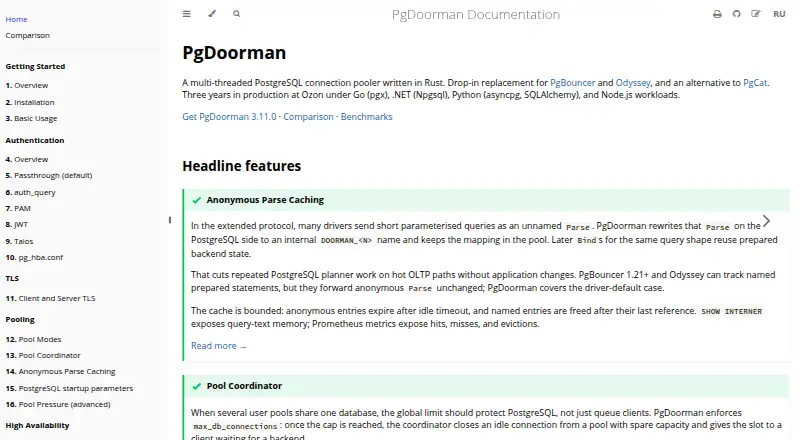
What PgDoorman is
PgDoorman is a free, open-source connection pooler for PostgreSQL, written in Rust and designed as a drop-in replacement for PgBouncer and Odyssey. It is self-hosted on Linux or macOS and supports PostgreSQL 10 and newer. Its pool coordinator applies per-database connection caps and can reclaim idle connections from pools with spare capacity. It caches anonymous Parse messages so pooled clients can reuse prepared backend state without application changes. With Patroni assistance, it can direct new backend connections to another live cluster member if the local PostgreSQL server goes away during a switchover. Monitoring includes a Prometheus metrics endpoint and an optional local diagnostic console covering pool, latency, error, query, log, CPU, and memory information. Authentication choices include MD5 or SCRAM passthrough, auth_query, PAM, JWT, Talos JWT, and pg_hba.conf rules. TLS can be set up for client and backend connections. The project reports three years of production use at Ozon with Go, .NET, Python, and Node.js workloads. It can be built from source, installed via distribution packages, or downloaded as a prebuilt binary; source builds require Rust 1.87 or newer. Docker is intended for development, CI, and demos rather than production.
Good
- Free and open source.
- Caps per-database connections and reallocates idle capacity.
- Patroni-assisted fallback supports failover.
- Prometheus endpoint and diagnostic console provide monitoring.
- TLS supports client and backend connections.
Watch out
- LDAP authentication is unsupported.
- Kerberos GSSAPI and certificate authentication are unsupported.
- SCRAM channel binding is unsupported.
- Docker is not intended for production.
Who it suits
PgDoorman suits teams that operate PostgreSQL themselves and need connection pooling, load balancing, or automatic failover. Its Linux or macOS and PostgreSQL version requirements matter when assessing a deployment.
Verdict
PgDoorman offers self-hosted pooling, balancing, and failover with monitoring and several authentication methods. Check its unsupported authentication options and deployment requirements before choosing it.
Plans and prices
From PgDoorman's own pricing page, checked 8 Oct 2026.
| Plan | Price | What it gives you |
|---|---|---|
| PgDoorman | Free | No paid plans or usage limits stated |
The facts
Each one read from PgDoorman's own pages, with the date it was checked.
What it does
- Authentication
- Documented authentication methods include MD5 or SCRAM passthrough, auth_query, PAM, JWT, Talos JWT, and pg_hba.conf access rules.checked 8 Oct 2026
- Credential handling
- In passthrough mode, the client’s MD5 hash or SCRAM ClientKey is reused for PostgreSQL authentication, so plaintext passwords are not needed in the configuration.checked 8 Oct 2026
- Deployment
- PgDoorman can be built from source, installed from distribution packages, or downloaded as a prebuilt binary; Docker is intended for development, CI, and demos rather than production.checked 8 Oct 2026
- High availability
- Patroni-assisted fallback can direct new backend connections to another live cluster member when the local PostgreSQL server disappears during a switchover.checked 8 Oct 2026
- Monitoring
- PgDoorman includes a Prometheus metrics endpoint and an optional local web diagnostic console for pool, latency, error, query, log, CPU, and memory information.checked 8 Oct 2026
- Pool coordination
- Its pool coordinator enforces a per-database connection cap and can redistribute capacity by closing idle connections from pools with spare capacity.checked 8 Oct 2026
- Prepared statements
- PgDoorman caches anonymous Parse messages so clients in a pool can reuse prepared backend state without application changes.checked 8 Oct 2026
- Production use
- The project says it has been in production at Ozon for three years with Go, .NET, Python, and Node.js workloads.checked 8 Oct 2026
- Requirements
- The installation guide requires PostgreSQL 10 or newer and Rust 1.87 or newer when building from source.checked 8 Oct 2026
- Security limits
- LDAP, Kerberos GSSAPI, certificate-based authentication, and SCRAM channel binding are listed as unsupported.checked 8 Oct 2026
- TLS
- TLS can be configured for client and backend connections, while seamless migration of TLS sessions during binary upgrades requires a Linux build with the tls-migration feature.checked 8 Oct 2026
- What it does
- PgDoorman is a multithreaded PostgreSQL connection pooler written in Rust and described as a drop-in replacement for PgBouncer and Odyssey.checked 8 Oct 2026
Where it runs
- Platforms
- The installation guide lists Linux and macOS as supported operating systems and recommends Linux for production.checked 8 Oct 2026
Alternatives to PgDoorman
- 1
OceanBase Database
Free planOpen sourceWebAPILinuxmacOS8.2$2.38 usage-based - 2

MySQL
Free planAPILinuxmacOSSelf-hosted7.9Free plan - 3
Supavisor
Free planOpen sourceAPILinuxSelf-hosted7.6From $25 a month - 4
Avidemux
Free planOpen sourceWebLinuxmacOSWindows7.3Free plan - 5
TiCDC
Free planOpen sourceAPILinuxmacOSSelf-hosted7.2Free plan - 6

Amazon RDS
Free planWebAPISelf-hosted7.1Free plan