OceanBase Database
OceanBase Database is a distributed database for transactional, analytical, and AI workloads, bringing those workload types into one database.
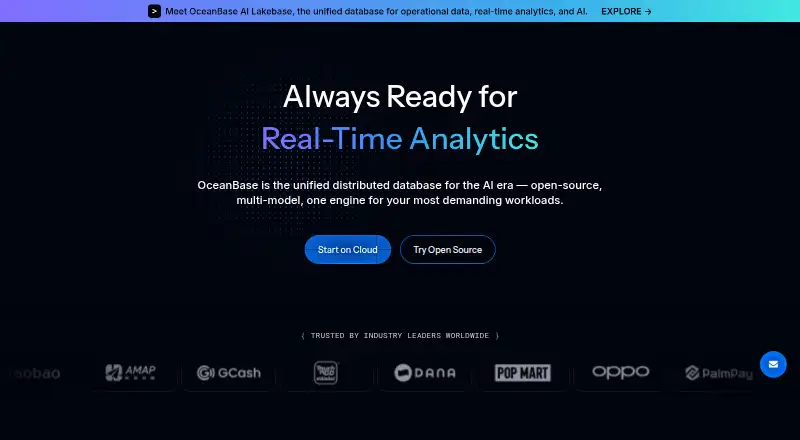
What OceanBase Database is
OceanBase Database is a distributed database for transactional, analytical, and AI workloads, bringing those workload types into one database. Built-in Oracle and MySQL compatibility is intended to simplify workload migration. The product is available as the open-source Community Edition, a self-hosted Enterprise edition, or OceanBase Cloud, which is fully managed across cloud providers. Documentation describes high availability and disaster recovery at node, data-center, and region levels. Linux installation packages are listed for Alibaba Cloud Linux, CentOS, Red Hat, Ubuntu, Debian, and Anolis OS. Docker deployment can be used on Windows and macOS, although that approach has not been validated at scale. A standalone instance can be deployed for learning; production environments require at least three servers. Community Edition is free and includes full kernel capabilities, while Enterprise pricing is available on request. Security features include role and permission management, network whitelists, encrypted communication, transparent data encryption, and SQL auditing, but Community Edition does not support security audit.
Good
- Combines transactional, analytical, and AI workloads.
- Built-in compatibility with Oracle and MySQL.
- Offers Community, Enterprise, and managed Cloud editions.
- Supports high availability and disaster recovery across regions.
- Community Edition is open source and free.
Watch out
- Production environments require at least three servers.
- Docker deployment on Windows and macOS is unvalidated at scale.
- Community Edition does not support security audit.
- Enterprise pricing is available only on request.
Who it suits
OceanBase Database may suit teams building transactional, analytical, or AI workloads that need Oracle or MySQL compatibility. Its Community, self-hosted Enterprise, and managed Cloud options address different deployment preferences.
Verdict
OceanBase offers multiple deployment models and combines three workload types with Oracle and MySQL compatibility. Teams considering Community Edition should note its security-audit limitation, while production deployments require at least three servers.
Plans and prices
From OceanBase Database's own pricing page, checked 15 Oct 2026.
| Plan | Price | What it gives you |
|---|---|---|
| Community Edition | Free | Open-source distributed database · standalone learning deployment or production cluster · MySQL compatibility |
| OceanBase Community Edition | Free | Open-source distributed database with full kernel capabilities |
| OceanBase Cloud Alibaba Cloud pay-as-you-go example | $2.38 a month | Singapore · 8 vCPUs/32 GiB · 2 replicas · 100 GiB ESSD PL1 storage · Hourly usage; example monthly estimate uses 730 hours |
| Enterprise | Priced on request | Self-hosted commercial license · enterprise support · Oracle and MySQL compatibility · OMS migration tooling |
| OceanBase Enterprise | Priced on request | Commercial self-hosted offering for mission-critical deployments · Pricing available on request |
The facts
Each one read from OceanBase Database's own pages, with the date it was checked.
What it does
- API limits
- OCP API documentation describes authentication by Basic or access-key/secret-key credentials and throttling that can return HTTP 429.checked 15 Oct 2026
- Availability
- The documentation says OceanBase supports high availability and disaster recovery at node, data center, and region levels.checked 2 Oct 2026
- Cloud availability
- OceanBase Cloud states an SLA commitment of at least 99.99%.checked 2 Oct 2026
- Cloud recovery targets
- OceanBase Cloud advertises zero-data-loss RPO and recovery time under eight seconds with three or more replicas.checked 15 Oct 2026
- Compatibility
- The database provides MySQL and Oracle compatibility modes and supports migration from several other database systems through its migration tools.checked 15 Oct 2026
- Compliance
- The Trust Center says OceanBase completed the EU Cloud Code of Conduct adherence process and lists ISO 27001, ISO 27701, ISO 27018, ISO 9001, and ISO 20000 certifications.checked 2 Oct 2026
- Compression claim
- OceanBase says compression and native multitenancy can reduce storage costs by 70–90% and total cost by 30%.checked 15 Oct 2026
- Container deployment
- The quick start says Docker deployment can be used on non-Linux operating systems such as Windows and macOS, with a caution that this method has not been validated at scale.checked 2 Oct 2026
- Deployment
- OceanBase Community Edition is open source, OceanBase Enterprise is self-hosted, and OceanBase Cloud is fully managed across cloud providers.checked 2 Oct 2026
- Developer ecosystem
- The integration catalog lists Java, Python, Go, C and beta PHP connectivity plus Flyway and Liquibase.checked 15 Oct 2026
- Documentation
- Official documentation covers deployment, migration, MySQL and Oracle compatibility, application development, drivers, ORMs, security, backup, monitoring and troubleshooting.checked 15 Oct 2026
- Drivers
- OceanBase Connector/J provides JDBC connections for Java applications and supports both OceanBase MySQL and Oracle modes.checked 2 Oct 2026
- Edition limitation
- OceanBase Database Community Edition does not support security audit, according to the audit documentation.checked 2 Oct 2026
- Elastic scaling
- OceanBase Cloud supports horizontal, vertical and tenant-level scaling without downtime.checked 15 Oct 2026
- Funding report
- The Straits Times reported on July 29, 2026 that OceanBase was seeking RMB2–3 billion in Series A funding; the report said the company had not confirmed the raise.checked 15 Oct 2026
- High availability
- OceanBase documents multi-replica availability and disaster recovery from node level through five data centers across three regions.checked 15 Oct 2026
- Integrations
- Documented integrations include Kafka, Debezium, Flink, Canal, dbt, DataWorks, AWS Glue, Informatica, NiFi, SeaTunnel and Maxwell.checked 15 Oct 2026
- JDBC driver
- OceanBase Connector/J is a Type-4 JDBC driver compatible with MySQL Connector/J and able to identify MySQL or Oracle mode connections.checked 15 Oct 2026
- License
- The current OceanBase GitHub repository states Apache License 2.0 for the database project.checked 15 Oct 2026
- Limit: confirmed software bug
- A GitHub issue records a reproducible OceanBase Community Edition 4.3.3 crash involving a vectorized LIKE expression that could disconnect clients.checked 15 Oct 2026
The company
- Company founding
- OceanBase states that its database operation began in 2010.checked 15 Oct 2026
- Company legal entity
- Beijing Aoxingbes Technology Co., Ltd. was established on June 8, 2020 as Ant Group’s wholly owned database company.checked 15 Oct 2026
- Company profile
- LinkedIn lists OceanBase as privately held, founded in 2010, headquartered in Singapore and employing 501–1,000 people.checked 15 Oct 2026
- Founded
- 2010checked 28 Sep 2026
The full review of OceanBase Database
OceanBase Database is a distributed database that brings transactional, analytical, and AI workloads together. It is best for teams able to run distributed infrastructure or choose a managed cloud deployment. Its broad workload support and Oracle and MySQL compatibility are compelling; production requires at least three servers, and Community Edition lacks security auditing.
Overview
OceanBase combines three workload types with horizontal scaling and multi-region deployment. That breadth can suit teams looking to consolidate varied database workloads or migrate applications built for Oracle or MySQL. Compatibility can simplify the starting point for a migration, but does not make operating a distributed database effortless; a standalone instance is suitable for learning, not the stated production setup.
Deployment options span open-source Community Edition, self-hosted Enterprise, and fully managed OceanBase Cloud across cloud providers. The choice lets teams match operations to their capacity, although Community Edition's missing security audit feature may rule it out where auditing is required.
Key features
Workload coverage and compatibility
Transactional, analytical, and AI support in one database is OceanBase's central advantage for organizations with mixed workloads. Built-in Oracle and MySQL compatibility can ease migration, while OceanBase Connector/J gives Java applications JDBC connections in both MySQL and Oracle modes.
Availability and operations
OceanBase supports high availability and disaster recovery at node, data-center, and regional levels. OceanBase Cloud states an SLA commitment of at least 99.99%, and its Trust Center describes 24/7 L1–L2–L3 after-sales service. Those are useful provisions for teams prioritizing continuity and support; self-hosted deployments still require teams to provide and operate the underlying infrastructure.
Security controls include role and permission management, network whitelists, encrypted communication, transparent data encryption, and SQL auditing. Community Edition does not support security audit, so teams that need that capability should assess another edition rather than assume the community offering covers it. OceanBase lists ISO 27001, ISO 27701, ISO 27018, ISO 9001, and ISO 20000 certifications and completion of the EU Cloud Code of Conduct adherence process.
Integrations and deployment
Kafka integration uses Debezium MySQL Connector and Confluent JDBC Sink Connector, but Debezium has no official OceanBase connector. That qualification matters for teams planning change-data capture: the documented route is not an OceanBase-specific Debezium connector. Installation packages cover Linux distributions including Ubuntu, Debian, CentOS, Red Hat, Alibaba Cloud Linux, and Anolis OS. Docker can support deployment on Windows and macOS for getting started, but that approach has not been validated at scale.
Pricing
OceanBase uses a freemium model. Community Edition costs nothing and is an open-source distributed database with full kernel capabilities, making it the natural choice for learning and for teams prepared to operate the software themselves. Its security-audit limitation is a consequential trade-off.
Enterprise is a commercial, self-hosted offering for mission-critical deployments, with custom pricing. It suits organizations that need a commercial self-hosted option; it is not the no-cost route. OceanBase Cloud is fully managed across cloud providers, but no price or plan terms are stated, so budget-conscious buyers should request pricing before choosing it.
Platforms
OceanBase is offered for Linux, macOS, Windows, web, API, and self-hosted environments. Linux has installation packages for several distributions. Windows and macOS deployment through Docker is a getting-started option rather than a validated-at-scale configuration, and production requires at least three servers.
Who it's for
OceanBase is a strong candidate for teams consolidating transactional, analytical, and AI workloads, migrating Oracle- or MySQL-compatible applications, or needing horizontal and multi-region deployment. Community Edition also suits learners who can use a standalone instance. It is a weaker fit for teams wanting a single-server production database, requiring Community Edition security auditing, or unwilling to manage distributed infrastructure when a managed service is not their choice.
Pros and cons
Pros
- Combines transactional, analytical, and AI workloads, potentially reducing the need to split those workloads across databases.
- Oracle and MySQL compatibility can simplify migration planning, with JDBC support for Java applications in both modes.
- Offers open-source, self-hosted commercial, and managed cloud deployment paths.
- Supports high availability and disaster recovery across nodes, data centers, and regions.
Cons
- Production requires at least three servers, raising the infrastructure commitment above a standalone learning deployment.
- Community Edition lacks security auditing, a material gap for teams that need that control.
- Docker on Windows and macOS has not been validated at scale, limiting its role to getting started.
- Kafka integration relies on connectors rather than an official Debezium OceanBase connector.
Alternatives
MySQL is worth considering for SQL and NoSQL applications with replication and high-availability components, especially if those capabilities are a closer match than OceanBase's combined workload focus.
PgDog is a free, open-source option for teams seeking a database proxy rather than OceanBase's distributed database.
ShardingSphere-Proxy is a free, open-source proxy with Docker and Helm deployment for teams whose need is specifically a proxy.
PgBouncer is a free self-hosted software option for readers seeking that alternative.
TurbineProxy offers free open-source software with no per-query fees for readers comparing proxy options.
ProxySQL offers a free Community plan with core features and community support channels for teams evaluating that option.
TiCDC is a free open-source alternative for readers comparing database-related software.
Amazon RDS is a paid service with a free tier for readers seeking that alternative.
Explore Distributed SQL Databases for more options in the category, or Database Proxy Software for proxy-focused alternatives.
Verdict
Choose OceanBase if you need a distributed database that combines transactional, analytical, and AI workloads, particularly when Oracle or MySQL compatibility and multi-region deployment matter. Look elsewhere if your production environment cannot meet the three-server requirement or if Community Edition's audit limitation conflicts with your security needs.
Getting started
- Choose Community Edition, self-hosted Enterprise, or fully managed OceanBase Cloud.
- For Linux installation, select a listed distribution such as Ubuntu, Debian, CentOS, or Red Hat.
- Use Docker deployment on Windows or macOS if appropriate, keeping in mind it has not been validated at scale.
- Deploy a standalone instance for learning, or use at least three servers for production.
- Connect Java applications with OceanBase Connector/J in MySQL or Oracle mode.
Limits worth knowing
Community Edition does not support security audit. Production environments require at least three servers; a standalone instance is suitable for learning.
Questions
Is OceanBase Database free?
The open-source Community Edition is listed as free and includes full kernel capabilities.
What deployment options are available?
Community Edition is open source, Enterprise is self-hosted, and OceanBase Cloud is fully managed across cloud providers.
Which databases is it compatible with?
OceanBase has built-in compatibility with Oracle and MySQL.
Which operating systems are supported?
Linux packages are listed for Alibaba Cloud Linux, CentOS, Red Hat, Ubuntu, Debian, and Anolis OS. Docker deployment can be used on Windows and macOS, but has not been validated at scale.
What does Enterprise cost?
Enterprise pricing is available on request.
Does Community Edition include security audit?
No. OceanBase Database Community Edition does not support security audit.
Alternatives to OceanBase Database
- 1

MySQL
Free planAPILinuxmacOSSelf-hosted7.9Free plan - 2
Supavisor
Free planOpen sourceAPILinuxSelf-hosted7.6From $25 a month - 3
Avidemux
Free planOpen sourceWebLinuxmacOSWindows7.3Free plan - 4
TiCDC
Free planOpen sourceAPILinuxmacOSSelf-hosted7.2Free plan - 5

Amazon RDS
Free planWebAPISelf-hosted7.1Free plan - 6
SPQR
Free planAPILinuxSelf-hosted6.3Free plan