Supavisor
Supavisor is a Postgres connection pooler for routing client connections into pools of native PostgreSQL connections.
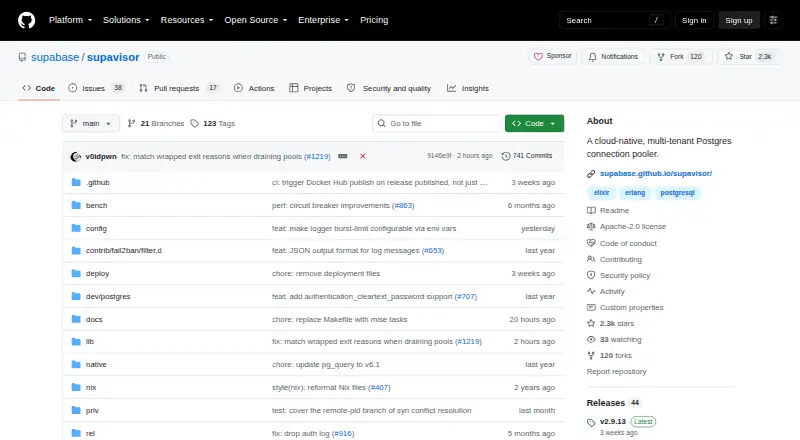
What Supavisor is
Supavisor is a Postgres connection pooler for routing client connections into pools of native PostgreSQL connections. It supports multi-tenant connections across Postgres instances or clusters, as well as single-tenant use as a PgBouncer replacement. Teams can choose transaction, session, or native pool modes, and client credentials can be checked against tenant user records or an authentication query. The project describes tenant-level throughput visibility and a Prometheus metrics endpoint, alongside management documentation through an OpenAPI specification at `/api/openapi` and Swagger UI at `/swaggerui`. Supavisor is self-hosted and Apache-2.0 licensed, with a free plan. Its deployment options include Supabase Dashboard, CLI, and MCP. Installation begins with a PostgreSQL database for tenant data, and a Docker Compose command is provided for PostgreSQL 14. The project supports rolling and blue-green deployments, but is not intended for serverless use. It does not depend on Kubernetes.
Good
- Supports transaction, session, and native pool modes
- Multi-tenant connections span multiple Postgres instances or clusters
- Provides tenant throughput visibility and Prometheus metrics
- Free and Apache-2.0 licensed
Watch out
- Not intended for serverless environments
- Requires a PostgreSQL database for tenant data
Who it suits
Supavisor suits teams operating PostgreSQL that need connection pooling across tenants or a single-tenant PgBouncer replacement. It is aimed at self-hosted deployments rather than serverless environments.
Verdict
Supavisor combines several pooling modes with tenant-aware connection management and monitoring. Its self-hosted, free model may suit PostgreSQL teams, provided serverless deployment is not required.
Plans and prices
From Supavisor's own pricing page, checked 21 Oct 2026.
| Plan | Price | What it gives you |
|---|---|---|
| Free | Free | Unlimited API requests · 50,000 monthly active users · 500 MB database · 5 GB egress · 1 GB file storage · 2 active projects · projects pause after 1 week inactivity · $0 / month |
| Open-source Supavisor | Free | Apache-2.0 licensed; self-hosted deployment |
| Pro | $25 a month | 100,000 monthly active users · 8 GB disk per project · 250 GB egress · 100 GB file storage · daily backups stored 7 days · 7-day log retention · From $25 / month |
| Team | $599 a month | SOC 2 and ISO 27001 · project-scoped and read-only access · HIPAA available as paid add-on · SSO · priority email support and SLAs · 14-day backups · 28-day logs · From $599 / month |
| Enterprise | Priced on request | Technical account management · uptime SLAs · AWS PrivateLink · 24×7×365 premium support · private Slack channel · custom security questionnaires · Custom |
The facts
Each one read from Supavisor's own pages, with the date it was checked.
What it does
- Authentication
- Client credentials can be verified using tenant user records or an authentication query.checked 4 Oct 2026
- Availability
- The README describes cluster behavior that can restart tenant pools when clients reconnect after a node goes down.checked 4 Oct 2026
- Benchmark result
- The published local benchmark recorded 189.23 transactions per second for Supavisor versus 195.96 for PgBouncer under the shown test.checked 21 Oct 2026
- Configuration documentation
- Environment-variable documentation lists pool settings, clustering, Phoenix API-server settings, logging and JWT-related security variables.checked 21 Oct 2026
- Connection-limit behavior
- Clients exceeding the configured client limit receive a PostgreSQL 'Max client connections reached' error.checked 21 Oct 2026
- Connection scale
- The project says a cluster can proxy millions of Postgres client connections into a stateful pool of native Postgres connections.checked 4 Oct 2026
- Container distribution
- A public GitHub Container Registry image is available, with linux/amd64 and linux/arm64 images shown for version 2.9.13.checked 21 Oct 2026
- Deployment limit
- The README says Supavisor is not intended to run in a serverless environment and does not depend on Kubernetes.checked 4 Oct 2026
- Deployments
- The README says Supavisor supports rolling and blue-green deployment strategies.checked 4 Oct 2026
- Deployment strategies
- The project documents rolling and blue-green deployment support.checked 21 Oct 2026
- Documentation depth
- The documentation site covers installation, setup, authentication, tenants, users, pool modes, metrics, logs, PgBouncer migration and Prisma.checked 21 Oct 2026
- Encryption
- Supabase states that customer data is encrypted at rest with AES-256 and in transit with TLS.checked 21 Oct 2026
- Funding news
- Supabase announced an $80 million Series B in May 2022, bringing reported total funding to $116 million at that time.checked 21 Oct 2026
- High availability
- Cluster nodes monitor tenant pools and reconnecting clients can start replacement pools after a node failure.checked 21 Oct 2026
- Hosted pooler role
- Supabase provides Supavisor as its shared, multi-tenant pooler and exposes transaction and session connection strings.checked 21 Oct 2026
- Independent technical description
- A PostgreSQL conference presentation identifies Supavisor as an Elixir-based, Apache-2.0, cloud-native pooler started at Supabase in 2023.checked 21 Oct 2026
- Infrastructure as code
- Pulumi and Terraform support are listed for configuring Supavisor clusters and tenant databases.checked 21 Oct 2026
- Installation
- The installation guide starts by setting up a PostgreSQL database for Supavisor tenant data and provides a Docker Compose command for PostgreSQL 14.checked 4 Oct 2026
- Licence
- The repository is distributed under the Apache-2.0 licence.checked 21 Oct 2026
- License and security reporting
- The repository is Apache-2.0 licensed and directs vulnerability reports to Supabase's HackerOne program.checked 4 Oct 2026
- Limit: pooler trade-offs
- The same independent comparison warns that poolers can add latency, complicate authentication and create more troubleshooting paths.checked 21 Oct 2026
- Limit: setup complexity
- A PostgreSQL conference comparison described Supavisor setup as difficult to understand from the operator's perspective.checked 21 Oct 2026
The company
- Founded
- 2020checked 28 Sep 2026
- Maker company size
- LinkedIn lists Supabase as a privately held company with 201–500 employees and a 2020 founding year.checked 21 Oct 2026
Alternatives to Supavisor
- 1
OceanBase Database
Free planOpen sourceWebAPILinuxmacOS8.2$2.38 usage-based - 2

MySQL
Free planAPILinuxmacOSSelf-hosted7.9Free plan - 3
Avidemux
Free planOpen sourceWebLinuxmacOSWindows7.3Free plan - 4
TiCDC
Free planOpen sourceAPILinuxmacOSSelf-hosted7.2Free plan - 5

Amazon RDS
Free planWebAPISelf-hosted7.1Free plan - 6
SPQR
Free planAPILinuxSelf-hosted6.3Free plan