PgBouncer
PgBouncer is a PostgreSQL connection pooler that reuses server connections to reduce the impact of opening new ones.
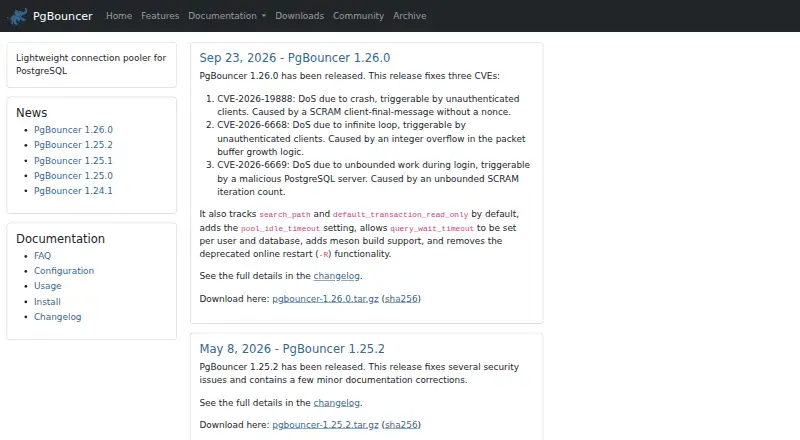
What PgBouncer is
PgBouncer is a PostgreSQL connection pooler that reuses server connections to reduce the impact of opening new ones. It supports session, transaction, and statement pooling; statement pooling does not allow multi-statement transactions. PgBouncer can route to databases on different hosts, but it does not provide internal multi-host load balancing or failover detection. Its FAQ describes DNS round-robin or external TCP load balancers for distributing connections, and DNS reconfiguration or external tools for failover. The tool can track protocol-level prepared statements in transaction and statement modes when max_prepared_statements is non-zero. Documented authentication choices include client certificates, SCRAM-SHA-256, LDAP, PAM, and HBA-based configuration. PgBouncer is free and self-hosted, with source releases and references to native OS packages and dedicated RPM and Debian repositories. Building requires Libevent 2.0 or later, pkg-config, and a C11-capable compiler; OpenSSL is needed for TLS support. Windows operation is documented, with MinGW specified as the only supported Windows build environment.
Good
- Free, self-hosted PostgreSQL connection pooling.
- Supports session, transaction, and statement modes.
- Can route to databases on different hosts.
- Documents several authentication options.
- Source and native package options are listed.
Watch out
- No internal multi-host load balancing.
- No internal failover-host configuration or detection.
- Statement pooling disallows multi-statement transactions.
- Windows builds require MinGW.
Who it suits
PgBouncer suits PostgreSQL operators who want to reuse connections and can manage self-hosted software. Teams needing load balancing or failover must provide those capabilities through external tools or DNS arrangements.
Verdict
PgBouncer focuses on PostgreSQL connection reuse and offers multiple pooling modes. Plan for external load distribution or failover if those functions are required.
Plans and prices
From PgBouncer's own pricing page, checked 3 Oct 2026.
| Plan | Price | What it gives you |
|---|---|---|
| PgBouncer | Free | Source release available · self-hosted software |
The facts
Each one read from PgBouncer's own pages, with the date it was checked.
What it does
- Authentication
- Documented authentication options include client certificates, SCRAM-SHA-256, LDAP, PAM, and HBA-based configuration.checked 3 Oct 2026
- Backend hosts
- PgBouncer can route to destination databases on different hosts and is not tied to one backend server.checked 3 Oct 2026
- Build dependencies
- Building requires Libevent 2.0 or later, pkg-config, and a C11-capable compiler; OpenSSL is needed for TLS support.checked 3 Oct 2026
- Distribution
- The downloads page offers source releases and points to native OS packages and dedicated RPM and Debian package repositories.checked 3 Oct 2026
- Failover
- PgBouncer does not provide internal failover-host configuration or detection; its FAQ describes DNS reconfiguration and external tools as options.checked 3 Oct 2026
- Integrations
- Optional build integrations include PAM, LDAP, and systemd support.checked 3 Oct 2026
- Load balancing
- PgBouncer has no internal multi-host load-balancing configuration; its FAQ describes using DNS round-robin or an external TCP load balancer such as HAProxy or LVS.checked 3 Oct 2026
- Memory
- The features page lists default memory requirements of 2 kB per connection.checked 3 Oct 2026
- Operating systems
- The installation page documents running PgBouncer on Windows and specifies MinGW as its only supported Windows build environment.checked 3 Oct 2026
- Pooling modes
- It supports session, transaction, and statement pooling, with statement pooling disallowing multi-statement transactions.checked 3 Oct 2026
- Prepared statements
- It can track protocol-level prepared statements in transaction and statement pooling when max_prepared_statements is non-zero.checked 3 Oct 2026
- Purpose
- PgBouncer is a PostgreSQL connection pooler that reuses server connections to reduce the performance impact of opening new connections.checked 3 Oct 2026
- Release and security
- The homepage says version 1.26.0, released September 23, 2026, fixes three denial-of-service CVEs.checked 3 Oct 2026
- TLS
- The installation documentation lists OpenSSL 1.0.1 or later as a build dependency for TLS support.checked 3 Oct 2026
The company
- Founded
- 2007checked 28 Sep 2026
The full review of PgBouncer
PgBouncer is a self-hosted connection pooler for PostgreSQL that lets applications reuse server connections rather than repeatedly opening new ones. It is best suited to teams comfortable operating database infrastructure and needing efficient connection management without a licensing bill. Its narrow focus is a strength for pooling, but high-availability designs need companion services.
Overview
PgBouncer mediates PostgreSQL connections and can send clients to databases on different hosts, so deployment is not tied to one backend server. It does not perform internal multi-host load balancing or detect failed hosts. DNS reconfiguration or an external TCP balancer such as HAProxy or LVS is therefore required when traffic distribution or failover is part of the architecture.
The project, founded in 2007, is available as source releases, native operating-system packages, and dedicated RPM and Debian repositories. Version 1.26.0, released September 23, 2026, fixes three denial-of-service CVEs. Operators should therefore treat timely upgrades as part of running it responsibly.
Key features
Pooling modes
Session, transaction, and statement pooling provide different trade-offs in connection reuse. Session pooling keeps a backend connection with a client for the whole session and is the least disruptive choice for applications that depend on session state. Transaction pooling returns connections after each transaction, improving reuse while imposing stricter application behavior. Statement pooling is the most aggressive option, but it disallows multi-statement transactions and is unsuitable for software that requires them.
Prepared statements and memory
In transaction and statement modes, protocol-level prepared statements can be tracked when max_prepared_statements is non-zero. That helps retain prepared-statement use under more efficient pooling modes, provided the setting is configured deliberately. The documented default memory requirement is 2 kB per connection, a useful planning figure for installations handling many concurrent connections.
Security and deployment
Authentication options include client certificates, SCRAM-SHA-256, LDAP, PAM, and HBA-based configuration. TLS support requires OpenSSL 1.0.1 or later at build time. Building also requires Libevent 2.0 or later, pkg-config, and a C11-capable compiler; PAM, LDAP, and systemd integrations are optional. Windows operation is documented, but MinGW is the only supported Windows build environment, making Linux the more natural choice for many server teams.
Pricing
PgBouncer — free. The free plan is the software itself: a source release for self-hosted deployment. There is no paid tier, usage charge, or free trial. You supply the infrastructure, installation, upgrades, authentication setup, and operational support, so the zero price is most valuable to organizations already equipped to run PostgreSQL services.
Platforms
PgBouncer supports Linux, self-hosted deployments, and Windows. Windows builds depend on MinGW, while builds with TLS require OpenSSL and the other stated development dependencies. Package repositories and native operating-system packages can reduce installation work compared with compiling from source.
Who it's for
Choose PgBouncer when PostgreSQL connection churn is a performance concern, your applications can follow the constraints of the selected pooling mode, and your team wants direct control over deployment. It is particularly compelling for self-hosted Linux environments that need a small, focused pooler and can add DNS or an external load balancer for topology management.
Look elsewhere when you need built-in host balancing, automatic failover detection, or a managed service. Statement-heavy applications that require multi-statement transactions should avoid statement pooling, and teams without capacity for builds, upgrades, and authentication administration may prefer a more managed option.
Pros and cons
- Pro: Three pooling modes let operators match connection reuse to application transaction behavior.
- Pro: Routing to databases on different hosts avoids a single-backend restriction.
- Pro: Broad authentication choices and protocol-level prepared-statement tracking support hardened, efficient deployments.
- Pro: The software is free and self-hosted, with source and multiple package distribution paths.
- Con: No internal load balancing or failover detection means extra DNS or infrastructure components are required.
- Con: Statement pooling forbids multi-statement transactions, limiting compatibility for some applications.
- Con: Windows support is constrained to MinGW, and self-hosting leaves operations and security maintenance to your team.
Alternatives
For a wider selection, browse Database Proxy Software.
- MySQL is the better pick when you need a full database platform with SQL and NoSQL applications, replication and high-availability components, and connectors across more operating systems.
- OceanBase Database suits teams seeking a distributed database with full kernel capabilities and both community and enterprise editions.
- PgDog is worth considering for an AGPL-3.0 PostgreSQL-focused alternative with an optional enterprise control plane and insights.
- ShardingSphere-Proxy fits deployments wanting an open-source proxy distributed with Docker and Helm options.
- TurbineProxy offers an Apache-2.0 open-source proxy with no per-query fees.
- pgagroal is another BSD-3-Clause, self-hosted PostgreSQL connection pool.
- PgDoorman is a free self-hosted PostgreSQL pooler with no paid plans or stated usage limits.
- ProxySQL is the alternative for teams wanting a broader open-source proxy with community and enterprise offerings.
Verdict
PgBouncer is a strong choice for PostgreSQL operators who want proven, focused connection pooling, flexible pooling modes, and zero software cost under self-hosting. Choose it for connection reuse and control; choose another solution, or pair it with external infrastructure, when balancing and automatic failover are requirements.
Alternatives to PgBouncer
- 1
OceanBase Database
Free planOpen sourceWebAPILinuxmacOS8.2$2.38 usage-based - 2

MySQL
Free planAPILinuxmacOSSelf-hosted7.9Free plan - 3
Supavisor
Free planOpen sourceAPILinuxSelf-hosted7.6From $25 a month - 4
Avidemux
Free planOpen sourceWebLinuxmacOSWindows7.3Free plan - 5
TiCDC
Free planOpen sourceAPILinuxmacOSSelf-hosted7.2Free plan - 6

Amazon RDS
Free planWebAPISelf-hosted7.1Free plan