PaddleOCR
PaddleOCR is an open-source OCR and document-parsing toolkit that can run through its official website or be called through an API.
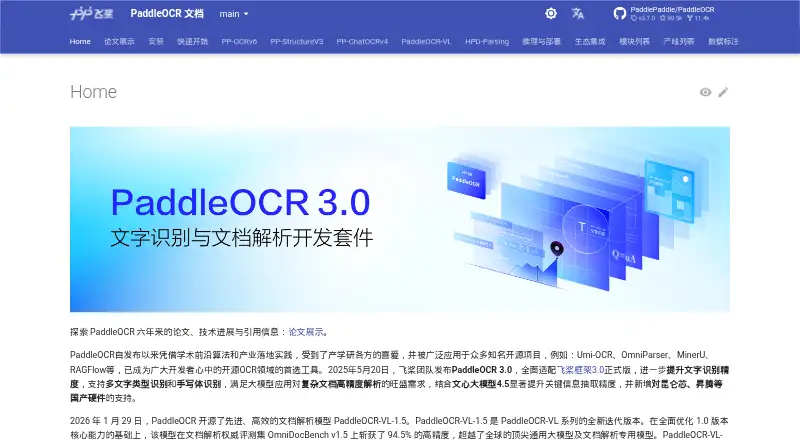
What PaddleOCR is
PaddleOCR is an open-source OCR and document-parsing toolkit that can run through its official website or be called through an API. It recognizes printed text and handwriting, and its document tools extract structure and tables from PDFs and document images. PP-StructureV3 converts complex documents into Markdown and JSON while retaining their organization. PaddleOCR-VL supports 109 languages for document parsing, while PP-OCRv6 handles 50 languages in one model. For large collections, PP-ChatOCRv4 extracts key information and integrates ERNIE 4.5. The project also offers MCP and Skills services, including official Agent Skills. Documentation describes local, C++, service, Android, iOS, and browser deployments, among others, and support is available through GitHub Issues. Its license permits use, modification, distribution, and sale without restriction. The official free API allows up to 20,000 pages of document parsing per day. Note that code written for PaddleOCR 2.x may not work with version 3.x.
Good
- Open-source license permits use, modification, and sale.
- Handwriting recognition is supported.
- Extracts document structure and tables.
- PaddleOCR-VL supports 109 languages.
- Official API allows 20,000 pages per day.
Watch out
- 2.x code may not run with 3.x.
- PP-OCRv6 supports 50 languages in one model.
Who it suits
PaddleOCR suits developers and teams that need OCR, multilingual document parsing, or structured extraction across varied deployment environments. Its API and SDK languages—Python, TypeScript, and Go—may suit users integrating OCR into software.
Verdict
PaddleOCR combines OCR, handwriting recognition, and document structure extraction with several deployment paths. Check version compatibility before moving code from 2.x to 3.x.
Plans and prices
From PaddleOCR's own pricing page, checked 27 Sep 2026.
| Plan | Price | What it gives you |
|---|---|---|
| Official API Free Tier | Free | Daily document parsing limit of 20,000 pages |
The facts
Each one read from PaddleOCR's own pages, with the date it was checked.
What it does
- API Access
- The models can be used online through the official website or called through an API.checked 27 Sep 2026
- Community Alliance
- PaddleOCR OCEAN is an open ecosystem alliance for global OCR and document-intelligence partners.checked 27 Sep 2026
- Deployment Options
- Documentation covers local, C++, service, Android, iOS, browser, and other deployments.checked 27 Sep 2026
- Document Parsing
- PP-StructureV3 converts complex PDFs and document images into Markdown and JSON while preserving structure.checked 27 Sep 2026
- Ecosystem Projects
- It is used in open-source projects including Umi-OCR, OmniParser, MinerU, and RAGFlow.checked 27 Sep 2026
- Handwriting OCR
- Yeschecked 23 Sep 2026
- Handwriting Recognition
- PaddleOCR 3.0 supports handwriting recognition.checked 27 Sep 2026
- Hardware Support
- PaddleOCR adds support for Kunlunxin, Ascend, and other domestic hardware.checked 27 Sep 2026
- Information Extraction
- PP-ChatOCRv4 extracts key information from large document collections and integrates ERNIE 4.5.checked 27 Sep 2026
- MCP And Skills
- The service provides MCP and Skills services, including official Agent Skills.checked 27 Sep 2026
- OCR Languages
- PP-OCRv6 supports 50 languages in one model.checked 27 Sep 2026
- Open Source License
- Software may be used, copied, modified, published, distributed, sublicensed, and sold without restriction.checked 27 Sep 2026
- Support Channel
- Users can obtain support through GitHub Issues.checked 27 Sep 2026
- Supported inputs
- bothchecked 23 Sep 2026
- Version Compatibility
- Code written for PaddleOCR 2.x may not run with PaddleOCR 3.x.checked 27 Sep 2026
- VL Languages
- PaddleOCR-VL supports 109 languages for multilingual document parsing.checked 27 Sep 2026
- Word export
- Yeschecked 23 Sep 2026
Where it runs
- Course Platform
- OCR courses are available on the AIStudio course platform.checked 27 Sep 2026
- Primary platform
- bothchecked 23 Sep 2026
Money
- Free API Limit
- The official free API allows up to 20,000 pages of document parsing per day.checked 27 Sep 2026
- Free plan
- Yeschecked 23 Sep 2026
The full review of PaddleOCR
Overview
PaddleOCR is an open-source OCR and document-processing project aimed at people who need to recognize text or extract structure from documents across different languages and deployment environments. Its strongest case is for developers and teams building document workflows, rather than readers seeking a simple desktop scanning app.
Text recognition is only part of its scope: the project also offers handwriting recognition, structured PDF and image parsing, and API access. Its permissive license and broad deployment options make it adaptable, though the 2.x-to-3.x compatibility break deserves attention before upgrading existing code.
Key features
- Multilingual recognition: PaddleOCR-VL supports document parsing in 109 languages, while PP-OCRv6 recognizes 50 languages in one model. That breadth is useful for multilingual document flows; the two figures describe different capabilities, not one identical model.
- Handwriting OCR: PaddleOCR 3.0 adds handwriting recognition, extending the project beyond printed text. It suits workflows that include handwritten material, though no accuracy or language-specific handwriting performance is established here.
- Document and table extraction: PP-StructureV3 converts complex PDFs and document images into Markdown and JSON while preserving structure. Table extraction and asynchronous processing are also supported, which is more relevant to automated document pipelines than to occasional single-page scanning.
- Information extraction: PP-ChatOCRv4 extracts key information from large document collections and integrates ERNIE 4.5. This gives teams a route beyond recognizing text, but it is a distinct component rather than a claim that every OCR task needs a language model.
- Integration and deployment: Models are usable through the official website or API, with documentation for local, service, C++, Android, iOS, browser, and other deployments. Python, TypeScript, and Go SDKs support common integration paths. MCP and Skills services, including official Agent Skills, add agent-oriented options.
- Permissive licensing: The software may be used, copied, modified, published, distributed, sublicensed, and sold without restriction. That flexibility is valuable for commercial and customized deployments.
Pricing
PaddleOCR is free, with a free plan and an official API tier capped at 20,000 pages of document parsing per day. The API tier's price is custom pricing; the stated daily allowance is the useful constraint for teams estimating throughput. A separate monthly page limit is 20,000 pages, so confirm which quota applies to the workflow before relying on a sustained volume.
There are no paid PaddleOCR plans or seat limits stated. The free option is a strong fit for individual developers and teams able to operate the software themselves; it does not come with a stated commercial support package. Support is available through GitHub Issues.
Platforms
Android and iOS are the listed platforms, and both are identified as primary platforms and supported inputs. The deployment documentation also covers local, C++, service, browser, and other environments, so the project is not limited to mobile use. Documentation includes support for Kunlunxin, Ascend, and other domestic hardware, giving organizations with those systems an additional deployment path.
Who it's for
PaddleOCR is best suited to developers, product teams, and organizations building OCR or document-understanding into their own software. Its API, language SDKs, multiple deployment routes, structure extraction, and permissive license make it a practical candidate for custom pipelines, including commercial ones.
It is less suited to someone who mainly wants a packaged PDF editor or a ready-made desktop workflow: the emphasis is on models, APIs, and deployment choices. Existing PaddleOCR users should also plan a compatibility review, since code written for 2.x may not run with 3.x.
Pros and cons
- Pro: The license permits unrestricted use, modification, redistribution, and sale, supporting commercial customization.
- Pro: Multilingual recognition, handwriting support, and structure-preserving extraction cover more than basic printed-text OCR.
- Pro: Local, service, mobile, browser, and API deployment options suit teams with different infrastructure needs.
- Pro: The official API's 20,000-page daily allowance provides substantial stated capacity for a free tier.
- Con: A 2.x-to-3.x compatibility break can make upgrades costly for projects with existing integrations.
- Con: The broad deployment and component choices favor technical users; the project is not presented as a turnkey desktop document editor.
Alternatives
For a broader shortlist, browse OCR software, OCR API Software, or AI Image Recognition Software.
- Tesseract OCR is another free option, with Linux, Windows, macOS, and Android platforms; consider it if those platforms better match your deployment needs.
- OCRmyPDF is free, self-hosted software for Linux, macOS, and Windows, with API availability; choose it when a self-hosted PDF workflow is the priority.
- FreeOCR.AI offers a free plan and paid monthly or annual credit plans; its listed Pro tiers provide 10,000 credits monthly for $10 a month or 120,000 annually for $80 a year.
- ABBYY FineReader PDF is a paid option for iOS, macOS, and Windows with standalone-license plans; consider it when a packaged PDF product is a better fit than a developer-focused OCR project.
- i2OCR is a freemium web option whose free OCR processes one image or PDF page at a time, suiting occasional page-by-page use.
- ABBYY Screenshot Reader is a paid Windows option with a free trial and a 9.99 USD perpetual license; it is an alternative for screen-area capture and OCR.
- Readiris PDF is a paid macOS and Windows alternative with lifetime-license plans for one PC or Mac.
- Prizmo is a freemium iOS and macOS option, including an on-device OCR premium pack and a cloud plan with handwriting recognition.
Verdict
Choose PaddleOCR if you need a free, permissively licensed foundation for multilingual OCR, handwriting recognition, or structured document extraction across custom deployments. Its combination of API access, SDKs, and deployment flexibility is the main reason to choose it; look elsewhere if you need a ready-made desktop PDF application or cannot absorb the compatibility work of a 2.x-to-3.x transition.
Getting started
- Visit the PaddleOCR website to use models online or access the API.
- Choose a deployment route from the documented local, C++, service, Android, iOS, or browser options.
- Select an SDK language: Python, TypeScript, or Go.
- Use the official free API within its daily document-parsing allowance.
Limits worth knowing
The official free API allows up to 20,000 pages of document parsing per day. Code written for PaddleOCR 2.x may not run with PaddleOCR 3.x.
Questions
Is PaddleOCR free?
The pricing model is free, and the official API has a free allowance of up to 20,000 pages of document parsing per day.
Which platforms are listed?
Android and iOS are listed. Documentation also covers local, C++, service, browser, and other deployments.
What languages does it support?
PaddleOCR-VL supports 109 languages for multilingual document parsing. PP-OCRv6 supports 50 languages in one model.
Can it recognize handwriting?
Yes. PaddleOCR 3.0 supports handwriting recognition.
Is PaddleOCR open source?
Its license permits use, copying, modification, publication, distribution, sublicensing, and sale without restriction.
What SDK languages are available?
The listed SDK languages are Python, TypeScript, and Go.
Alternatives to PaddleOCR
- 1
FreeOCR.AI
Free planWebAPImacOSWindows8.2From $80 a year - 2
Tesseract OCR
Free planAndroidAPILinuxmacOS7.9Free plan - 3

Open-Capture
Free planOpen sourceWebAPILinuxSelf-hosted7.9Free plan - 4
ScanScan
AndroidiOSWebmacOS7.7CN¥30 one-time - 5
Prizmo
Free planiOSmacOS7.7Free plan - 6
Tungsten OmniPage
APILinuxmacOSSelf-hosted7.6€99 one-time