
OSSEC
OSSEC is an open-source, host-based intrusion detection system for monitoring systems and network components across multiple platforms.
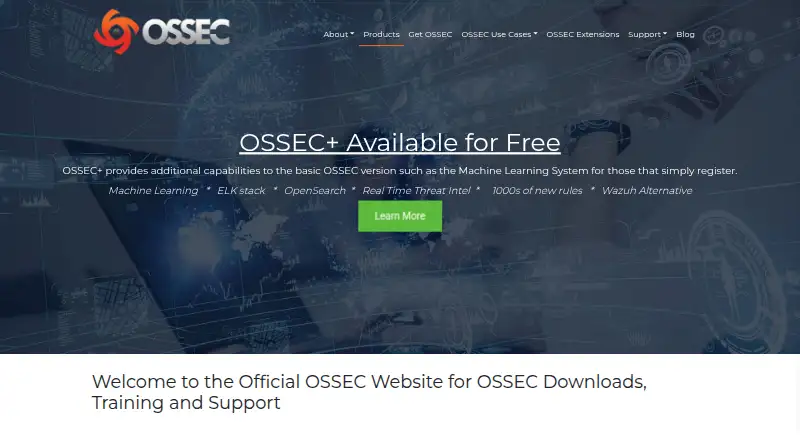
What OSSEC is
OSSEC is an open-source, host-based intrusion detection system for monitoring systems and network components across multiple platforms. It analyzes logs, checks file integrity, monitors the Windows registry, detects rootkits, and can send real-time alerts or take active response measures. Monitoring can use agents or run without them, and a central server can apply policies across operating systems with server-specific overrides. Alert routes include SMTP, SMS, and syslog. OSSEC can help address PCI and HIPAA requirements through file-integrity monitoring, log review, and policy enforcement. OSSEC and OSSEC+ use command-line management; Atomic OSSEC editions add a management console. OSSEC+ also adds machine learning, ELK integration, community threat sharing, and additional rules. The OSSEC plan is free, while OSSEC+ is free with registration. Atomic OSSEC is $5.00 per month per device. Atomic OSSEC SaaS offers a free 14-day trial for up to 10 endpoints without a credit card.
Good
- Monitors logs, files, registry, and rootkits.
- Supports agent-based and agentless monitoring.
- Centralized policies support multiple operating systems.
- Can help address PCI and HIPAA requirements.
Watch out
- OSSEC and OSSEC+ use command-line management.
- OSSEC+ requires billed registration.
- Atomic OSSEC costs $5.00 per month per device.
Who it suits
OSSEC suits teams that need host monitoring, centralized policy management, and alerting across multiple operating systems. Atomic OSSEC may suit organizations seeking a management console and commercial support.
Verdict
OSSEC covers host intrusion detection, monitoring, alerting, and active response, with free and paid editions. Check the command-line limitation and per-device Atomic OSSEC cost against your management needs.
Plans and prices
From OSSEC's own pricing page, checked 14 Oct 2026.
| Plan | Price | What it gives you |
|---|---|---|
| OSSEC | Free | Basic out-of-the-box ruleset · community support · self-hosted |
| OSSEC+ | Free | Registration required · hundreds of additional rules · machine learning |
| Atomic OSSEC | $5 a month | Commercial rules · GUI · vulnerability management · SIEM · professional support · per agent; stated as under $5 per device per month |
| Atomic OSSEC | $55 a year | Volume discounts available · enterprise FIM and compliance features · per server per year |
The facts
Each one read from OSSEC's own pages, with the date it was checked.
What it does
- Active response
- Active response runs administrator-defined commands locally or on selected agents when alerts, levels or rule groups match.checked 14 Oct 2026
- Agentless monitoring
- The documentation supports agentless monitoring and custom agentless scripts for systems where software installation is restricted.checked 14 Oct 2026
- Alert integrations
- SMTP, SMS and syslog integrations can send alerts to email-enabled devices, and active response can block an attack immediately.checked 1 Oct 2026
- Alert outputs
- OSSEC documents email, syslog, JSON, database and Prelude output options.checked 14 Oct 2026
- API
- Atomic OSSEC advertises a web API and application-protection capabilities.checked 14 Oct 2026
- Centralized management
- OSSEC provides a centralized management server for policies across multiple operating systems with server-specific overrides.checked 1 Oct 2026
- Centralized policy enforcement
- A manager can distribute centralized agent configuration and policy settings.checked 14 Oct 2026
- Commercial support
- Atomicorp provides OSSEC deployment assistance and post-sale support services.checked 1 Oct 2026
- Compliance
- OSSEC helps address PCI and HIPAA requirements, including file-integrity monitoring, log inspection and policy enforcement.checked 1 Oct 2026
- Current release
- OSSEC 4.4.0 was released on October 5, 2026 according to the project homepage.checked 14 Oct 2026
- Custom extensibility
- Administrators can write custom decoders and rules and test them with ossec-logtest.checked 14 Oct 2026
- Detection capabilities
- OSSEC provides log analysis, file-integrity checking, Windows registry monitoring, centralized policy enforcement, rootkit detection, real-time alerting and active response.checked 1 Oct 2026
- Documentation depth
- The manual includes architecture, supported systems, agents, log monitoring, syscheck, rootcheck, rules, decoders, output formats, configuration syntax, man pages and examples.checked 14 Oct 2026
- Enterprise integrations
- Atomic OSSEC includes native integrations for AWS, Azure, GCP, Splunk, Arcsight, OpenSearch, ELK, Slack, PagerDuty, Jira, Cloudflare, Amazon S3 and Glacier.checked 1 Oct 2026
- File integrity monitoring
- Syscheck hashes monitored files and Windows registry entries with MD5, SHA-1 and SHA-256 and alerts on changes.checked 14 Oct 2026
- Installation choices
- Documentation covers source compilation, RPM, DEB and BSD package installation plus Windows agent installation.checked 14 Oct 2026
- Integrations
- Atomic OSSEC lists Splunk, Sumo Logic, Jira, ArcSight, BMC Remedy, Elasticsearch, AWS CloudTrail, Slack, ServiceNow, VirusTotal, Cisco, Palo Alto and Cloudflare integrations.checked 14 Oct 2026
- License
- OSSEC is distributed under the GNU General Public License version 2.checked 14 Oct 2026
- Limit: dashboard usability
- G2's review summary identifies the lack of a user-friendly data-visualization dashboard as a recurring limitation.checked 14 Oct 2026
- Log analysis
- The product analyzes operating-system, application, firewall, IDS, web-server and authentication logs.checked 14 Oct 2026
Where it runs
- GetApp feature ratings
- The single GetApp review gives file-integrity monitoring, intrusion detection and log management 5.0 out of 5.checked 14 Oct 2026
- GetApp integrations
- GetApp identifies Cloudflare and Slack as reviewed integrations and also lists Microsoft Azure and PagerDuty.checked 14 Oct 2026
- GetApp support
- GetApp lists FAQs/forums and phone support for Atomicorp OSSEC.checked 14 Oct 2026
The company
- Maker founded
- LinkedIn states that Atomicorp was founded in 2015 by Mike and Scott Shinn.checked 14 Oct 2026
The full review of OSSEC
OSSEC is an open-source host intrusion detection system for teams monitoring varied operating systems and network components. It is strongest for administrators comfortable managing security from the command line; Atomic OSSEC is the more suitable route when a console and professional support matter.
Overview
OSSEC combines log analysis, file-integrity checking, Windows registry monitoring and rootkit detection with real-time alerts and active response. It can monitor systems with agents or monitor systems and network components such as routers and firewalls without agents. That flexibility suits mixed environments, though command-line management makes the free editions a less natural fit for teams that expect a graphical console.
A centralized server applies policies across operating systems and allows server-specific overrides. File-integrity monitoring, log inspection and policy enforcement can help address PCI and HIPAA requirements. Alerts can be sent through SMTP, SMS or syslog to email-enabled devices, and active response can block an attack immediately.
Key features
- Detection and response: OSSEC brings several host-security functions together, from log and file-integrity analysis to registry monitoring, rootkit detection and active response. This breadth is useful for teams seeking one system for monitoring and response, but still requires command-line administration in the free editions.
- Agent and agentless monitoring: The choice of monitoring mode helps cover hosts as well as network components such as routers and firewalls, including cases where an agent is not practical.
- Central policy management: Policies can span multiple operating systems, with server-specific overrides. That supports mixed deployments without forcing identical policies everywhere.
- OSSEC+ additions: OSSEC+ adds machine learning, ELK stack integration, community threat sharing and thousands of new rules. It expands detection and analysis without a listed charge, but requires billed registration.
- Atomic OSSEC security features: Atomic OSSEC adds advanced encryption using PKI and Noise Socket, compliance auditing and reporting, vulnerability management, antivirus protection and firewall management. Those additions make it a broader security offering than the free core editions.
- Integrations: Atomic OSSEC includes native integrations for AWS, Azure, GCP, Splunk, Arcsight, OpenSearch, ELK, Slack, PagerDuty, Jira, Cloudflare, Amazon S3 and Glacier, which can connect monitoring to cloud, analysis and response workflows.
Pricing
OSSEC is freemium, with free editions and a paid per-device option. The choice turns largely on whether command-line management is acceptable and whether console access, professional support or the additional Atomic security features justify a recurring device cost.
- OSSEC — free: Includes command-line management and core OSSEC rules, with no dedicated support staff. It suits administrators who want the core host-based detection capabilities and can manage the system themselves.
- OSSEC+ — free: Adds machine learning, ELK stack integration, thousands of new rules and threat sharing. Billed registration is required, and management remains command-line based. It fits teams wanting the expanded rule and analysis set without moving to a paid tier.
- Atomic OSSEC — $5 a month, billed per device: Includes enterprise features, a GUI, professional support and advanced rules. It is the better fit for teams that need console-based management or commercial assistance, but the per-device billing means costs rise with the monitored fleet.
Atomic OSSEC SaaS offers a free 14-day trial for up to 10 endpoints with no credit card required. That gives teams a bounded way to assess the paid service before committing; it does not cover larger fleets during the trial.
Platforms
OSSEC runs on Linux, OpenBSD, FreeBSD, MacOS, Solaris and Windows, with self-hosted deployment and cloud workload support. Its multi-platform coverage and hybrid deployment model suit organizations managing a mix of operating systems and environments.
Who it's for
OSSEC is a strong candidate for security administrators who need host monitoring across mixed systems, want agentless coverage for some network components, and can work in a command-line environment. Its centralized policies and compliance-related monitoring can also help teams addressing PCI or HIPAA requirements.
Look elsewhere if a console is essential but a per-device paid plan is not appropriate, or if the team cannot take on command-line management. Atomic OSSEC addresses the console and support gap, but its monthly price is per device.
Pros and cons
- Pro — Broad host monitoring: Logs, file integrity, Windows registry activity and rootkits are covered alongside alerting and active response.
- Pro — Flexible deployment: Agent-based and agentless modes, centralized policies and support for multiple operating systems suit varied environments.
- Pro — Useful free expansion: OSSEC+ adds machine learning, ELK integration, threat sharing and thousands of rules at no cost.
- Con — Free editions are command-line managed: Teams needing a graphical console must choose Atomic OSSEC.
- Con — Paid pricing scales by device: Atomic OSSEC is $5 a month per device, so larger deployments carry a higher recurring cost.
- Con — Core OSSEC has no dedicated support staff: Teams that need post-sale assistance should consider the commercial offering.
Alternatives
Consider Wazuh if you want a free, open-source, self-hosted option, or need its listed paid Small plan starting at $571 a month. Choose CrowdSec if its Community plan's three blocklists or its IP Reputation API at $49 a month better match your needs. Suricata is a free, open-source option for Linux, MacOS and Windows. pfSense offers open-source firewall and router software through its Community Edition. SELKS is a free, open-source option, with no planned releases after January 1, 2025. Zscaler Private Access is a paid alternative. Arista NG Firewall has a free tier with basic security and connectivity features, while IPFire is an open-source firewall operating system without feature tiers or licence renewals.
For broader comparisons, browse Intrusion Detection and Prevention Software or File Integrity Monitoring Software.
Verdict
Choose OSSEC for flexible, multi-platform host monitoring, centralized policy enforcement and active response, especially if your administrators are comfortable with command-line tools. Its core and expanded editions make a capable no-cost starting point; teams that need a console and professional support should weigh Atomic OSSEC's per-device charge against their management needs.
Getting started
- Visit the OSSEC website
- Choose OSSEC, OSSEC+, or an Atomic OSSEC edition
- Select a supported operating system such as Linux, macOS, or Windows
- Deploy monitoring with agents or an agentless configuration
- Set centralized policies and operating-system-specific overrides
- Configure SMTP, SMS, or syslog alert delivery
- For Atomic OSSEC SaaS, start the 14-day trial for up to 10 endpoints without a credit card
Limits worth knowing
The free OSSEC plan provides command-line management and core rules, while OSSEC+ requires registration. Atomic OSSEC SaaS trial access lasts 14 days and covers up to 10 endpoints; Atomic OSSEC is $5 a month per device.
Questions
Is OSSEC free?
OSSEC is free, and OSSEC+ is also listed as free with registration required.
What platforms does OSSEC support?
It runs on Linux, OpenBSD, FreeBSD, macOS, Solaris, and Windows, and supports cloud workloads.
Does OSSEC include a management console?
The OSSEC and OSSEC+ editions use command-line management. Atomic OSSEC editions provide a management console.
What does OSSEC+ add?
OSSEC+ adds machine learning, ELK stack integration, real-time community threat sharing, and thousands of new rules.
How much does Atomic OSSEC cost?
The Atomic OSSEC plan is $5 a month, billed per device.
Is there an Atomic OSSEC trial?
Atomic OSSEC SaaS offers a free 14-day trial for up to 10 endpoints without requiring a credit card.
Alternatives to OSSEC
- 1
Wazuh
Free planOpen sourceWebAPILinuxmacOS8.4From $571 a month - 2
Kaspersky Endpoint Security for Business
AndroidiOSWebAPI7.8From $29.99 a month - 3

PA File Sight
AndroidiOSWebAPI7.7From $30 a month - 4

Paessler PRTG Network Monitor
Free planAndroidiOSWebAPI7.7From $200 a month - 5
Avidemux
Free planOpen sourceWebLinuxmacOSWindows7.3Free plan - 6
FileAudit
AndroidiOSWebSelf-hosted7.2