Orx
Orx is a free, open-source 2.5D game development engine for C and C++ programmers.
What Orx is
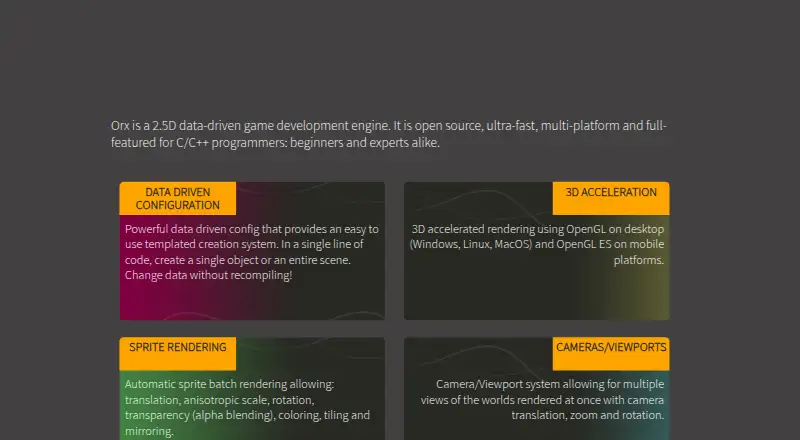
Orx is a free, open-source 2.5D game development engine for C and C++ programmers. Its templated, data-driven configuration can define objects and scenes, with changes possible without recompiling. Rendering tools include accelerated rendering, sprite batching, multiple cameras and viewports, custom shaders, off-screen rendering and multiple render targets. The engine also provides audio features for 3D sound and music, recording, filters, and volume, pitch and stereo-balance control. Collision handling, rigid-body physics and joints support game interactions, while abstract input covers keyboard, joystick, mouse and touch. Data-driven animation graphs and event management handle a range of engine events. Localization can select separate images, text and sounds for different languages while a game runs. A plugin architecture allows extension and porting to new platforms. Target platforms include Windows, Linux, macOS, Web/HTML5, Android and iOS. The zlib license permits free use and modification in freeware and commercial projects. Learning resources include tutorials, examples, setup guides and configuration information; questions and feedback can go to the Discord community or GitHub issue tracker.
Good
- Free for freeware and commercial projects under zlib.
- Configuration changes can be made without recompiling.
- Includes rendering, audio, physics and input systems.
- Targets desktop, web, Android and iOS.
Watch out
- Requires C or C++ programming.
- Multiplayer tools are not provided.
Who it suits
Orx is suited to C or C++ programmers building 2.5D games for desktop, web or mobile target platforms. Its learning wiki offers tutorials and setup guidance for people getting started.
Verdict
Orx provides a broad set of game-engine systems within a free, extensible C/C++ framework. It may fit developers who want configuration-driven workflows and can work within its programming languages.
Plans and prices
From Orx's own pricing page, checked 7 Oct 2026.
| Plan | Price | What it gives you |
|---|---|---|
| Orx | Free | Free to use for any kind of project · freeware and commercial use permitted under zlib license |
The facts
Each one read from Orx's own pages, with the date it was checked.
What it does
- Animation and events
- It includes data-driven animation graphs and event management for clocks, effects, input, physics, shaders, sound, spawners and timelines.checked 7 Oct 2026
- Audio
- Its audio system supports 3D sound and music, recording, audio filters, and control of volume, pitch and stereo balance.checked 7 Oct 2026
- Configuration
- Its templated data-driven configuration can create objects or scenes and be changed without recompiling.checked 7 Oct 2026
- Extensibility
- A plugin-based architecture allows users to port Orx to new platforms and extend or customize it with their own plugins.checked 7 Oct 2026
- Input
- Its abstract input system supports keyboard, joystick, mouse and touch input.checked 7 Oct 2026
- Learning resources
- The maker's learning wiki provides tutorials, examples, setup guides, beginner guides and configuration syntax information.checked 7 Oct 2026
- License
- Orx is licensed under zlib and can be used or modified for free in freeware and commercial projects.checked 7 Oct 2026
- Localization
- Its localization system supports separate images, text and sounds for multiple languages with on-the-fly selection.checked 7 Oct 2026
- Mobile export
- Yeschecked 20 Sep 2026
- Multiplayer tools
- Nochecked 20 Sep 2026
- Physics
- It includes collision handling and rigid-body physics with joints support.checked 7 Oct 2026
- Product
- Orx is an open-source, data-driven 2.5D game development engine for C/C++ programmers.checked 7 Oct 2026
- Rendering
- It supports accelerated rendering, sprite batching, multiple cameras and viewports, custom shaders, off-screen rendering and multiple render targets.checked 7 Oct 2026
- Scripting languages
- C,C++checked 20 Sep 2026
- Source code model
- open_sourcechecked 20 Sep 2026
- Support
- The project directs users with questions, feedback or comments to its Discord community and GitHub issue tracker.checked 7 Oct 2026
- Web build
- The project README lists Web/HTML5 builds using Emscripten among supported platforms.checked 7 Oct 2026
Money
- Free plan
- Yeschecked 20 Sep 2026
Where it runs
- Platforms
- The maker lists Windows, Linux, MacOS, iPhone/iPad and Android as development platforms.checked 7 Oct 2026
- Target platforms
- Windows,Linux,macOS,Web/HTML5,Android,iOSchecked 20 Sep 2026
The full review of Orx
Orx is a C/C++ engine for building 2.5D games, with systems for graphics, audio, physics and input. It is best suited to developers who want to shape a game through code and configuration; its broad platform support and permissive license are strong advantages, but multiplayer tools are absent.
Overview
Orx puts game objects and scenes in templated configuration that can be changed without recompiling. That can make content iteration more flexible, while keeping programming central to the workflow. It is a better match for C and C++ developers than for creators seeking a visual, no-code approach.
The plugin architecture lets developers customize the engine or port it to new platforms. Its zlib license permits free use and modification in both freeware and commercial projects, making it practical to adopt without a licensing charge. The trade-off is that extending or adapting the engine calls for development skills.
Key features
Rendering includes acceleration, sprite batching, multiple cameras and viewports, custom shaders, off-screen rendering and multiple render targets. This range gives programmers control over how a game is drawn, rather than limiting them to a single presentation path.
Orx also combines 3D sound and music with recording, filters and controls for volume, pitch and stereo balance. Collision handling and rigid-body physics with joints provide core simulation tools. The abstract input system covers keyboard, joystick, mouse and touch, which helps accommodate different device controls within one engine.
Data-driven animation graphs and event management cover clocks, effects, input, physics, shaders, sound, spawners and timelines. Localization can select separate images, text and sounds for different languages on the fly. Together, these systems make Orx a broad foundation for game logic and content, though multiplayer is not part of its toolset.
Learning materials include tutorials, examples, setup and beginner guides, plus configuration syntax guidance. The project also directs questions and feedback to its Discord community and GitHub issue tracker. These are useful starting points for a framework whose configuration and code-oriented approach may take time to learn.
Pricing
| Plan | Price | What it includes |
|---|---|---|
| Orx | free | Free use for any kind of project, including freeware and commercial projects under the zlib license. |
There is no paid tier or free-trial period in the plan structure. The free license is not restricted to noncommercial work, so commercial developers can use the same plan without giving up the stated engine capabilities.
Platforms
Orx targets Windows, Linux, macOS, Web/HTML5, Android and iOS. Web builds use Emscripten, and mobile export is supported. The breadth is valuable for developers aiming to ship across desktop, web and mobile, though it does not add multiplayer tools.
Who it's for
Choose Orx if you are comfortable programming in C or C++, want configuration-driven iteration, and value an engine you can modify or extend under a zlib license. It is less suitable if you need built-in multiplayer support or want to avoid a code-centered workflow.
Pros and cons
Pros
- Broad built-in systems: rendering, audio, physics, input, animation, events and localization cover many core game needs in one engine.
- Flexible configuration: objects and scenes can be changed without recompiling, supporting iteration outside the code build cycle.
- Permissive, free use: the zlib license allows freeware and commercial use and modification.
- Six target platforms: desktop, web and mobile targets widen the range of projects it can support.
Cons
- No multiplayer tools: projects needing multiplayer capabilities must look beyond Orx for that part of development.
- C/C++-centered: the engine is aimed at programmers, not users looking for a no-code workflow.
Alternatives
- CRYENGINE is another free-to-download engine with royalty-based licensing terms; consider it if that model better fits your project.
- GameBench is a paid product with a free plan and trial, for readers comparing a different software option.
- Tracy Profiler is a free tool under a 3-clause BSD license, rather than a game engine.
- Cocos Creator offers its game engine editor and runtime at no charge, for readers weighing another free engine.
- Unity Version Control has a free tier with unlimited cloud seats and 25 GB of storage, with usage beyond included limits billed pay-as-you-go; it is a different kind of tool from an engine.
- Arm Performance Studio is a free suite of profiling tools for Arm CPU and GPU applications.
- GFXReconstruct provides free, open-source graphics API capture and replay tools.
- MicroProfile is an embeddable C++ profiler.
For broader comparisons, browse Game Engine Software or Game Profiling Software.
Verdict
Orx is a strong choice for C/C++ developers who want a free, modifiable engine with substantial built-in game systems and configuration they can revise without recompiling. Its cross-platform targets and commercial-use license make it easy to consider for a wide range of projects. Look elsewhere if multiplayer tools or a non-programming workflow are essential.
Getting started
- Visit the Orx project website
- Choose a target platform from Windows, Linux, macOS, Web/HTML5, Android or iOS
- Follow the setup guide or beginner material in the learning wiki
- Create objects or scenes with the templated data-driven configuration
- Use the examples and tutorials to build a C or C++ project
- Join the Discord community or open a GitHub issue for questions
Limits worth knowing
The engine provides no multiplayer tools. Web builds are listed as using Emscripten, and development is centered on C and C++ scripting.
Questions
How much does Orx cost?
Orx is free to use, including in commercial projects, under the zlib license.
Is Orx open source?
Yes. Orx is open-source and licensed under zlib.
Which platforms can Orx target?
Targets include Windows, Linux, macOS, Web/HTML5, Android and iOS.
Does Orx support mobile export?
Yes, mobile export is listed as available.
What programming languages does Orx use?
Orx is designed for programmers using C and C++.
Where can users get help?
The project directs questions, feedback and comments to its Discord community and GitHub issue tracker.
Alternatives to Orx
- 1

Unity
Free planAndroidiOSWebAPI8.4Free plan - 2

Unity Version Control
Free planWebAPILinuxmacOS8.1Free plan - 3

GameBench
Free planAndroidiOSWebAPI7.6Free plan - 4

CRYENGINE
Free planAndroidiOSWebLinux7.5Free plan - 5

Cocos Creator
Free planAndroidiOSWebmacOS7.1Free plan - 6
Tracy Profiler
Free planAndroidiOSLinuxmacOS7.1Free plan