OpenText Universal Discovery and CMDB
OpenText Universal Discovery and CMDB finds and tracks configuration items across hybrid, network, multicloud, and on-premises environments.
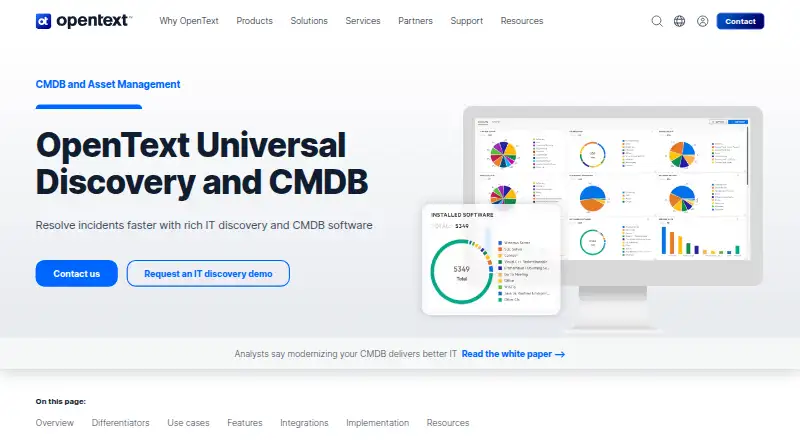
What OpenText Universal Discovery and CMDB is
OpenText Universal Discovery and CMDB finds and tracks configuration items across hybrid, network, multicloud, and on-premises environments. It combines agent-based, agentless, and API discovery, and maps infrastructure relationships to business-critical applications and services. That mapping can support change and configuration management and efforts to reduce mean time to repair. Network discovery covers more than 250 vendors and 3,500 devices, while a software content library holds over 140,000 titles and end-of-life information. Cloud discovery identifies IaaS and PaaS resources across AWS, Azure, Google Cloud, and Oracle Cloud. Deployment options include SaaS, public or private cloud, and on premises; the product also supports self-hosted deployment. Depending on storage, one instance can capture up to 200,000 servers or desktops and up to 200 million configuration items. The Core SaaS service description includes one production and one non-production tenant, plus premium discovery for up to 500 server OSIs. Some discovery components require customer deployment and maintenance. Pricing is on request, with a 30-day trial.
Good
- Combines agent-based, agentless, and API discovery.
- Covers more than 250 network vendors.
- Software library includes over 140,000 titles.
- Offers SaaS, cloud, and on-premises deployment.
- Includes 24/7 support in the Core SaaS description.
Watch out
- Pricing is available on request.
- Some discovery components require customer maintenance.
- Core SaaS premium discovery covers up to 500 server OSIs.
Who it suits
It suits organizations that need to discover and map infrastructure across cloud, network, and on-premises environments. Teams can also use it to identify misconfigured or noncompliant infrastructure and outdated or vulnerable software.
Verdict
OpenText Universal Discovery and CMDB brings infrastructure discovery, software inventory, and service mapping into one product. Review deployment needs and the Core SaaS service limits when considering it.
Plans and prices
From OpenText Universal Discovery and CMDB's own pricing page, checked 30 Sep 2026.
| Plan | Price | What it gives you |
|---|---|---|
| OpenText Universal Discovery and CMDB license | Priced on request | Price based on environment and deployment needs |
The facts
Each one read from OpenText Universal Discovery and CMDB's own pages, with the date it was checked.
What it does
- Cloud discovery
- It identifies IaaS and PaaS resources across AWS, Azure, Google Cloud, and Oracle Cloud.checked 30 Sep 2026
- Deployment
- The product page says it can be deployed via SaaS, public or private cloud, or on premises.checked 30 Sep 2026
- Discovery methods
- Discovery combines agent-based, agentless, and API methods for visibility across multicloud and on-premises environments.checked 30 Sep 2026
- Integrations
- Listed integrations include ServiceNow, BMC Helix, Jira Service Management, Microsoft System Center Operations Manager, Microsoft Intune, Cisco Catalyst Center, Jamf, Infoblox, NetApp, HPE OneView, Dynatrace, CyberArk, HashiCorp, BeyondTrust, Broadcom SiteMinder SSO, Raynet, and Salesforce.checked 30 Sep 2026
- Network discovery
- Advanced network discovery covers more than 250 vendors and 3,500 network devices, including SDN, SDWAN, firewall, and wireless components.checked 30 Sep 2026
- Purpose
- It discovers, maps, and manages configuration items across hybrid, network, and multicloud environments.checked 30 Sep 2026
- SaaS service and limits
- The Core SaaS service description includes one production tenant, one non-production tenant, and premium discovery for up to 500 server OSIs; some discovery components must be deployed and maintained by the customer.checked 30 Sep 2026
- Scale
- It can capture up to 200,000 servers or desktops and up to 200 million configuration items per instance, depending on storage used.checked 30 Sep 2026
- Security and compliance
- The product helps identify misconfigured or noncompliant infrastructure and outdated or vulnerable software to reduce security and compliance risks.checked 30 Sep 2026
- Software inventory
- Its software content library contains over 140,000 software titles and end-of-life data.checked 30 Sep 2026
- Support
- The Core SaaS service description includes product support and says authorized users can contact support through the web portal or by telephone 24 hours a day, seven days a week.checked 30 Sep 2026
The company
- Founded
- 1991checked 28 Sep 2026
- Headquarters
- Waterloo, Ontario, Canadachecked 28 Sep 2026
- Maker
- OpenText says it was founded in 1991.checked 30 Sep 2026
Where it runs
- Service mapping
- Service mapping reveals how infrastructure delivers business-critical applications and services to support change and configuration management and reduce mean time to repair.checked 30 Sep 2026
The full review of OpenText Universal Discovery and CMDB
Overview
OpenText Universal Discovery and CMDB discovers infrastructure and software, then maps the configuration items and dependencies behind business services. It suits organizations managing complex hybrid, network, and multicloud estates that need a shared view for configuration and change work. Its reach is substantial, but custom pricing and customer-managed components in the Core SaaS service make deployment scope important to weigh.
Key features
Discovery and inventory
Agent-based, agentless, and API discovery methods cover on-premises and multicloud environments, giving teams several ways to bring infrastructure into view. The network discovery breadth is a particular strength: support spans more than 250 vendors and 3,500 devices, including SDN, SDWAN, firewall, and wireless components. A library covering over 140,000 software titles, with end-of-life data, can help teams identify aging software alongside infrastructure.
Cloud discovery identifies IaaS and PaaS resources across AWS, Azure, Google Cloud, and Oracle Cloud. The product can capture up to 200,000 servers or desktops and up to 200 million configuration items per instance, depending on storage used. That scale is relevant to large environments; it does not by itself remove the need to plan storage and deployment.
Service context and risk
Service mapping connects infrastructure to business-critical applications and services, supporting change and configuration management and helping reduce mean time to repair. Dependency mapping and impact analysis can make the consequences of a proposed change easier to assess. The product also helps identify misconfigured or noncompliant infrastructure and outdated or vulnerable software, connecting inventory work to security and compliance risk reduction.
Integrations include ServiceNow, BMC Helix, Jira Service Management, Microsoft System Center Operations Manager, Microsoft Intune, Cisco Catalyst Center, Jamf, Infoblox, NetApp, HPE OneView, Dynatrace, CyberArk, HashiCorp, BeyondTrust, Broadcom SiteMinder SSO, Raynet, and Salesforce. This breadth is useful for organizations that need discovery data to fit into existing service, operations, and security workflows.
Pricing
The OpenText Universal Discovery and CMDB license has custom pricing based on environment and deployment needs. A 30-day trial is offered. This is a paid product without a stated entry price, so buyers should establish costs against their required scale and deployment before treating it as a fit.
The Core SaaS service description includes one production tenant, one non-production tenant, and premium discovery for up to 500 server OSIs. Product support is included, with authorized users able to contact support through the web portal or by telephone 24 hours a day, seven days a week. Some discovery components must be deployed and maintained by the customer, so SaaS does not mean that every part of setup and upkeep is handled for you.
Platforms
Supported platforms include Linux, Windows, web, and self-hosted deployment. Deployment options span SaaS, public or private cloud, and on premises, making the product suitable for organizations with varied hosting requirements. That flexibility also means implementation choices and responsibilities should be settled early.
Who it's for
This is best suited to larger IT organizations that need infrastructure discovery across on-premises, network, and multicloud systems, plus service and dependency context for change management. Its stated capacity and broad network and software coverage address environments where a narrower inventory tool may leave important assets out of view. Smaller teams with limited discovery needs may find the custom-priced, deployment-sensitive product harder to justify.
Pros and cons
- Pro: Multiple discovery methods span cloud and on-premises assets, helping accommodate heterogeneous environments.
- Pro: Coverage of more than 250 vendors, 3,500 network devices, and over 140,000 software titles gives teams unusually broad inventory scope.
- Pro: Service mapping and impact analysis connect infrastructure records to business services and change decisions.
- Con: Custom pricing tied to environment and deployment makes budget comparison difficult without scoping the estate.
- Con: The Core SaaS service caps premium discovery at 500 server OSIs, and some components remain the customer's responsibility to deploy and maintain.
Alternatives
For a wider shortlist, compare Application Dependency Mapping Software and CMDB Software.
- Mugato is another paid option for collecting physical servers, virtual machines, and cloud assets, with subscription pricing based on collected servers.
- Cartography is a free, open-source infrastructure mapping tool for teams that prefer a no-cost option.
- Tripl-i is a paid alternative with a free trial and API, Linux, self-hosted, web, and Windows platforms.
- ManageEngine Applications Manager is worth considering when monitoring a small number of apps or servers: its free plan covers up to five, with paid plans also available.
- Virima Discovery and ViVID Service Mapping offers a free trial and a Business Pro plan at $395 a year, billed annually, for 2,000 assets.
- ServiceNow Service Mapping fits buyers considering ITOM Advanced or ITOM Prime, which include service mapping and discovery capabilities.
- Device42 is another paid, trial-available option with custom annual subscription pricing based on device count.
- Jira is a freemium alternative with a free plan for up to 10 users, rather than a dedicated infrastructure discovery product.
Verdict
Choose OpenText Universal Discovery and CMDB if your organization needs broad hybrid infrastructure discovery tied to software inventory, network coverage, and business-service dependencies. Its scale and service context are compelling for complex estates, but custom pricing and customer-managed SaaS components warrant a careful deployment and cost review. Look elsewhere if you need a clearly priced, lightweight starting point.
Alternatives to OpenText Universal Discovery and CMDB
- 1
runZero
Free planWebAPILinuxmacOS7.8Free plan - 2

CAST Highlight
WebAPILinuxmacOS6.9From $6,800 a year - 3

CAST Imaging
WebAPILinuxSelf-hosted6.7From $2 a year - 4

Virima Discovery and ViVID Service Mapping
WebAPILinuxmacOS6.7From $4,740 a year - 5

Faddom
WebLinuxSelf-hostedWindows6.6 - 6

Device42
WebAPILinuxmacOS6.5