runZero
runZero is an attack surface and exposure management platform for discovering and tracking IT, OT, IoT, cloud, mobile, and remote assets.
What runZero is
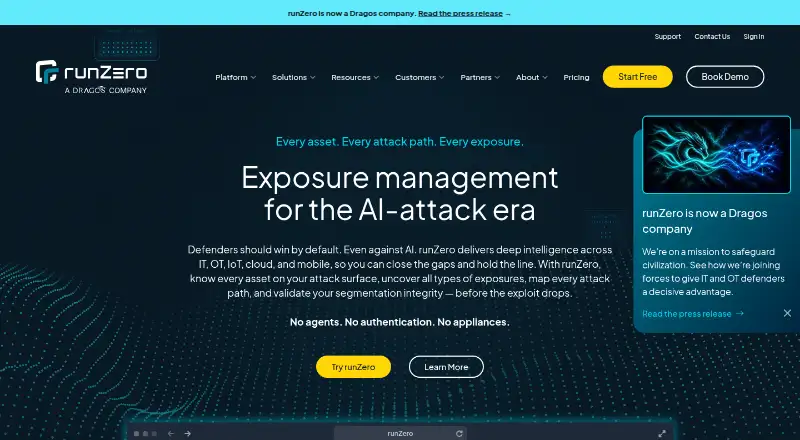
runZero is an attack surface and exposure management platform for discovering and tracking IT, OT, IoT, cloud, mobile, and remote assets. It combines active scanning, passive traffic sampling, and API integrations to keep an inventory updated. That inventory can include assets, services, screenshots, software, vulnerabilities, certificates, wireless devices, users, and groups. Reports include layer-2 topology maps and asset risk; alerts can appear in the product or arrive by email or webhook, including Slack. The service can run as hosted SaaS or on-premise through Consoles, distributed Explorers, and a command-line tool. runZero says it works without agents, authentication, or appliances. Prebuilt integrations cover cloud providers, EDRs, MDMs, vulnerability scanners, ITSM systems, and detection platforms, with an API and scripts for custom connections. Self-hosting the console requires a Platform license and runZero Care.
Good
- Combines active scans, passive traffic, and API discovery.
- Tracks vulnerabilities, software, certificates, and users.
- Reports include layer-2 maps and asset risk.
- Integrates with cloud, EDR, MDM, and ITSM tools.
- Alerts can arrive by email or webhook.
Watch out
- Community Edition is limited to 100 assets.
- Self-hosting requires Platform and runZero Care.
Who it suits
Community Edition is aimed at small businesses, individuals, and security researchers with 100 or fewer assets. The Platform is built for enterprises managing larger environments.
Verdict
runZero combines multiple discovery methods with inventory, risk reporting, and alerting across varied asset types. Check the Community Edition limits and self-hosting requirements against your deployment needs.
Plans and prices
From runZero's own pricing page, checked 15 Oct 2026.
| Plan | Price | What it gives you |
|---|---|---|
| Community Edition | Free | 100 recent assets · 1 organization · 10 recurring tasks · 30 days data retention · self-hosted Explorers · Flat Rate, Per Month |
| runZero Platform | Priced on request | Contract asset limit · unlimited organizations · self-hosted console requires Platform plus runZero Care · Starts at $5,000 |
The facts
Each one read from runZero's own pages, with the date it was checked.
What it does
- Active scanning
- Its proprietary active scanner fingerprints operating systems, services, hardware and software and is designed for IT, OT and IoT environments.checked 15 Oct 2026
- Agent requirements
- runZero states that it operates without agents, authentication, or appliances.checked 30 Sep 2026
- API security
- API access supports API keys or OAuth-style API clients, configurable IP allowlists and a documented limit of 2,000 requests per five minutes per source IP.checked 15 Oct 2026
- Compliance
- runZero announced completion of an independent SOC 2 Type II audit and documents mappings to frameworks including CIS Controls, CMMC, ISO 27001, NERC-CIP, NIST CSF and PCI DSS.checked 15 Oct 2026
- Custom extensibility
- Customers can build integrations with the Custom Integration API, custom scripts and a runZero Python SDK.checked 15 Oct 2026
- Data protection
- runZero states that customer data is logically separated and encrypted at rest and in transit.checked 30 Sep 2026
- Deployment model
- runZero can run as a hosted SaaS service or on-premise with Consoles, distributed Explorers, and a command-line tool.checked 30 Sep 2026
- Discovery
- The platform combines high-speed active scanning, passive traffic sampling, and API integrations into a continuously updated inventory.checked 30 Sep 2026
- Documentation and support
- The help center provides user-guide and API PDFs, an HTML API package, SBOM, training, release notes and human support through the console or contact form.checked 15 Oct 2026
- Explorer deployment
- Explorers install as services on Windows, Linux, macOS and BSD, require administrator or root privileges, and can also run in containers with raw-network access.checked 15 Oct 2026
- Exposure management
- The platform identifies vulnerabilities and other exposures through query logic, active scans and vulnerability or endpoint-management integrations, then recalculates findings and asset risk during task processing.checked 15 Oct 2026
- Funding history
- runZero’s history page says Rumble raised $5 million in 2021 and $15 million in a 2022 Series A led by Decibel Partners.checked 15 Oct 2026
- Integrations
- Inbound integrations include AWS, Google Cloud, Azure, Prisma, VMware, Wiz, CrowdStrike, Microsoft 365 Defender, Intune, Miradore, SentinelOne, Tanium, MECM and Google Workspace.checked 15 Oct 2026
- Inventory
- The inventory tracks assets, services, screenshots, software, vulnerabilities, certificates, wireless devices, users, and groups.checked 30 Sep 2026
- Licence
- The master subscription agreement says the Services are licensed rather than sold, runZero retains intellectual-property ownership, and third-party open-source components are separately attributed.checked 15 Oct 2026
- Limit: reporting depth
- A GetApp reviewer wanted more built-in presentation of the raw data and reporting or analysis capabilities.checked 15 Oct 2026
- Limit: scan safety and classification
- Review feedback notes that aggressive packet rates can risk disrupting devices and that some device categories or operating-system fingerprints may be inaccurate.checked 15 Oct 2026
- Limit: usability
- A G2 reviewer said some menus and functions were not intuitive, while Gartner feedback said querying the database took time to learn.checked 15 Oct 2026
- Network and attack-surface views
- Features include network topology, external and internal attack-surface visibility, RFC1918 coverage, outlier identification, segmentation analysis and vulnerability prioritization.checked 15 Oct 2026
- Notable news: version 5.1
- Release notes dated August 26, 2026 describe AI workflows, OAuth support for the MCP service, Mermaid diagrams, Censys v3 support and faster MAC merging.checked 15 Oct 2026
- Outbound integrations
- Outbound connectors include Jira and Atlassian Insight, ServiceNow CMDB, Panther, Splunk, Sumo Logic, Tines, Thinkst Canary and SecurityGate.io.checked 15 Oct 2026
The company
- Company facts
- LinkedIn lists Austin, Texas headquarters, 51–200 employees, private ownership and a 2018 founding year.checked 15 Oct 2026
- Company identity
- Crunchbase lists the legal name as runZero, Inc., formerly Rumble Network Discovery, and says it was acquired by Dragos.checked 15 Oct 2026
Where it runs
- Notable news: Dragos acquisition
- The company’s history page records that runZero became a Dragos company in 2026.checked 15 Oct 2026
The full review of runZero
runZero is an attack-surface and exposure-management platform for organizations that need visibility across IT, OT, IoT, cloud, mobile, and remote assets. It will suit security teams seeking a unified inventory from several discovery methods; its free edition is aimed at small environments, while enterprise use and console self-hosting require the paid Platform.
Overview
runZero builds a continuously updated inventory by combining active scanning, passive traffic sampling, and API integrations. It records more than devices: services, screenshots, software, vulnerabilities, certificates, wireless devices, users, and groups are also in scope. That breadth can help teams connect asset discovery to exposure review, though its value depends on the systems and environments an organization needs to cover.
The agentless model avoids deploying agents, configuring authentication, or adding appliances. That reduces collection overhead, but it does not eliminate setup requirements: Explorer binaries for Windows, Linux, and macOS require administrative or root privileges. Deployment can be hosted SaaS or on-premise using Consoles, distributed Explorers, and a command-line tool. The console cannot be self-hosted on the free edition; it requires a Platform license and runZero Care.
Key features
Discovery and inventory
Active scanning, passive sampling, and integrations support hardware, software, cloud, and network asset discovery. Using several methods is a practical advantage in mixed environments where one collection route may leave gaps. Prebuilt integrations cover cloud providers, EDRs, MDMs, vulnerability scanners, ITSM systems, and detection platforms; a Custom Integration API and scripts offer more flexibility. Teams should weigh that breadth against the work of connecting the sources relevant to their own environment.
Risk reporting and alerts
Reports include layer-2 topology maps and asset risk, while alerts can arrive in the product, by email, or through webhooks including Slack. Those options support both network-level review and routing findings into existing workflows, without requiring every team to monitor the console continuously.
Security and support
runZero completed a SOC 2 Type II audit covering the security Trust Service Criteria. It says customer data is logically separated and encrypted at rest and in transit. Documentation, API resources, release notes, a Trust Center, and human support through the console or contact form provide several routes for implementation and ongoing questions.
Pricing
runZero uses a freemium model, with a 21-day trial and paid pricing from $5,000. The Community Edition costs nothing and is capped at 100 assets, one organization, 10 recurring tasks, and 30 days of data retention. It is a sensible starting point for individuals, small businesses, or security researchers who can work within those limits, but the asset and retention caps may constrain longer-running or broader programs.
The runZero Platform costs from $5,000 (priced on request), with the asset limit set by contract, unlimited organizations, projects, and recurring tasks, and three years of data retention. This is the fit for enterprise deployments that need room to scale. Console self-hosting is optional but also requires runZero Care, so teams considering an on-premise deployment should account for that support requirement as well as the license.
Platforms
runZero supports API, Linux, macOS, self-hosted, web, and Windows. Explorer software is available for Windows, Linux, and macOS; installations need administrative or root privileges. The self-hosted option is conditional on a Platform license and runZero Care rather than being a deployment choice available on the free tier.
Who it's for
The Community Edition is designed for small businesses, individuals, and security researchers with 100 or fewer assets. The Platform targets enterprises that need contract-defined asset capacity, more organizations and projects, unlimited recurring tasks, or longer data retention. Organizations that require a self-hosted console also need the Platform and runZero Care. Buyers seeking a free tool for larger inventories or self-hosting without those paid requirements should look elsewhere.
Pros and cons
- Pros: Multiple discovery methods feed one inventory across varied asset types, making the platform suited to complex environments.
- Pros: Prebuilt integrations, a Custom Integration API, and scripts give teams options for bringing other systems into discovery.
- Pros: Risk reports, topology maps, and in-product, email, and webhook alerts connect inventory to review and response workflows.
- Cons: The free tier stops at 100 assets, one organization, 10 recurring tasks, and 30 days of retention, limiting its fit for larger or longer-term programs.
- Cons: Self-hosting the console requires both a Platform license and runZero Care, adding a support requirement to on-premise plans.
- Cons: Explorer installation requires administrator or root privileges, so agentless does not mean setup-free.
Alternatives
Attack Surface Management Software, Exposure Management Software, IT Asset Discovery Software, and Network Discovery Software offer category-level starting points for comparing tools.
- Qualys External Attack Surface Management is worth considering for a 30-day, no-cost CSAM with EASM offer; it has no free plan, unlike runZero's capped Community Edition.
- Bitdefender Total Security is aimed at a different need: its listed individual plan covers five devices for $59.99 a year at the first-year price, plus applicable sales tax.
- FullHunt may suit users seeking a free API or web option with 10 credits per month for evaluation or internal use, rather than runZero's 100-asset inventory tier.
- Ivanti Neurons for Zero Trust Access is another option for buyers evaluating paid, named-user licensing with SaaS deployment.
- ImmuniWeb may fit teams focused on mobile-app scanning: its listed Neuron subscription costs €395 a month per app and allows unlimited scans of builds or versions of the same Android or iOS app.
- Tenable One Attack Surface Management is an alternative for teams seeking unified visibility across IT, cloud, web applications, OT, and external attack surfaces.
- CrowdStrike Falcon Surface is another paid option, with a free trial and demo-based sales process.
- Rapid7 Surface Command is another paid option with a free trial.
Verdict
runZero is a strong choice for security teams that need a broad, continuously refreshed asset inventory assembled from scanning, passive traffic, and integrations. The Community Edition gives smaller environments a useful starting point, while enterprise capacity and self-hosting require the Platform and, for self-hosting, runZero Care. Look elsewhere if those limits or deployment terms do not fit your program.
Getting started
- Open the runZero website
- Choose hosted SaaS or an on-premise deployment
- Select Community Edition or contact runZero for the Platform
- Install Explorer binaries on Windows, Linux or macOS with administrative or root privileges
- Connect available integrations or use the Custom Integration API
- Begin discovery and review inventory, reports and alerts
Limits worth knowing
Community Edition is free for 100 assets, one organization, 10 recurring tasks and 30 days of data retention. The Platform starts at $5,000, with contract asset limits, unlimited organizations, projects and recurring tasks, and three years of data retention; self-hosted consoles require runZero Care.
Questions
Is there a free plan?
Yes. Community Edition costs nothing and supports up to 100 assets, one organization, 10 recurring tasks and 30 days of data retention.
Where can runZero run?
It is available as hosted SaaS or on-premise, with API, Linux, macOS, self-hosted, web and Windows support.
Does runZero require agents?
The platform states that it operates without agents, authentication or appliances.
What integrations are available?
Prebuilt integrations cover cloud providers, EDRs, MDMs, vulnerability scanners, ITSM systems and detection platforms. A Custom Integration API and scripts are also provided.
What is required for self-hosting?
Self-hosting the console requires a Platform license with the runZero Care support package explicitly enabled.
Alternatives to runZero
- 1

CAST Highlight
WebAPILinuxmacOS6.9From $6,800 a year - 2

CAST Imaging
WebAPILinuxSelf-hosted6.7From $2 a year - 3

Virima Discovery and ViVID Service Mapping
WebAPILinuxmacOS6.7From $4,740 a year - 4

Faddom
WebLinuxSelf-hostedWindows6.6 - 5
Device42
WebAPILinuxmacOS6.5 - 6

Flexera One IT Asset Management
WebSelf-hosted6.4