
Tenable One Attack Surface Management
Tenable One Attack Surface Management helps organizations identify and assess internet-facing assets and services that could be reached externally.
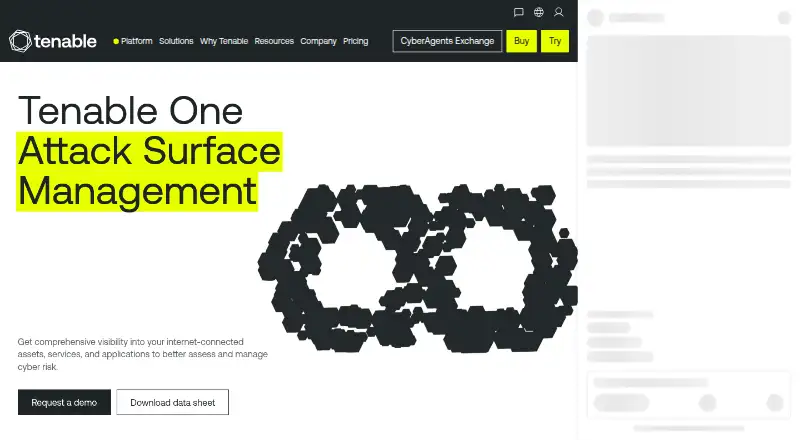
What Tenable One Attack Surface Management is
Tenable One Attack Surface Management helps organizations identify and assess internet-facing assets and services that could be reached externally. It continuously maps the internet and offers an attack surface map covering more than 5 billion assets to help teams spot unknown assets associated with their organization. Ongoing monitoring and notifications flag changes, while users can scan assets that have not yet been assessed to look for hidden risk. More than 200 metadata fields, filters, tags, and datatypes provide context for evaluating internet-connected assets. The product is part of Tenable One, which brings external attack surface assets and exposure data together. Connectors combine information from third-party security tools with Tenable sensor data; examples include CrowdStrike, Qualys, Rapid7 InsightVM, and ServiceNow CMDB. An Open Connector can also ingest information from other tools, internal systems, spreadsheets, or files. Listed use cases include cybersecurity, compliance, brand protection, mergers and acquisitions, competitive analysis, and legal. The hybrid-deployment product starts at $4,790/yr, and no free plan is listed.
Good
- Continuously monitors the external attack surface.
- Offers over 200 fields for asset context.
- Can scan unassessed assets for hidden risk.
- Connectors combine third-party and Tenable sensor data.
- Supports hybrid deployment.
Watch out
- Starts at $4,790/yr.
- No free plan is listed.
- The product is part of Tenable One.
Who it suits
It is aimed at organizations assessing internet-facing assets and external exposure. The listed use cases include security, compliance, brand protection, mergers and acquisitions, competitive analysis, and legal work.
Verdict
Tenable One Attack Surface Management focuses on discovering and monitoring internet-facing assets, with scanning and metadata to support assessment. Its listed starting price is $4,790/yr, and buyers can request a demo or quote.
Plans and prices
From Tenable One Attack Surface Management's own pricing page, checked 20 Sep 2026.
| Plan | Price | What it gives you |
|---|---|---|
| Tenable One Foundation | Priced on request | Includes attack surface management · Unified visibility across IT, cloud, web applications, OT, and external attack s · Includes asset inventory and third-party data connectors |
| Tenable One Advanced | Priced on request | Includes attack surface management · Includes attack path analysis · Adds exposure insights and risk prioritization capabilities |
| Tenable One Attack Surface Management | Priced on request | Request a demo or quote; public price not stated |
The facts
Each one read from Tenable One Attack Surface Management's own pages, with the date it was checked.
What it does
- Asset discovery
- Continuously maps the internet and offers an attack surface map of more than 5 billion assets to help identify unknown assets related to an organization.checked 29 Sep 2026
- Business context
- Provides more than 200 fields of metadata, filters, tags, and datatypes to help assess internet-connected assets.checked 29 Sep 2026
- Integrations
- Tenable One connectors combine third-party security-tool data with Tenable sensor data; listed examples include CrowdStrike, Qualys, Rapid7 InsightVM, and ServiceNow CMDB.checked 29 Sep 2026
- Monitoring
- Provides notifications on changes and continuous monitoring of the external attack surface.checked 29 Sep 2026
- Open connector
- Tenable One Open Connector can ingest data from additional tools, internal systems, spreadsheets, or files.checked 29 Sep 2026
- Purpose
- Identifies internet-facing assets and services that threat actors could externally access.checked 29 Sep 2026
- Risk assessment
- Users can start scans of unassessed assets to identify hidden risk across the external attack surface.checked 29 Sep 2026
- Sales and pricing
- The product page offers a demo request, and the Tenable One pricing page directs buyers to request a quote rather than listing a price.checked 29 Sep 2026
- Security and trust
- Tenable says security and service availability are priorities and directs customers to its trust portal for security and compliance information.checked 29 Sep 2026
- Support
- Tenable provides technical support resources and product documentation through its support page.checked 29 Sep 2026
- Use cases
- Tenable lists cybersecurity, compliance, brand protection, mergers and acquisitions, competitive analysis, and legal as use cases.checked 29 Sep 2026
The company
- Founded
- 2002checked 28 Sep 2026
- Headquarters
- Columbia, Maryland, United Stateschecked 28 Sep 2026
Where it runs
- Platform relationship
- The product page describes Attack Surface Management as part of Tenable One, which unifies external attack surface assets and exposure data.checked 29 Sep 2026
The full review of Tenable One Attack Surface Management
Tenable One Attack Surface Management is an external attack surface product within Tenable One, a platform that brings exposure data together. It suits security teams that need to find and monitor internet-facing assets across a broad environment. Its strength is continuous discovery paired with asset context and scanning; buyers seeking a published, flexible plan price should look elsewhere.
Overview
The product maps internet-facing assets and services that outside actors could reach, including assets an organization may not already know about. Tenable says its map covers more than 5 billion assets. Continuous monitoring and change notifications help teams keep track of an external footprint that can shift over time.
More than 200 metadata fields, filters, tags, and data types give teams ways to assess discovered assets, while scans of unassessed assets can help surface hidden risk. This combination is useful when discovery alone would leave a security team with too little context to prioritize follow-up.
Tenable One connectors combine data from third-party security tools with Tenable sensor data. Examples include CrowdStrike, Qualys, Rapid7 InsightVM, and ServiceNow CMDB; the Open Connector can also ingest data from additional tools, internal systems, spreadsheets, or files. That breadth can help consolidate asset context, though the product is positioned as part of the wider Tenable One platform rather than as a standalone exposure-management tier with a public price.
Key features
- External asset discovery: Continuous internet mapping and an attack surface map help identify unknown internet-facing assets.
- Monitoring and assessment: Continuous monitoring and change notifications track the external surface, while scans of unassessed assets support risk discovery.
- Asset context: More than 200 metadata fields, filters, tags, and data types support assessment of internet-connected assets.
- Connectors: Third-party security data can be combined with Tenable sensor data, and Open Connector accepts data from additional sources such as internal systems and files.
- Scanning and integrations: The product supports API access, authenticated and credentialed scans, browser-based and web application scanning, CI/CD integration, and SIEM integration. It also supports agent-based assessment, compliance checks, and third-party patching.
- OT coverage: OT asset discovery and passive monitoring are supported, with protocols including Modbus, CIP, PROFINET, DNP3, IEC 60870-5-104, MMS, S7/S7+, and IEC 61850.
Attack-path analysis and cloud asset discovery are also supported. The breadth is attractive to teams looking across external, cloud, application, and OT exposures, but these capabilities are most compelling when used within a broader exposure-management program.
Pricing
The product is paid, with a starting price of $4,790/yr. Tenable offers a demo request, while its Tenable One pricing page directs buyers to request a quote. The standalone Attack Surface Management plan has custom pricing.
- Tenable One Foundation: Custom pricing. Includes attack surface management, unified visibility across IT, cloud, web applications, OT, and external assets, plus asset inventory and third-party data connectors. It fits organizations seeking broad visibility and inventory, but does not include the attack-path analysis and exposure insights called out for Advanced.
- Tenable One Advanced: Custom pricing. Adds attack path analysis, exposure insights, and risk prioritization capabilities to attack surface management. It is the better fit for teams that need prioritization beyond discovery and inventory.
- Tenable One Attack Surface Management: Custom pricing; buyers can request a demo or quote. It is the most direct fit for organizations focused on external attack surface management.
The published starting price gives buyers a budget anchor, but custom quotes make direct plan-to-plan price comparison difficult. The product has no free plan. The accompanying scan details specify 5 scan targets and a 100-asset limit, so teams should confirm that those caps fit their intended scope before buying.
Platforms
The product is supported on Windows, macOS, Linux, and web, with a hybrid deployment model. Supported operating systems include Amazon Linux, CentOS, Debian Linux, Red Hat Enterprise Linux, Ubuntu Linux, OS X, macOS, Windows Server 2008/2012, and Windows 7/8/10. Scheduled deployment and reboot scheduling are supported. Network discovery is not supported, which may matter to teams whose priority is mapping network-connected assets rather than the internet-facing surface.
Who it's for
Tenable One Attack Surface Management is best suited to security teams that need continuous visibility into externally reachable assets and want metadata, integrations, and scanning to assess what they find. Tenable identifies cybersecurity, compliance, brand protection, mergers and acquisitions, competitive analysis, and legal as use cases, making the product relevant to teams beyond vulnerability operations.
It is a less natural fit for buyers who need network discovery, a free tier, or a clear self-service price. Tenable provides technical support resources and product documentation, and directs customers to its trust portal for security and compliance information.
Pros and cons
Pros
- Broad external discovery: Continuous mapping of more than 5 billion assets can help teams identify unknown internet-facing exposure.
- Useful context and follow-through: More than 200 metadata fields and the ability to scan unassessed assets make discovery more actionable than a bare asset list.
- Flexible data integration: Named security-tool connectors and Open Connector support a wider range of third-party and internal data sources.
- Coverage beyond conventional IT: Cloud discovery, web application scanning, and OT discovery broaden its relevance for mixed environments.
Cons
- Custom plan pricing: Buyers must request a quote for the plans, limiting upfront price comparisons; the starting price is $4,790/yr.
- Small stated scan and asset caps: The accompanying details give 5 scan targets and a 100-asset limit, which may constrain smaller-scope evaluation or require clarification for larger estates.
- No network discovery: Teams needing network-level discovery will need another tool or approach.
- No free plan: There is no free tier for ongoing use.
Alternatives
Qualys TotalCloud is worth considering for cloud security buyers who want a free evaluation tier: its Free license costs nothing, though API calls are limited for control evaluation. It also offers a free trial, while paid subscription pricing varies by Cloud Platform.
Sysdig Secure may suit teams looking for a security product across API, Linux, macOS, self-hosted, web, and Windows environments. Its licensing is based on host count, with compute instances used for CSPM.
Uptycs CNAPP is another paid option across API, Linux, macOS, self-hosted, web, and Windows. Its Discover — Workload plan is $36 a year, billed annually at $3.00/month, with a $12K minimum annual order, so the entry figure does not mean a low minimum commitment.
CrowdStrike Falcon Surface is a paid alternative on Linux, macOS, web, and Windows, with a free trial and demo-based pricing for Falcon Exposure Management.
FortiCNAPP is a paid option for Linux, web, and Windows environments, with Standard tiers available on one- and three-year terms and entitlement per vCPU.
Palo Alto Networks Cortex Cloud API Security is a paid alternative for API, Linux, and web platforms.
Upwind CNAPP is a paid alternative for API and web platforms.
AccuKnox may appeal to buyers seeking a freemium option across Linux, self-hosted, and web environments; its custom quote can be pay-as-you-go for individual modules or a broader CNAPP bundle.
For category browsing, see Attack Surface Management Software, Exposure Management Software, Vulnerability Management Software, Cloud-Native Application Protection Platforms, OT and ICS Security Monitoring Software, and Dynamic Application Security Testing Software.
Verdict
Choose Tenable One Attack Surface Management if your security team needs continuous discovery of internet-facing assets, useful asset context, and scanning within a broader exposure-management platform. Its strongest case is turning a changing external footprint into assessable, integrated exposure data. Look elsewhere if network discovery, a free plan, or upfront plan pricing is essential.
Getting started
- Open the Tenable Attack Surface Management product page
- Request a demo or quote through Tenable
- Select a Tenable One plan
- Deploy the platform in a hybrid environment
- Connect third-party tools through Tenable One connectors or the Open Connector
- Configure monitoring and scans for external assets
Limits worth knowing
The listed configuration includes five scan targets and an asset limit of 100 assets. There is no free plan, and public plan pages direct buyers to request pricing.
Questions
How much does Tenable One Attack Surface Management cost?
The listed pricing note starts at $4,790/yr. Tenable’s pricing page directs buyers to request a quote.
Is there a free plan?
No. The product is listed as paid and has no free plan.
Which operating systems are supported?
Supported platforms include Windows, macOS and Linux, with operating-system listings covering Amazon Linux, CentOS, Debian Linux, Red Hat Enterprise Linux, Ubuntu Linux, Windows Server and macOS.
What integrations are available?
Examples include CrowdStrike, Qualys, Rapid7 InsightVM and ServiceNow CMDB. The Open Connector can ingest additional tools, internal systems, spreadsheets or files.
What does it monitor?
It continuously monitors the external attack surface, sends change notifications and can scan unassessed assets for hidden risk.
Is deployment cloud-only?
No. The deployment model is hybrid.
Alternatives to Tenable One Attack Surface Management
- 1

UpGuard
Free planAndroidiOSWebAPI8.2From $1,750 a month - 2
Microsoft Defender for Business
AndroidiOSAPImacOS7.5 - 3

Detectify Surface Monitoring
Free planWebAPI6.9From €2,500 a year - 4
RiskRecon
Free planWebAPI6.9Free plan - 5

CyCognito Platform
AndroidiOSWebAPI6.8 - 6
ImmuniWeb
AndroidiOSWebAPI6.8From €595 a year