
Uptycs CNAPP
Uptycs CNAPP provides risk visibility, protection, and prevention for hybrid cloud workloads from build time through runtime.
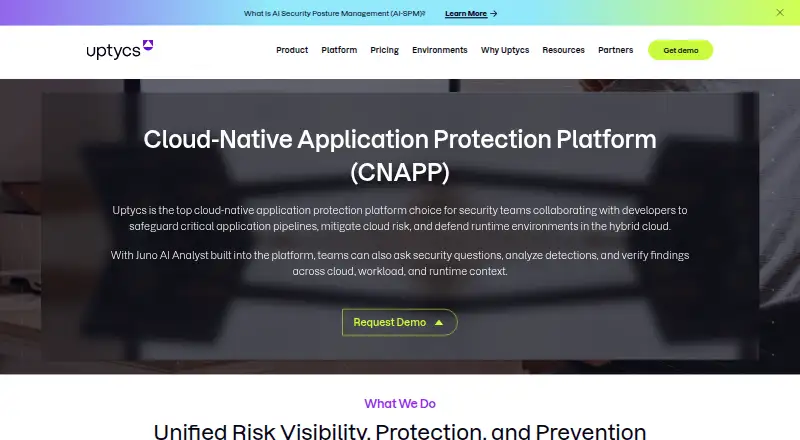
What Uptycs CNAPP is
Uptycs CNAPP provides risk visibility, protection, and prevention for hybrid cloud workloads from build time through runtime. It combines continuous workload scanning, agentless scans, and eBPF runtime insights to catalog software across assets. Workload risk scores connect attack paths and runtime threats with related context, including committed code. Build-time tools scan AMIs, images, infrastructure as code, and code repositories for alerts and third-party dependency vulnerabilities. Runtime defenses can stop threats such as cryptominers and reverse shells, and support customized FIM and YARA policies. Investigation options include Attack Path, Ask Uptycs, Unified Threat Hunting, Juno AI Analyst, and historical and real-time queries. Listed reporting covers SOC 2, CIS, PCI DSS, HITRUST, NIST, DISA, ISO, and FedRAMP. It supports AWS, Azure, and Google Cloud. Historical raw telemetry is retained for 7 days by default.
Good
- Scans workloads continuously and agentlessly.
- Maps threats and attack paths to code context.
- Runtime defense supports customized FIM and YARA policies.
- Supports AWS, Azure, and Google Cloud.
Watch out
- No free plan is listed.
- Minimum order is $12K per year.
- Historical raw telemetry retention is 7 days by default.
- Workload units support up to 8 processing cores.
Who it suits
It is aimed at teams securing hybrid cloud environments, particularly larger environments spanning AWS, Azure, or Google Cloud. Its build-to-runtime scope may suit teams that want development and runtime security in one platform.
Verdict
Uptycs CNAPP combines workload scanning, runtime defense, and investigation tools across hybrid cloud deployments. Its annual minimum order and workload-unit limits are important purchasing considerations.
Plans and prices
From Uptycs CNAPP's own pricing page, checked 5 Oct 2026.
| Plan | Price | What it gives you |
|---|---|---|
| Discover — Workload | $36 a year | Starting at $3 per month · minimum order per year: $12K · $36.00 per year (= $3.00/month, billed annually) |
| Discover — Cloud Workload | $60 a year | Starting at $5 per month · minimum order per year: $12K · $60.00 per year (= $5.00/month, billed annually) |
| Audit — Workload | $72 a year | Starting at $6 per month · minimum order per year: $12K · $72.00 per year (= $6.00/month, billed annually) |
| Audit — Cloud Workload | $120 a year | Starting at $10 per month · minimum order per year: $12K · $120.00 per year (= $10.00/month, billed annually) |
| Secure — Cloud Workload | Priced on request | Request for Pricing · minimum order per year: $12K |
| Secure — Workload | Priced on request | Request for Pricing · minimum order per year: $12K |
The facts
Each one read from Uptycs CNAPP's own pages, with the date it was checked.
What it does
- Cloud coverage
- Uptycs pricing FAQ says its multi cloud pricing supports AWS, Azure, and Google Cloud deployments.checked 30 Sep 2026
- Compliance
- The product page lists out of the box reporting for SOC 2, CIS, PCI DSS, HITRUST, NIST, DISA, ISO, and FedRAMP.checked 30 Sep 2026
- Data retention
- The pricing comparison lists historical raw telemetry retention as 7 days by default.checked 30 Sep 2026
- Development security
- It supports build time scanning of AMIs, images, and IaC, and scanning code repositories for alerts and third party dependency vulnerabilities.checked 30 Sep 2026
- Integrations
- The integrations page lists ServiceNow, PagerDuty, Jira, Slack, Splunk, Azure Sentinel, Elastic Security, QRadar, Amazon Security Lake, Okta, Azure AD, Google Workspace, GitHub, and Cloudflare among its integrations.checked 30 Sep 2026
- Intended users
- Uptycs describes CNAPP as intended for hybrid cloud environments and its About page calls it a platform for large hybrid cloud environments.checked 30 Sep 2026
- Investigations
- Incident investigations can use Attack Path, Ask Uptycs, Unified Threat Hunting, Juno AI Analyst, and historical and real time queries.checked 30 Sep 2026
- Pricing and licensing limits
- The pricing page sets a $12K minimum order per year and says workloads are licensed by unit, with workload units supporting up to 8 processing cores.checked 30 Sep 2026
- Product scope
- Uptycs CNAPP provides unified risk visibility, protection, and prevention for hybrid cloud workloads from build time to runtime.checked 30 Sep 2026
- Risk prioritization
- The platform combines insights into a risk score for each cloud workload and maps attack paths and runtime threats to related context, including committed code.checked 30 Sep 2026
- Runtime defense
- Uptycs says its platform can stop threats such as cryptominers and reverse shells in real time and supports customized FIM and YARA policies.checked 30 Sep 2026
- Scanning and visibility
- It combines continuous workload scanning with agentless scans and eBPF runtime insights to catalog software across assets.checked 30 Sep 2026
- Security controls
- Uptycs states that customer data is protected in transit with TLS 1.2 and encrypted at rest with AES 256, and that it maintains active SOC 2 Type II compliance.checked 30 Sep 2026
The company
- Headquarters
- Lexington, Massachusetts, United Stateschecked 28 Sep 2026
The full review of Uptycs CNAPP
Uptycs CNAPP is a cloud security platform for teams protecting workloads across hybrid environments. It is best suited to large organizations that need development scanning, runtime controls, and investigation tools in one product. Its broad coverage is useful, but the $12K annual minimum and core-based workload units make it a substantial commitment.
Overview
Uptycs connects security work from build time through runtime across AWS, Azure, Google Cloud, and hybrid deployments. Its risk scores bring workload findings together with attack paths, runtime threats, and committed-code context, helping security teams prioritize related issues rather than treat each alert in isolation. That breadth makes more sense for a large estate than a small cloud deployment.
Workloads are licensed by unit, with each unit supporting up to 8 processing cores. Historical raw telemetry retention is 7 days by default, so teams that need a longer investigation window should account for that limit. Uptycs says customer data is protected in transit with TLS 1.2 and encrypted at rest with AES 256, and that it maintains active SOC 2 Type II compliance.
Key features
Workload visibility and development scanning
Continuous workload scanning, agentless scans, and eBPF runtime insights help catalog software across assets. At build time, Uptycs scans AMIs, images, and infrastructure as code; it can also scan code repositories for alerts and third-party dependency vulnerabilities. This joined-up view is useful to teams that want development risks considered alongside what is deployed, though smaller teams may not need coverage across every stage.
Risk context and runtime defense
Workload risk scores link attack paths and runtime threats to related context, including committed code. Uptycs says it can stop threats such as cryptominers and reverse shells in real time, and supports customized file integrity monitoring and YARA policies. These controls make the platform relevant to teams seeking both prioritization and prevention, not just an inventory of findings.
Investigations, compliance, and integrations
Investigators can use Attack Path, Ask Uptycs, Unified Threat Hunting, Juno AI Analyst, and historical and real-time queries. Out-of-the-box reporting covers SOC 2, CIS, PCI DSS, HITRUST, NIST, DISA, ISO, and FedRAMP. Integrations include ServiceNow, PagerDuty, Jira, Slack, Splunk, Azure Sentinel, Elastic Security, QRadar, Amazon Security Lake, Okta, Azure AD, Google Workspace, GitHub, and Cloudflare. This range can help teams connect security findings with existing operations and identity tools.
Pricing
Pricing is workload-unit based, with a $12K minimum order per year across the plans. The displayed annual rates are entry prices, not a low-cost way to adopt the platform below that minimum; buyers should weigh the yearly commitment against the size of their deployment and the 8-core unit limit.
| Plan | Annual price | Best fit |
|---|---|---|
| Discover — Workload | $36 a year ($3.00/month, billed annually) | Teams starting with workload coverage |
| Discover — Cloud Workload | $60 a year ($5.00/month, billed annually) | Teams focused on cloud workloads |
| Audit — Workload | $72 a year ($6.00/month, billed annually) | Teams seeking workload audit coverage |
| Audit — Cloud Workload | $120 a year ($10.00/month, billed annually) | Teams seeking cloud-workload audit coverage |
| Secure — Workload | Custom pricing | Teams considering the Secure workload tier |
| Secure — Cloud Workload | Custom pricing | Teams considering the Secure cloud-workload tier |
The Discover and Audit prices distinguish workload from cloud-workload licensing, but plan descriptions do not establish feature differences beyond those names. The Secure tiers require a pricing request. There is no free plan, so organizations looking to evaluate at no cost should consider an alternative with a free option.
Platforms
Uptycs supports API, Linux, macOS, self-hosted, web, and Windows. Its multi-cloud pricing supports AWS, Azure, and Google Cloud, making it a fit for mixed environments rather than a single-cloud-only deployment.
Who it's for
Uptycs is strongest for security teams in large hybrid-cloud environments that need workload scanning, code-to-cloud context, runtime defense, and investigation capabilities under one platform. It is a weaker fit for smaller teams that cannot justify the minimum annual order, need telemetry retention beyond 7 days by default, or want a free starting tier.
Pros and cons
Pros
- Connects build-time scans, workload visibility, and runtime insights, giving teams a broader view of risk across the deployment lifecycle.
- Risk scores tie attack paths and runtime threats to code context, which can help prioritize related issues.
- Investigation tools, compliance reporting, and integrations span common security and operations workflows.
- Supports AWS, Azure, and Google Cloud alongside hybrid deployments.
Cons
- The $12K minimum order per year is a high barrier for smaller deployments, even when an entry rate is shown per workload unit.
- Each workload unit supports up to 8 processing cores, so buyers need to understand how their estate maps to unit licensing.
- Seven days of default raw telemetry retention can limit investigations requiring a longer history.
- No free plan means there is no free tier for evaluation.
Alternatives
Cloud-Native Application Protection Platforms provides a broader category comparison for readers still weighing the field.
- Qualys TotalCloud is worth considering if a free license and free trial matter; its free license has limited API calls for control evaluation.
- Sysdig Secure may suit teams looking for a host-based licensing approach, with CSPM compute instances also part of its licensing basis.
- Tenable One Attack Surface Management is an alternative for teams seeking unified visibility across IT, cloud, web applications, OT, and external attack surfaces.
- CrowdStrike Falcon Surface is another paid option with a free trial.
- FortiCNAPP offers Standard tiers with one- and three-year terms and entitlement per vCPU.
- Palo Alto Networks Cortex Cloud API Security is another paid option.
- Upwind CNAPP is another paid option.
- AccuKnox is worth comparing if a freemium model and pay-as-you-go purchasing are a better match.
Verdict
Choose Uptycs CNAPP if you run a large hybrid-cloud estate and want workload scanning, runtime defense, code context, and investigation tools in one platform. Its lifecycle coverage is the main reason to choose it; the $12K annual minimum, unit limits, and 7-day default telemetry retention are strong reasons for smaller teams or long-lookback investigations to look elsewhere.
Alternatives to Uptycs CNAPP
- 1
Microsoft Defender for Business
AndroidiOSAPImacOS7.5 - 2

Sysdig Secure
WebAPILinuxmacOS7.2From $20 a month - 3
Qualys TotalCloud
Free planWebAPI7.0Free plan - 4

Cloudanix
WebAPISelf-hosted6.5From $3.49 a month - 5
Cisco Catalyst Center
WebAPILinuxmacOS6.2 - 6

Palo Alto Networks Cortex Cloud API Security
WebAPILinux6.2