OpenFieldPro
OpenFieldPro is open-source, self-hostable software for managing field-service work from lead through payment.
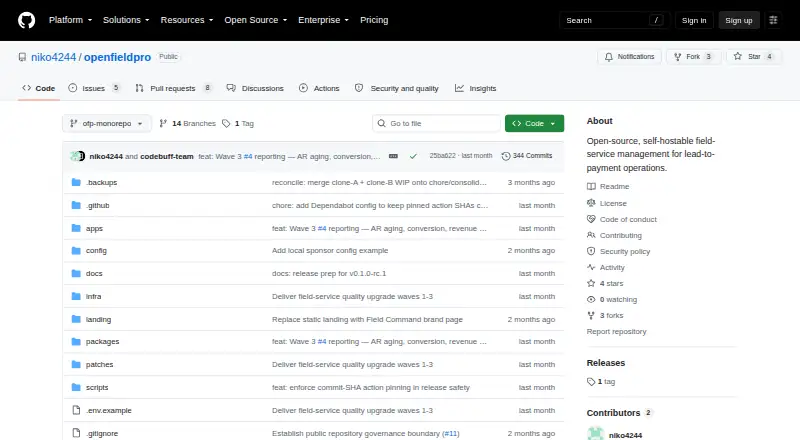
What OpenFieldPro is
OpenFieldPro is open-source, self-hostable software for managing field-service work from lead through payment. It brings CRM, customer and property records, equipment history, scheduling, dispatch, work orders, estimates, invoices, payments, documents, service plans, reviews and reporting into one system. Technicians can use mobile workflows with offline foundations. Payment options described by the project include offline payments, optional Stripe checkout and Stripe webhook processing. A plugin registry, scoped API tokens and outbound events support integrations. The repository includes helpers for installation, updates, backups and restores. The listed stack comprises a Next.js web frontend, Fastify API, React Native Expo mobile app and PostgreSQL database. The README describes checks for production JWT secrets and CORS settings, as well as bounded rate limits on selected routes. It also says the project has no telemetry or phone-home licensing, with optional entitlements checked locally. The AGPL version 3 core is free, with no limits listed on users, technicians, customers, jobs, invoices, locations or core operations. The project remains in release-candidate hardening.
Good
- Free AGPL core with no listed operational limits
- Technician mobile workflows have offline foundations
- Includes scheduling, dispatch, work orders and invoicing
- Self-hosting helpers cover install, update, backup and restore
Watch out
- Project is still undergoing release-candidate hardening
- Production release still requires its checklist gates
Who it suits
It suits field-service teams that want self-hosted lead-to-payment workflows and technician mobile access. Its free core has no listed limits on core operational features.
Verdict
OpenFieldPro covers a broad field-service workflow and offers a free, self-hosted core. Its release-candidate status is important to weigh before relying on it in production.
Plans and prices
From OpenFieldPro's own pricing page, checked 2 Oct 2026.
| Plan | Price | What it gives you |
|---|---|---|
| Self-hosted AGPL core | Free | No limits on users, technicians, customers, jobs, invoices, locations, or core operational features |
The facts
Each one read from OpenFieldPro's own pages, with the date it was checked.
What it does
- Core workflows
- It provides CRM, customer and property records, equipment history, scheduling, dispatch, work orders, estimates, invoicing, payments, documents, service plans, reviews, reporting, and technician mobile workflows.checked 2 Oct 2026
- Integrations
- The project describes a plugin registry, scoped API tokens, outbound events, and an integration surface.checked 2 Oct 2026
- License
- The repository license is GNU Affero General Public License version 3.checked 2 Oct 2026
- Payments
- The project describes estimates, line items, invoices, offline payments, optional Stripe checkout, and Stripe webhook processing.checked 2 Oct 2026
- Privacy
- The README describes the project as having no telemetry or phone-home licensing and says optional entitlements are verified locally.checked 2 Oct 2026
- Product
- OpenFieldPro is open-source, self-hostable field-service management software for lead-to-payment operations.checked 2 Oct 2026
- Release status
- The README describes the project as undergoing release-candidate hardening and says production release still requires its release checklist gates.checked 2 Oct 2026
- Security
- The README says production startup rejects default or short JWT secrets and wildcard or missing production CORS configuration, and applies bounded route-level rate limits to authentication, public booking, uploads, and checkout.checked 2 Oct 2026
- Self-hosting
- The repository includes self-hosting install, update, backup, and restore helpers.checked 2 Oct 2026
- Support
- The support guide directs users to GitHub Issues for bugs and feature requests and GitHub Discussions for questions and ideas.checked 2 Oct 2026
- Technician workflows
- The technician mobile workflows have offline foundations.checked 2 Oct 2026
- Technology
- The listed stack includes a Next.js web frontend, Fastify API, React Native Expo mobile app, and PostgreSQL database.checked 2 Oct 2026
The full review of OpenFieldPro
OpenFieldPro is an open-source field-service system that connects customer administration, job execution and payment in one self-hosted application. It is most compelling for contractors and technical teams that want unrestricted core records and control of their deployment. The trade-off is that operating the software yourself, and its release-candidate stage, demand more responsibility than a managed service.
Overview
The product covers the full lead-to-payment path: CRM, customer and property records, equipment history, scheduling, dispatch, work orders, estimates, invoices, payments, documents, service plans, reviews and reporting. That breadth can replace a collection of narrowly focused tools and keep office and field information connected.
Its GNU Affero General Public License version 3 gives organizations a permissive-cost route to running and adapting the core, but self-hosting is part of the bargain. The repository supplies helpers for installation, updates, backups and restores, while your team remains responsible for the resulting infrastructure and operations. The project describes itself as undergoing release-candidate hardening, with release-checklist gates still required before production release. Businesses that cannot tolerate immature software should therefore choose a more established service.
Key features
Dispatch, scheduling and a dedicated dispatch board address day-to-day allocation of jobs. Customer and property records, equipment history and service plans preserve context for repeat visits, while work orders, documents and reviews extend the record beyond a single appointment. Online booking, an estimate builder, invoicing and invoice payments complete the core service-business loop.
Technician mobile workflows have offline foundations, an important advantage when technicians lose connectivity at a property. Estimates support line items. Payment handling includes offline payments, optional Stripe checkout and Stripe webhook processing, so teams can combine field collection with online checkout where Stripe fits; the project does not promise universal payment-provider coverage.
For integration work, OpenFieldPro describes a plugin registry, scoped API tokens and outbound events. Those are useful building blocks for connecting other systems without handing every integration unrestricted credentials, although implementation effort will still fall on the operator. The listed architecture—Next.js web frontend, Fastify API, React Native Expo mobile app and PostgreSQL—will matter to teams planning hosting and maintenance around those technologies.
Production safeguards include rejecting default or short JWT secrets and rejecting wildcard or missing production CORS configuration at startup. Bounded route-level rate limits cover authentication, public booking, uploads and checkout. The project also says it has no telemetry or phone-home licensing and that optional entitlements are checked locally, which suits organizations that want deployment privacy.
Pricing
Self-hosted AGPL core — free. There are no limits on users, technicians, customers, jobs, invoices, locations or core operational features. This is an unusually unrestricted plan for a service operation, and it makes OpenFieldPro attractive to growing teams that can host it themselves. The price does not remove the cost of servers, administration or release management, and there is no managed support tier described. Bug reports and feature requests go to GitHub Issues; questions and ideas go to GitHub Discussions.
Platforms
OpenFieldPro provides Android and iOS mobile access, a web application, an API and self-hosted deployment. The mobile app supports technician workflows, including offline foundations, while the web and API layers suit office users and integrations. This combination is a better fit for organizations comfortable running a server than for buyers seeking a turnkey hosted subscription.
Who it's for
Choose OpenFieldPro if your field-service business needs CRM through payment, wants unlimited core records, and has the technical capacity to install, update, back up and secure a self-hosted system. It is particularly relevant to teams that value local control, offline-oriented technician work and an AGPL-licensed codebase.
Look elsewhere if production continuity depends on a mature, vendor-operated platform, if you need guaranteed support, or if your staff cannot own deployment and release-readiness decisions. The release-candidate status is a material risk for those buyers.
Pros and cons
Pros
- Unrestricted free core: users, technicians, customers, jobs, invoices and locations have no stated caps.
- Broad workflow coverage: CRM, dispatch, work orders, estimates, payments, documents and reporting share one system.
- Field-ready foundations: mobile workflows are designed with offline operation in mind.
- Self-hosting controls: install, update, backup and restore helpers reduce routine administration, while local entitlement checks avoid phone-home licensing.
- Integration hooks: plugins, scoped tokens and outbound events provide defined extension points.
Cons
- Release risk: release-candidate hardening and remaining checklist gates make production adoption a calculated decision.
- Operational ownership: hosting, security, maintenance and recovery remain the customer’s responsibility.
- Payment scope: documented payment paths center on offline collection and Stripe rather than a broad provider catalogue.
- Community support model: support is routed through GitHub Issues and Discussions rather than a stated commercial support desk.
Alternatives
For a category-wide comparison, see Plumbing Software.
Opsler is a better fit for a small team wanting a hosted freemium option with two seats and 50 jobs per month on its free plan, rather than unlimited self-hosted capacity.
FieldBench suits buyers who prefer a hosted plan with a clearly bounded free tier of one user and 20 jobs per month, with paid expansion afterward.
ServiceM8 is an alternative for teams seeking a freemium mobile service product with a one-user, 30-jobs-per-month free plan.
Contractor+ is worth choosing when a free hosted tier covering basic CRM and up to 250 leads or clients is more useful than self-hosting.
Tradify is the paid option for teams prepared to spend $47 per user per month on job management, scheduling, quoting and invoicing.
BigChange is a price-by-request alternative with support, CRM, scheduling, mobile, tracking, quotes, invoices and business intelligence included in its plans.
FieldPulse offers seat-based custom pricing tailored to team needs.
SAWIN Service Automation is an enterprise alternative sold through a requested demo.
Verdict
OpenFieldPro is the right choice for technically capable field-service teams that want a genuinely free, unlimited operational core, offline-oriented mobile work and control over hosting. Its main reason to choose it is breadth without per-seat or record caps. Its main reason to look elsewhere is the release-candidate status combined with the responsibility of running and supporting the system yourself.