OpenCanary
OpenCanary is free, self-hosted software that acts as a network honeypot, imitating services so it can alert when someone interacts with them after entering …
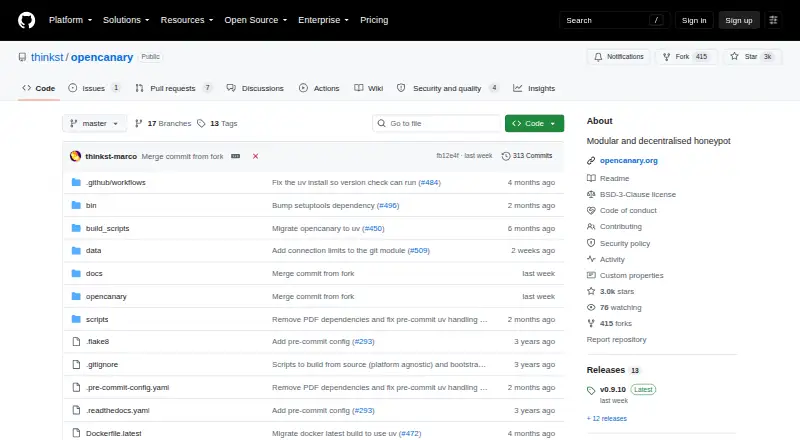
What OpenCanary is
OpenCanary is free, self-hosted software that acts as a network honeypot, imitating services so it can alert when someone interacts with them after entering a non-public network. It runs as a daemon and can report details such as a source IP address and a possible breach location. Its service modules cover SSH, FTP, Git, HTTP and HTTPS, databases, Telnet, SNMP, SIP, VNC, Redis, TFTP, NTP and TCP banners. Alerts can go to files, Syslog, email, HTTP webhooks, Slack, Microsoft Teams or HPFeeds-compatible daemons. Webhooks can send data using GET, POST or PUT. The companion opencanary-correlator can group related events, such as repeated login attempts, into a single email or SMS alert. The project says it has very low resource requirements and can run on a Raspberry Pi or a minimally resourced virtual machine. Deployment documentation covers Ubuntu, macOS and Docker on Linux hosts. Linux offers the most options: SMB monitoring is unavailable on macOS, and portscan monitoring is Linux-only and disabled in Docker. The project advises making the configuration file root-owned and writable only by root because the process reads it with root privileges.
Good
- Mimics many common network services.
- Alerts can include source IP and possible breach location.
- Supports email, Syslog, webhooks and chat channels.
- Correlator can combine related events into one alert.
- Can run on a Raspberry Pi or minimally resourced VM.
Watch out
- SMB monitoring is unavailable on macOS.
- Portscan monitoring is Linux-only and disabled in Docker.
- Configuration file should be writable only by root.
Who it suits
It suits administrators who want a self-hosted decoy for detecting interactions with network services. Linux provides the widest module options; macOS lacks SMB monitoring, and portscan monitoring is limited to Linux and disabled in Docker.
Verdict
OpenCanary offers a broad range of decoy services and alert destinations for self-hosted network monitoring. Its platform limits and configuration-file permissions are important deployment considerations.
Plans and prices
From OpenCanary's own pricing page, checked 2 Oct 2026.
| Plan | Price | What it gives you |
|---|---|---|
| OpenCanary | Free | Open-source software · self-hosted deployment |
The facts
Each one read from OpenCanary's own pages, with the date it was checked.
What it does
- Alert channels
- The documentation lists Syslog, email, and the opencanary-correlator as alert destinations.checked 1 Oct 2026
- Alert destinations
- Documented logging and alert options include files, Syslog, SMTP email, HTTP webhooks, Slack, Microsoft Teams, and HPFeeds-compatible daemons.checked 2 Oct 2026
- Alert details
- Alerts can identify the threat source IP address and where the breach may have occurred.checked 1 Oct 2026
- Chat integrations
- Webhooks can post to Slack or Microsoft Teams channels.checked 1 Oct 2026
- Correlator
- The companion opencanary-correlator can combine related events into a single email or SMS alert.checked 2 Oct 2026
- Deployment
- The project documents installation on Ubuntu and macOS, plus Docker deployment on Linux hosts using host networking.checked 2 Oct 2026
- Event correlation
- The correlator coalesces multiple related events, such as individual brute-force login attempts, into one alert sent by email or SMS.checked 1 Oct 2026
- Extra modules
- Optional SMB monitoring watches Samba logs for files opened in a Windows file share, and optional portscan monitoring uses iptables to detect scans.checked 2 Oct 2026
- License
- The PyPI listing identifies OpenCanary as OSI Approved BSD licensed software.checked 1 Oct 2026
- Maintainer and commercial relation
- OpenCanary is maintained by Thinkst Canary and described as the open-source version of its commercial Thinkst Canary honeypot.checked 2 Oct 2026
- Operation
- It runs as a daemon that imitates network services and sends alerts when they are accessed.checked 2 Oct 2026
- Optional modules
- The optional SNMP module requires Scapy, while the Windows File Share module requires Samba.checked 1 Oct 2026
- Portscan limit
- The portscan module is supported only on Linux hosts because it modifies iptables rules, and it is automatically disabled in Dockerized OpenCanary.checked 1 Oct 2026
- Privilege handling
- When started with uid and gid flags, OpenCanary drops root privileges after binding to its ports.checked 2 Oct 2026
- Protocol mimicry
- It can mimic an array of network-accessible services for attackers to interact with.checked 1 Oct 2026
- Protocols
- Native service modules include SSH, FTP, Git, HTTP, HTTPS, HTTP proxy, MSSQL, MySQL, Telnet, SNMP, SIP, VNC, Redis, TFTP, NTP, and TCP banner.checked 2 Oct 2026
- Purpose
- OpenCanary is a multi-protocol network honeypot intended to detect attackers interacting with services on non-public networks.checked 2 Oct 2026
- Resource needs
- The project says it has very low resource requirements and can run on a Raspberry Pi or a minimally resourced virtual machine.checked 2 Oct 2026
- Resource use
- OpenCanary has extremely low resource requirements and can run on a Raspberry Pi or a minimally resourced virtual machine.checked 1 Oct 2026
- Security configuration
- The project recommends making its configuration file root-owned and writable only by root because it is read while the process has root privileges.checked 2 Oct 2026
- Security guidance
- The project recommends making the configuration file root-owned and writable only by root because writable configuration can allow privilege escalation.checked 1 Oct 2026
- Security reports
- Thinkst accepts vulnerability reports at [email protected] or through GitHub and says it will request a CVE on the reporter’s behalf for reported security bugs.checked 2 Oct 2026
- Support
- Bug reports are requested through GitHub, security vulnerabilities through the project security policy, and feature requests through the project tracker.checked 1 Oct 2026
Where it runs
- Platform limits
- Linux offers the most options; the SMB module is unavailable on macOS, and portscan is Linux-only and uses iptables rather than nftables.checked 2 Oct 2026
The full review of OpenCanary
OpenCanary is a self-hosted honeypot that waits for intruders to engage with decoy network services. It suits defenders who can manage their own host and alert pipeline; its wide protocol selection costs nothing, but Linux is the strongest fit and configuration permissions demand care.
Overview
Run as a daemon, OpenCanary mimics network-accessible services and alerts when someone interacts with them. Its native decoys span SSH, FTP, Git, web and database services, Telnet, SNMP, SIP, VNC, Redis, TFTP, NTP and TCP banners. Alerts can identify a source IP and indicate where a breach may have occurred, giving operators useful leads for investigation—not a substitute for broader monitoring.
Its very low resource needs make it feasible to run on a Raspberry Pi or a minimally resourced virtual machine. The software is BSD-licensed and maintained by Thinkst Canary as the open-source counterpart to its commercial honeypot.
Key features
Alert destinations include files, Syslog, SMTP email, HTTP webhooks, Slack, Microsoft Teams and HPFeeds-compatible daemons. The customizable webhook handler supports GET, POST and PUT, which gives teams flexibility to route event data to an HTTP endpoint. The companion opencanary-correlator can combine related events—such as separate brute-force login attempts—into a single email or SMS alert, reducing the noise of one message per attempt.
Optional modules broaden the picture: SMB monitoring watches Samba logs for files opened in a Windows file share, while portscan monitoring uses iptables to detect scans. These add-ons come with dependencies and platform restrictions, so they are not equally useful in every deployment.
Pricing
The OpenCanary plan costs nothing and includes open-source software for self-hosted deployment. There is no software charge, but operators provide and manage the host and its network configuration. This fits teams comfortable running their own honeypot; it is not a hosted service.
Platforms
OpenCanary supports Linux and macOS, with self-hosted deployment and Docker deployment on Linux hosts using host networking. Linux offers the broadest options: SMB monitoring is unavailable on macOS, and portscan monitoring is Linux-only because it modifies iptables rules rather than nftables. Portscan is automatically disabled in Dockerized OpenCanary. The optional SNMP module requires Scapy, and the Windows File Share module requires Samba.
Security configuration matters because the program reads its configuration while running with root privileges. The project recommends making that file root-owned and writable only by root; a writable configuration can enable privilege escalation. When started with uid and gid flags, OpenCanary drops root privileges after binding to its ports.
Who it's for
OpenCanary is a good match for security teams and technically capable administrators who want several network-service decoys on modest infrastructure and can manage alert delivery themselves. Its source-IP context and event correlation help make interactions actionable. Choose another approach if you need a managed deployment or cannot accommodate its host-specific limitations and security setup.
Pros and cons
- Pros: Broad native protocol coverage and multiple alert destinations give defenders room to tailor decoys and routing without a software fee.
- Pros: Low resource requirements make deployment on a Raspberry Pi or small virtual machine practical.
- Cons: Linux-only portscan monitoring depends on iptables, is unavailable in Dockerized deployments, and does not use nftables.
- Cons: The configuration file must be protected carefully because writable settings can create a privilege-escalation risk.
Alternatives
Canarytokens is another free option, with token deployment through its hosted service and support for mobile, web, desktop and self-hosted platforms. Consider T-Pot for a free self-hosted honeypot on Linux, macOS or Windows if its hardware and network requirements suit your environment. Beelzebub offers a free self-hosted core framework for API and Linux deployments, with a free trial also available.
Cowrie is a free, BSD-licensed Linux honeypot focused on SSH and Telnet. Endlessh is a free standalone C SSH tarpit for Linux, with a default maximum of 4096 clients. Dionaea is a free, open-source Linux honeypot under GPLv2+. Heralding is a free GPL-3.0-licensed Linux honeypot. DentiGrid is a commercial MSSP and enterprise option for API, self-hosted and web deployments, with custom pricing.
Browse the Honeypot Software category for more options.
Verdict
Choose OpenCanary if you want a free, low-resource way to expose a broad set of network decoys and can operate a self-hosted Linux or macOS deployment. Its range of protocols and alert routes is the main draw; look elsewhere if you need a managed service, or if Linux's fuller module support and strict configuration-file permissions are poor fits.
Getting started
- Visit the OpenCanary GitHub project.
- Choose an Ubuntu or macOS installation, or Docker on a Linux host using host networking.
- Configure the service modules and alert destinations you intend to use.
- Make the configuration file root-owned and writable only by root.
- Use uid and gid flags if you want OpenCanary to drop root privileges after binding to ports.
Limits worth knowing
The portscan module is available only on Linux, uses iptables rather than nftables, and is automatically disabled in Dockerized OpenCanary. SMB monitoring is unavailable on macOS.
Questions
Does OpenCanary cost anything?
OpenCanary is free, open-source software under an OSI Approved BSD license.
Which platforms can run it?
The listed platforms are Linux, macOS and self-hosted. Deployment documentation covers Ubuntu and macOS, as well as Docker on Linux hosts using host networking.
What alerts can it send?
Documented destinations include files, Syslog, SMTP email, HTTP webhooks, Slack, Microsoft Teams and HPFeeds-compatible daemons. The correlator can send grouped alerts by email or SMS.
Can it monitor port scans on macOS or in Docker?
No. Portscan monitoring is Linux-only, uses iptables and is disabled in Dockerized OpenCanary.
Who maintains OpenCanary?
Thinkst Canary maintains OpenCanary and describes it as the open-source version of its commercial Thinkst Canary honeypot.
Alternatives to OpenCanary
- 1

Canarytokens
Free planAndroidiOSWebSelf-hosted6.6Free plan - 2
Honeytrap
Free planLinuxSelf-hosted6.2Free plan - 3
KFSensor
Windows6.2From $120 a year - 4

Thinkst Canary
WebAPILinuxmacOS6.2From $7,500 a year - 5
Honeyd
Free planLinuxSelf-hostedWindows6.0Free plan - 6
MedPot
Free planLinuxSelf-hosted6.0Free plan