
Cowrie
Cowrie is a free, open-source SSH and Telnet honeypot for recording brute-force attempts and activity in attackers’ shell sessions.
What Cowrie is
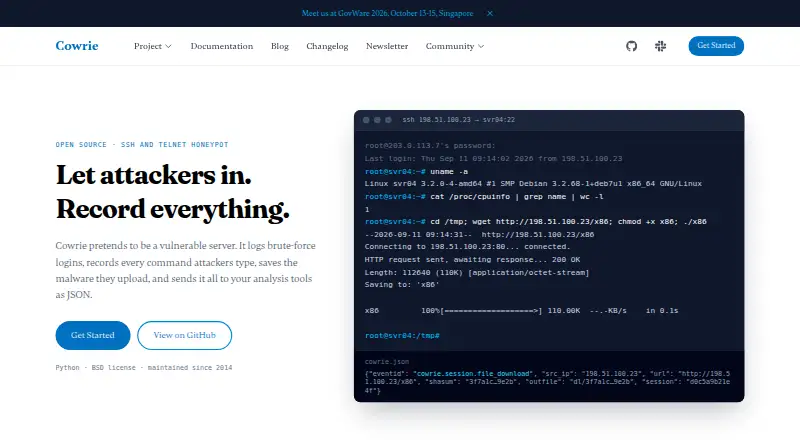
Cowrie is a free, open-source SSH and Telnet honeypot for recording brute-force attempts and activity in attackers’ shell sessions. In its default mode, it imitates a UNIX environment in Python with a fake filesystem, so commands do not run on the real host. Its proxy mode instead forwards SSH and Telnet sessions to another system while monitoring behavior. Cowrie records terminal sessions with timing information for replay and saves files fetched with wget or curl, as well as files uploaded through SFTP or SCP. JSON logs can include logins, commands, downloads, TCP forwards, and session metadata. Output plugins connect to tools and services such as Elasticsearch, Splunk, Microsoft Sentinel, MISP, VirusTotal, databases, Slack, and Prometheus. An experimental LLM backend can generate shell responses while keeping session context. Cowrie is self-hosted and can be installed with pip, Docker, or a Git checkout; the documentation lists Python 3.11+ and python-virtualenv as local requirements. It is BSD-licensed, began in 2014, and is maintained by volunteers.
Good
- Fake filesystem keeps emulated commands off the real host
- Proxy mode monitors forwarded SSH and Telnet sessions
- Records sessions for timed replay
- Captures downloads and SFTP or SCP uploads
- JSON logs and many output plugins
Watch out
- Self-hosted deployment
- Requires Python 3.11+ and python-virtualenv
- LLM backend is experimental
Who it suits
Cowrie is aimed at security researchers, CERTs, and defenders who want to observe SSH and Telnet activity. It requires self-hosting and the listed local software requirements.
Verdict
Cowrie offers a self-hosted honeypot with session capture, file collection, and multiple logging integrations. Its default emulated shell is designed to keep commands within a fake filesystem, while proxy mode monitors sessions forwarded to another system.
Plans and prices
From Cowrie's own pricing page, checked 2 Oct 2026.
| Plan | Price | What it gives you |
|---|---|---|
| Cowrie | Free | Free and open-source SSH and Telnet honeypot · BSD licensed |
The facts
Each one read from Cowrie's own pages, with the date it was checked.
What it does
- Deployment
- Cowrie can be installed using pip, Docker or a Git checkout, and its documentation lists Python 3.11+ and python-virtualenv as local requirements.checked 2 Oct 2026
- Emulated shell
- Its default shell mode emulates a UNIX system in Python with a fake filesystem and does not run attackers’ commands on the real host.checked 2 Oct 2026
- Integrations
- Output plugins include Elasticsearch, Splunk, Microsoft Sentinel, MISP, VirusTotal, Slack, Discord, MySQL, PostgreSQL, SQLite, MongoDB, Graylog, Kafka, Prometheus, Datadog and Amazon S3.checked 2 Oct 2026
- Intended users
- The project says it is used by security researchers, CERTs and defenders around the world.checked 2 Oct 2026
- License and history
- Cowrie is free and open source under a BSD license and began in 2014 as a fork of the Kippo honeypot.checked 2 Oct 2026
- LLM mode
- An experimental LLM backend can generate dynamic shell responses and maintain conversation context across a session.checked 2 Oct 2026
- Logging
- Cowrie logs attacker activity as JSON, including logins, commands, downloads, TCP forwards and session metadata.checked 2 Oct 2026
- Malware capture
- Cowrie saves files fetched with wget or curl and files uploaded with SFTP or SCP for later inspection.checked 2 Oct 2026
- Proxy mode
- Proxy mode forwards SSH and Telnet sessions to another system while monitoring attacker behavior.checked 2 Oct 2026
- Security boundary
- The feature page says the emulated shell is safe to expose because commands run in a fake filesystem and do not touch the real host.checked 2 Oct 2026
- Session recording
- Cowrie records terminal sessions with timing information for later replay using its playlog utility.checked 2 Oct 2026
- Support
- The project links users to community Slack and Discord channels.checked 2 Oct 2026
- What it does
- Cowrie is a medium- to high-interaction SSH and Telnet honeypot designed to log brute-force attacks and attackers’ shell activity.checked 2 Oct 2026
- Who maintains it
- Cowrie is maintained by volunteers, and the project credits creator and maintainer Michel Oosterhof.checked 2 Oct 2026
The company
- Founded
- 2014checked 23 Sep 2026
The full review of Cowrie
Cowrie is a free, self-hosted SSH and Telnet honeypot for security researchers, CERTs and defenders who want to observe hostile activity. Its strongest case is detailed session and file capture; operating and securing the deployment is your responsibility.
Overview
Cowrie is built to record brute-force attempts and what attackers do after connecting. Its default emulated shell presents a UNIX-like environment backed by a fake filesystem, keeping commands away from the real host. That boundary makes it suitable for exposing a decoy service, but it does not turn Cowrie into a general-purpose endpoint defense.
Proxy mode takes a different approach: it forwards SSH and Telnet sessions to another system while monitoring behavior. That offers visibility into sessions reaching a real system, but it is not the same isolation model as the emulated shell.
Key features
Session recordings preserve terminal activity with timing information, which can be replayed later with Cowrie’s playlog utility. This is useful when command order and pacing matter to an investigation, rather than relying only on a summary of events.
Cowrie captures files fetched with wget or curl and files uploaded over SFTP or SCP for later inspection. Its JSON logs cover logins, commands, downloads, TCP forwards and session metadata, giving defenders material to route into analysis and monitoring workflows.
Output plugins connect Cowrie to systems including Elasticsearch, Splunk, Microsoft Sentinel, MISP, VirusTotal, Slack, Discord, SQL and NoSQL databases, Graylog, Kafka, Prometheus, Datadog and Amazon S3. That breadth suits teams with an existing monitoring stack, though choosing and maintaining those integrations remains part of running a self-hosted tool.
An experimental LLM backend can produce dynamic shell responses and retain conversation context during a session. Its experimental status makes it an option to explore, not a reason to depend on it for a production workflow.
Pricing
Cowrie is free and open source under a BSD license. The Cowrie plan costs nothing and includes the free, BSD-licensed SSH and Telnet honeypot. There is no paid tier or feature-based plan distinction in this offering; the tradeoff is that deployment and operation are self-hosted.
Installation options include pip, Docker and a Git checkout. Local requirements include Python 3.11+ and python-virtualenv, so teams need the ability to manage a Linux environment and its dependencies rather than expecting a hosted service.
Platforms
Cowrie is for Linux and is self-hosted. It began in 2014 as a fork of the Kippo honeypot and is maintained by volunteers; the project credits creator and maintainer Michel Oosterhof. Community Slack and Discord channels provide places to seek support.
Who it's for
Cowrie is a strong fit for security researchers, CERTs and defenders who need to collect SSH or Telnet attack behavior, retain captured files and feed structured events into other tools. It is less suited to people seeking a managed honeypot, turnkey operations or a broadly supported commercial service.
Pros and cons
- Pros: The emulated shell uses a fake filesystem rather than running commands on the real host, making it a practical decoy boundary.
- Pros: Timed session replay, file capture and structured JSON logs provide complementary evidence for investigating activity.
- Pros: A wide selection of output plugins can fit Cowrie into established security and observability systems.
- Cons: Linux self-hosting and Python requirements mean teams must handle installation and ongoing operation themselves.
- Cons: Proxy mode forwards sessions to another system, so it does not provide the fake-filesystem boundary of the emulated shell.
- Cons: The LLM backend is experimental and should not be treated as a dependable core capability.
Alternatives
For another free, self-hosted option, Beelzebub offers an open-source core framework across API, Linux and self-hosted platforms, and includes a free trial.
T-Pot is also free and open source, with Linux, macOS, Windows and self-hosted support; choose it if those platform options matter, while accounting for its hardware and network requirements.
Canarytokens is a free alternative with a hosted service whose tokens are free, as well as Android, iOS, web, Windows and self-hosted platforms.
OpenCanary is another free, open-source, self-hosted option for Linux or macOS.
Thinkst Canary is a paid choice at $7,500 a year for five canaries, with hardware, virtual, cloud or container deployment options.
CounterCraft The Platform is a paid, self-hosted and web option with custom pricing based on environment size, deployment scope and use case.
DentiGrid is a paid API, self-hosted and web option with commercial licensing for MSSPs and enterprises.
Heralding is a free, GPL-3.0-licensed open-source honeypot for Linux and self-hosted deployment.
Browse more options in Honeypot Software.
Verdict
Choose Cowrie if you want a free Linux honeypot that captures SSH and Telnet sessions, downloaded or uploaded files, and structured activity for your own security workflow. Its fake-filesystem shell and broad integrations are compelling strengths; look elsewhere if you need managed hosting, commercial support or a platform that does not require self-hosting.
Alternatives to Cowrie
- 1

Canarytokens
Free planAndroidiOSWebSelf-hosted6.6Free plan - 2
OpenCanary
Free planLinuxmacOSSelf-hosted6.5Free plan - 3
Honeytrap
Free planLinuxSelf-hosted6.2Free plan - 4
KFSensor
Windows6.2From $120 a year - 5

Thinkst Canary
WebAPILinuxmacOS6.2From $7,500 a year - 6
Honeyd
Free planLinuxSelf-hostedWindows6.0Free plan