Honeytrap
Honeytrap is a free, open-source system for running, monitoring, and managing honeypots on self-hosted Linux deployments.
What Honeytrap is
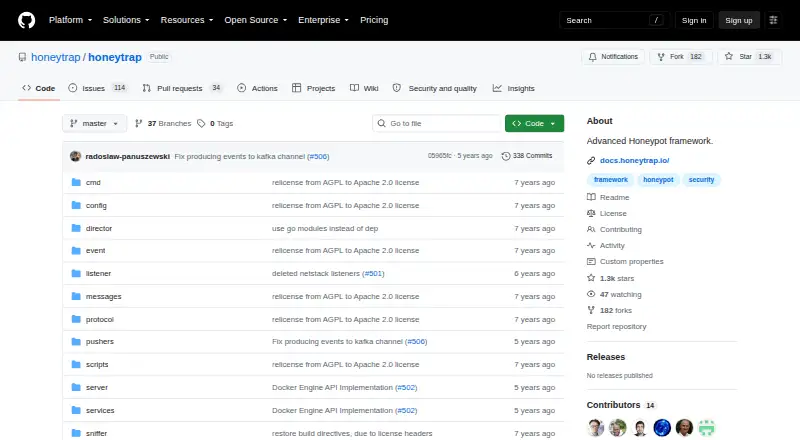
Honeytrap is a free, open-source system for running, monitoring, and managing honeypots on self-hosted Linux deployments. It can combine multiple services in one honeypot, such as a LAMP server, and supports interaction levels from low to high. Agents download configuration from a Honeytrap Server, enabling centralized configuration and logging across many agents. Agents can also redirect traffic from one network to another. Payload detection can choose which service handles a request, including when one port handles multiple protocols. A Sensor listener can complete a TCP handshake and store payloads to help monitor lateral movement within a network. For high-interaction honeypots, LXC or remote-host directors can proxy traffic and extract information. Honeytrap can also extend existing honeypots such as Cowrie or Glutton with its listening and logging framework. Logging supports filtering and destinations including Elasticsearch, Kafka, Splunk, Raven, files, and the console. The code is released under the Apache License 2.0, and the project directs users to a mailing list for community discussion. The repository's releases page states that there are no releases.
Good
- Combines multiple services in one honeypot
- Centralizes configuration and logging across agents
- Supports low- to high-interaction honeypots
- Filters and routes logs to several destinations
Watch out
- The repository currently has no releases
- Deployment is self-managed on Linux
Who it suits
Honeytrap suits security teams or operators building self-hosted honeypot deployments on Linux. Its centralized agent configuration and logging can support deployments across multiple agents.
Verdict
Honeytrap provides configurable honeypot capabilities and centralized logging for self-hosted Linux use. The project currently lists no releases, so prospective users should account for that limitation.
Plans and prices
From Honeytrap's own pricing page, checked 7 Oct 2026.
| Plan | Price | What it gives you |
|---|---|---|
| Open-source software | Free | Apache License 2.0 · Self-managed deployment |
The facts
Each one read from Honeytrap's own pages, with the date it was checked.
What it does
- Agent and server
- Honeytrap agents download configuration from a Honeytrap server, which can centralize logging across many agents.checked 7 Oct 2026
- Agent configuration
- Honeytrap Agent downloads its configuration from the Honeytrap Server.checked 4 Oct 2026
- Centralized deployment
- The project describes deploying many agents with one server, automatic configuration downloads, and centralized logging.checked 4 Oct 2026
- Community support
- The project points users to its documentation and a honeytrap-users mailing list.checked 7 Oct 2026
- Existing honeypots
- Honeytrap can extend existing honeypots including Cowrie and Glutton using its logging and listening framework.checked 7 Oct 2026
- High interaction honeypots
- LXC or remote host directors can create high interaction honeypots using man-in-the-middle traffic proxying and information extraction.checked 4 Oct 2026
- High-interaction honeypots
- LXC or remote-host directors can create high-interaction honeypots by proxying traffic and extracting information.checked 7 Oct 2026
- Interaction levels
- It supports low- to high-interaction honeypots and can seamlessly upgrade connections to high interaction.checked 7 Oct 2026
- Lateral movement monitoring
- The Sensor listener can complete a TCP handshake and store the payload to monitor lateral movement.checked 7 Oct 2026
- License
- The code is released under the Apache License, Version 2.0.checked 7 Oct 2026
- Logging integrations
- Its filtering and logging system supports Elasticsearch, Kafka, Splunk, Raven, files, and console output.checked 7 Oct 2026
- Multiple services
- It can combine multiple services into one honeypot, such as a LAMP server.checked 4 Oct 2026
- Multi-service honeypots
- It can combine multiple services into one honeypot, such as a LAMP server.checked 7 Oct 2026
- Payload detection
- Payload detection selects which service handles a request, and one port can handle multiple protocols.checked 4 Oct 2026
- Protocol detection
- Payload detection can select a service to handle a request and lets one port handle multiple protocols.checked 7 Oct 2026
- Purpose
- Honeytrap is an extensible open-source system for running, monitoring, and managing honeypots.checked 7 Oct 2026
- Release availability
- The GitHub releases page currently says there are no releases.checked 7 Oct 2026
- Traffic routing
- Agents can redirect traffic from one network to a separate network.checked 7 Oct 2026
The full review of Honeytrap
Overview
Honeytrap is an open-source system for building and coordinating honeypots on self-hosted Linux deployments. It suits security practitioners who want flexible decoys and centralized logging across multiple agents. Its breadth of traffic handling is compelling, but the project has no releases, which makes deployment less straightforward.
Key features
A honeypot can combine services such as a LAMP server, while payload detection routes requests to the service suited to the traffic and allows one port to handle multiple protocols. That flexibility helps administrators model varied targets without assigning a separate port to every protocol.
Honeytrap’s agent-and-server architecture is designed for distributed deployments: agents download configuration from a central server, which can coordinate many agents and consolidate their logs. Agents can also redirect traffic between networks. This is useful when decoys need centralized management, but it places deployment and operation responsibility on the team.
Interaction options span low to high, and connections can be upgraded to high interaction. Sensor listeners can complete a TCP handshake and store payloads to help monitor lateral movement. LXC or remote-host directors can build high-interaction honeypots by proxying traffic and extracting information. Honeytrap can also extend existing honeypots, including Cowrie and Glutton, with its listening and logging framework.
Filtering and logging integrations cover Elasticsearch, Kafka, Splunk, Raven, files, and the console. This gives teams several destinations for honeypot data, though they must run and maintain the surrounding infrastructure themselves.
Pricing
Honeytrap is free under its Open-source software plan: free. The Apache License 2.0 permits use of the code, and deployment is self-managed. There is no free trial because the software is free; the tradeoff is that users take on setup and ongoing operation rather than receiving a hosted service.
Platforms
Honeytrap supports Linux and self-hosted deployment. It is not a fit for readers seeking a hosted honeypot service or a turnkey desktop application.
Who it's for
Choose Honeytrap if you need to combine decoy services, tune traffic handling, and coordinate agents with centralized logging in a Linux environment. It is less suitable if you need a packaged release to install directly or prefer a provider to manage the deployment. The project directs users to the honeytrap-users mailing list for discussion.
Pros and cons
Pros
- Flexible decoy design: Multiple services and protocols can share a honeypot and port, supporting varied target configurations.
- Distributed coordination: A server can push agent configuration and centralize logging across many agents.
- Broad interaction and logging options: Low- through high-interaction setups and several logging destinations support different monitoring needs.
Cons
- No repository releases: The lack of releases makes it a weaker choice for users who want a conventional packaged installation.
- Self-managed Linux deployment: Teams must operate the deployment and its infrastructure themselves.
Alternatives
Browse honeypot software for more options. Canarytokens is a free alternative that spans Android, iOS, self-hosted, web, and Windows, with free tokens deployed through canarytokens.org. For another self-hosted option, OpenCanary is free and supports Linux and macOS.
T-Pot is a free, open-source self-hosted choice for Linux, macOS, and Windows, with hardware and network requirements to consider. Honeyd is a free GPL-licensed option for Linux, self-hosted, and Windows. Beelzebub offers a free self-hosted core framework for API and Linux environments, with a free trial also available.
Cowrie is a free, BSD-licensed SSH and Telnet honeypot for Linux and self-hosted use. Endlessh is a free standalone C SSH tarpit for Linux and self-hosted environments, with a default maximum of 4096 clients. Dionaea is a free GPLv2+ open-source honeypot for Linux and self-hosted use.
Verdict
Honeytrap is a strong choice for security practitioners who want configurable, multi-service honeypots and centralized agent management without a software fee. Its main reason to choose it is the combination of traffic flexibility, interaction levels, and logging integrations; look elsewhere if the absence of releases or the responsibility of self-hosting is a barrier.
Getting started
- Open the Honeytrap GitHub repository
- Prepare a Linux self-hosted environment
- Deploy a Honeytrap Server and Honeytrap agents
- Configure agents to download settings from the server
- Choose honeypot services, interaction levels, and traffic routing
- Set filtering and a logging destination such as Elasticsearch, Kafka, Splunk, Raven, files, or console
Limits worth knowing
Honeytrap is self-managed software deployed on Linux, so the operator provides and maintains the hosting environment. The repository’s GitHub releases page currently shows no releases.
Questions
Is Honeytrap free and open source?
Yes. The Open-source software plan costs nothing, and the project uses the Apache License 2.0.
Where does Honeytrap run?
It runs on Linux in a self-hosted deployment.
Can one server manage multiple honeypot agents?
Yes. Agents download configuration from a Honeytrap Server, enabling centralized configuration and logging across many agents.
Which logging systems are supported?
Filtering and logging can send data to Elasticsearch, Kafka, Splunk, Raven, files, or the console.
Can Honeytrap monitor lateral movement?
Its Sensor listener can complete a TCP handshake and store the payload for monitoring lateral movement within a network.
Can it work with existing honeypots?
Yes. Honeytrap can extend honeypots such as Cowrie or Glutton with its listening and logging framework.
Alternatives to Honeytrap
- 1

Canarytokens
Free planAndroidiOSWebSelf-hosted6.6Free plan - 2
OpenCanary
Free planLinuxmacOSSelf-hosted6.5Free plan - 3
KFSensor
Windows6.2From $120 a year - 4

Thinkst Canary
WebAPILinuxmacOS6.2From $7,500 a year - 5
Honeyd
Free planLinuxSelf-hostedWindows6.0Free plan - 6
MedPot
Free planLinuxSelf-hosted6.0Free plan