Honeyd
Honeyd is a free, self-hosted daemon for creating virtual network hosts and honeypots for threat detection, assessment, simulation, and monitoring.
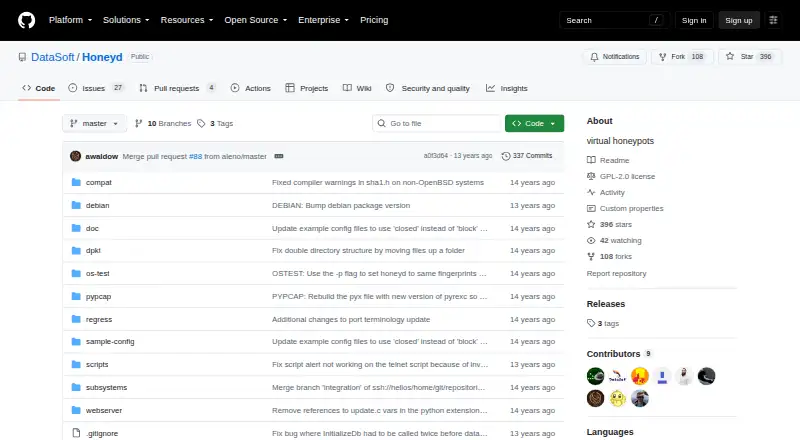
What Honeyd is
Honeyd is a free, self-hosted daemon for creating virtual network hosts and honeypots for threat detection, assessment, simulation, and monitoring. A single machine can claim as many as 65,536 IP addresses, and Honeyd can simulate thousands of virtual hosts at once. Configurations can provide arbitrary services or proxy them to another machine. Honeyd can also adjust TCP/IP behavior to imitate operating-system personalities that Nmap or Xprobe can identify. For network simulation, it supports virtual routing topologies with configurable latency, packet loss, asymmetric routes, physical hosts, and GRE tunnels. Its flow-log option records connection and packet information, including protocol, connection details, and passive OS identification comments. Honeyd does not direct traffic to itself automatically; traffic must be routed to it using routing, proxy ARP, or arpd. The project documents dependencies on libevent, libdnet, and libpcap. The maker recommends sandboxing it with Systrace because it interacts with potentially malicious adversaries and scripts. Honeyd is GPL-licensed. The listed latest release is version 1.5c, released 2007-05-27; the download page says it should compile and run on *BSD, GNU/Linux, and Solaris, while the FAQ describes a Windows port of version 0.5.
Good
- Can simulate thousands of virtual hosts.
- Supports configurable routing topologies and GRE tunnels.
- Flow logging records connection and packet details.
- Free and distributed under the GNU General Public License.
Watch out
- Traffic must be directed to Honeyd manually.
- The latest listed release dates to 2007-05-27.
- The maker recommends sandboxing with Systrace.
Who it suits
Honeyd suits network security practitioners who need virtual honeypots, honeynets, or network simulation in a self-hosted environment. Users must be prepared to direct traffic to the daemon and sandbox it as recommended.
Verdict
Honeyd offers extensive virtual-host and network simulation capabilities, but traffic setup is a separate task and its latest listed release is old. Its guidance to sandbox the daemon is especially relevant given its interaction with potentially malicious traffic and scripts.
Plans and prices
From Honeyd's own pricing page, checked 7 Oct 2026.
| Plan | Price | What it gives you |
|---|---|---|
| Honeyd | Free | Distributed free of charge; GPL-licensed |
The facts
Each one read from Honeyd's own pages, with the date it was checked.
What it does
- Integrations
- The project documents Nmap and Xprobe fingerprinting, GRE tunneling, and dependencies on libevent, libdnet, and libpcap.checked 7 Oct 2026
- Intended users
- The maker describes Honeyd for creating host-based and network-based virtual honeypots, virtual honeynets, and general network monitoring.checked 7 Oct 2026
- Latest listed release
- The maker's releases page lists Honeyd 1.5c, released 2007-05-27, as its latest release.checked 7 Oct 2026
- License
- Honeyd is open source software released under the GNU General Public License.checked 7 Oct 2026
- Logging
- Honeyd's -l option creates a flow log for connections and packets, including protocol, connection details, and passive OS identification comments.checked 7 Oct 2026
- Network simulation
- It supports virtual routing topologies with configurable latency, packet loss, asymmetric routes, physical hosts, and GRE tunnels.checked 7 Oct 2026
- Purpose
- Honeyd is a daemon for creating virtual hosts and honeypots on a network for threat detection, assessment, and network simulation.checked 7 Oct 2026
- Security guidance
- The maker recommends sandboxing Honeyd with Systrace because it interacts with potentially malicious adversaries and scripts.checked 7 Oct 2026
- Services
- Hosts can simulate arbitrary services from configuration files or proxy services to another machine.checked 7 Oct 2026
- Support
- The FAQ invites users whose questions are unanswered to contact the maintainer by email.checked 7 Oct 2026
- Traffic setup
- Honeyd does not intercept network traffic automatically; users must direct traffic to it using routing, proxy ARP, or arpd.checked 7 Oct 2026
- Virtual hosts
- A single host can claim as many as 65,536 IP addresses, and Honeyd can simulate thousands of virtual hosts at once.checked 7 Oct 2026
Where it runs
- OS emulation
- Honeyd adapts TCP/IP behavior to emulate operating system personalities that Nmap or Xprobe can identify.checked 7 Oct 2026
- Platform support
- The download page says Honeyd should compile and run on *BSD, GNU/Linux, and Solaris; the FAQ also describes a Windows port of Honeyd 0.5.checked 7 Oct 2026
The full review of Honeyd
Overview
Honeyd is a free, open-source daemon for building virtual hosts, honeypots, and simulated networks. It is best suited to network defenders and researchers who can manage routing and self-hosted infrastructure. Its depth is impressive, but operating it safely and directing traffic to it require real networking expertise.
Key features
Large-scale virtual hosts
One Honeyd host can claim up to 65,536 IP addresses, and the daemon can represent thousands of virtual hosts simultaneously. Each host can imitate arbitrary services from configuration files or proxy a service to another machine. This makes Honeyd a strong choice for broad network deception, assessment labs, and honeynets; it is excessive for a single narrowly defined service decoy.
Operating-system and network emulation
Honeyd changes TCP/IP behavior to reproduce operating-system personalities that Nmap or Xprobe can identify. It can also construct virtual routing topologies with configurable latency, packet loss, asymmetric routes, physical hosts, and GRE tunnels. Those controls support realistic network simulations rather than simple banner-based traps, although they demand careful design and configuration.
Traffic control and logging
Honeyd does not capture traffic automatically. Operators must direct traffic to it through routing, proxy ARP, or arpd, so deployment planning is a substantive part of the job. The -l option writes flow logs covering protocols, connection and packet details, and passive OS-identification comments, giving investigators useful context for observed activity.
Security and ecosystem
Because the daemon interacts with potentially malicious adversaries and scripts, its maker recommends sandboxing it with Systrace. That precaution is particularly important in an exposed honeypot deployment. Documentation covers Nmap and Xprobe fingerprinting, GRE tunneling, and dependencies including libevent, libdnet, and libpcap. Honeyd is GPL-licensed open-source software, and unanswered questions can be directed to the maintainer by email.
Pricing
Honeyd costs free under its sole Honeyd plan. It is distributed free of charge under the GPL, with self-hosted deployment and no paid tier or seat-based allowance. The trade-off is operational rather than financial: you provide the host, networking, isolation, configuration, and maintenance yourself.
Platforms
Honeyd is self-hosted. The download guidance says it should compile and run on *BSD, GNU/Linux, and Solaris, while the FAQ describes a Windows port of Honeyd 0.5. The platform breadth helps teams working across Unix-like systems, but the latest listed release is Honeyd 1.5c from 2007-05-27, which should weigh heavily in platform and security planning.
Who it's for
Choose Honeyd if you need host-based or network-based virtual honeypots, virtual honeynets, or general network monitoring with control over thousands of simulated systems and their network behavior. It fits experienced administrators, incident-response teams, and researchers comfortable with routing, proxy ARP, GRE, and daemon sandboxing. It is a poor match for users who want an appliance-style honeypot, automatic traffic interception, or a narrowly scoped decoy with minimal upkeep.
Pros and cons
- Pro: Up to 65,536 IP addresses on one host and thousands of simultaneous virtual hosts support unusually broad network deception.
- Pro: Service proxying, OS fingerprint emulation, and configurable topology produce richer simulations than a basic listener.
- Pro: Flow logging includes packet, protocol, connection, and passive OS-identification information.
- Con: Traffic must be routed to Honeyd manually through routing, proxy ARP, or arpd.
- Con: The maker's sandboxing advice reflects genuine exposure when handling hostile traffic and scripts.
- Con: Honeyd 1.5c dates from 2007, making currency and maintenance a serious concern.
Alternatives
Honeypot Software is the broader category to browse when you want to compare approaches. Choose Canarytokens instead for free tokens deployed through its hosted service, with Android, iOS, web, Windows, and self-hosted options. OpenCanary is a free, open-source self-hosted choice for Linux and macOS. Honeytrap offers a free Apache-licensed, self-managed deployment on Linux. T-Pot is another free open-source self-hosted option spanning Linux, macOS, and Windows, provided your hardware and network meet its requirements. Beelzebub suits users wanting a free open-source core framework with a trial and API, Linux, or self-hosted deployment. Cowrie focuses on free, open-source SSH and Telnet honeypot work. Endlessh is a free standalone SSH tarpit for Linux, with a default maximum of 4,096 clients. MedPot is a free open-source repository for Linux and self-hosting that requires Go 1.17 or newer.
Verdict
Honeyd is worth choosing for technically capable teams that need large, programmable virtual networks and detailed protocol-level simulation without licensing cost. Look elsewhere if current maintenance, automatic traffic handling, or a simpler focused honeypot matters more than its exceptional scale and topology control.
Alternatives to Honeyd
- 1

Canarytokens
Free planAndroidiOSWebSelf-hosted6.6Free plan - 2
OpenCanary
Free planLinuxmacOSSelf-hosted6.5Free plan - 3
Honeytrap
Free planLinuxSelf-hosted6.2Free plan - 4
KFSensor
Windows6.2From $120 a year - 5

Thinkst Canary
WebAPILinuxmacOS6.2From $7,500 a year - 6
MedPot
Free planLinuxSelf-hosted6.0Free plan